Beyond Meeting Notes: Why Enterprise Programs Need an Intelligence Engine
Published on Jul 29, 2026
Beyond Meeting Notes
Why Enterprise Programs Need an Intelligence Engine
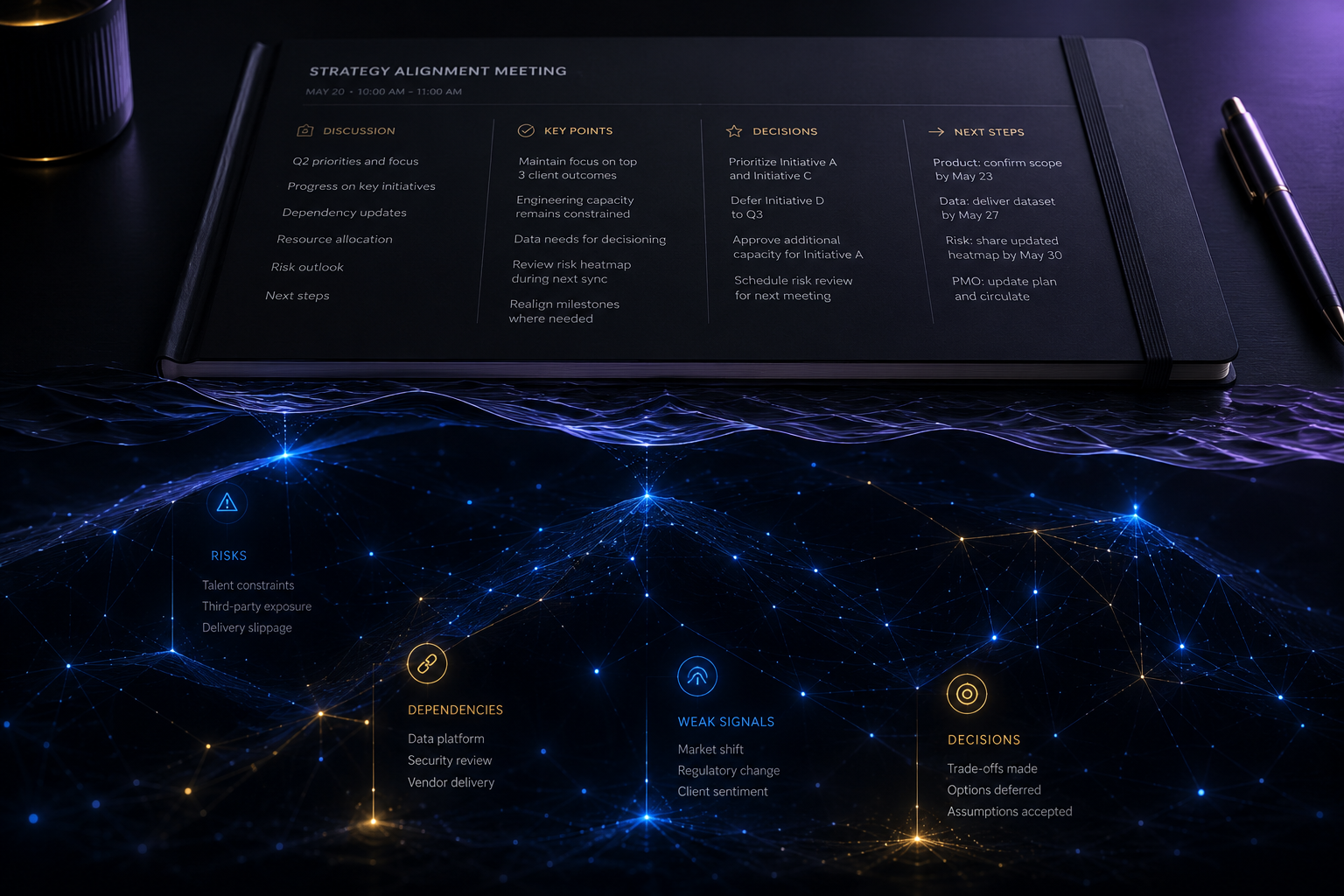
Meeting notes help the system remember what was said. Program intelligence helps leaders understand what is changing.
Every large enterprise program eventually creates its own weather system.
Meetings stack on meetings. Status forums breed more status forums. Steering committees request pre-reads. Workstream leads maintain trackers. Teams update tools. Risks live in RAID logs, RAIDD logs, slide decks, spreadsheets, email threads, chat messages, and the memory of the one person who somehow knows where everything is buried.
Then, someone asks a simple question:
Are we in trouble?
And suddenly the enterprise begins its favorite ritual: reconstructing reality by hand.
Someone checks the latest status deck. Someone else opens Jira. A third person searches meeting notes. A fourth person says, “I think that dependency was closed.” Another person says, “No, that was the other dependency.” Then the room quietly realizes the program has been producing information all week and intelligence almost never.
That is the problem.
Enterprise programs are not short on notes.
They are short on signal.
In Financial Services, that distinction matters because the work has consequence. Large programs move through legacy platforms, shared services, data constraints, regulatory expectations, operational resilience requirements, cyber controls, third-party dependencies, portfolio funding, test environments, and release windows that do not care how enthusiastic the transformation deck looked.
A note says what someone said.
A signal says something may need action.
That is the gap.
And right now, too many programs are asking highly paid humans to do signal extraction manually, usually under pressure, while pretending the issue is “meeting discipline.”
Please.
Meeting discipline matters. Clear notes matter. Action items matter.
But if the only thing your program gets from twenty meetings is twenty sets of notes, congratulations: you have built a transcript archive with calendar invites.
The bar has to be higher.
The Short Version
If you only remember six things from this article, make them these:
- Meeting notes are useful, but they are not program intelligence.
- Enterprise programs fail when risks, dependencies, decisions, blockers, and readiness signals are scattered across disconnected forums and tools.
- The real opportunity is to build an intelligence engine that ingests program artifacts, standardizes signals, links them to owners and outcomes, and surfaces patterns earlier.
- AI can help, but only as part of the full automation continuum: deterministic extraction, rules, workflow, analytics, generative summarization, and agentic reasoning used where they actually belong.
- Financial Services programs need this discipline because weak signals can become release risk, regulatory exposure, customer impact, operational disruption, or expensive executive archaeology.
- I am working on a lightweight hybrid delivery framework, and one of the modules (named RADAR) should help address this problem. You don’t have to remember that. I’ll remember it enough for the both of us. But the bigger point comes first: modern programs need signal intelligence, not better meeting notes.
The Meeting Notes Trap
Notes are the surface. Signals live underneath.
Meeting notes feel productive, especially when using AI. Come up with a great prompt for meeting notes, and you end up proudly sharing your notes like Patrick Bateman sharing his business card in “American Psycho.” Well, maybe not quite like that.
They capture decisions. They assign actions. They preserve context. They give people a record of what happened when everyone was multitasking, half-listening, or recovering from the previous meeting that should have been an email but somehow became verbal fisticuffs.
Good notes are better than bad notes. That is an irrefutable truth.
Leaders lay a trap for their future selves when they mistake documented conversation for program understanding.
A transcript can tell you that a dependency was mentioned.
It may not tell you that the same dependency has now been mentioned in four separate forums, by three different teams, with slightly different language, and no clear owner.
A meeting summary can tell you that a risk was discussed.
It may not tell you that the risk has been softened from red to amber twice, without the underlying condition changing.
An action log can tell you that someone owns a follow-up.
It may not tell you that the same person now owns fourteen follow-ups across three workstreams and became the program’s unofficial single point of failure 3 sprints ago.
This is where notes stop being enough.
The program does not need more prose.
The program needs a way to identify what the prose is trying to warn everyone about.
Otherwise, the meeting note becomes a very faint indicator light on a machine nobody is watching.
Why This Is Getting More Urgent
Enterprise project and program management is already shifting from reactive reporting toward AI-assisted planning, risk prediction, workflow automation, and decision support. Multiple 2026 industry summaries describe AI becoming embedded in planning, reporting, risk forecasting, task creation, and program governance rather than living as a novelty tool on the side. source-1 source-2
That shift is useful, but it also creates a new problem: if the underlying program signals are fragmented, AI-assisted reporting can simply summarize fragmentation faster.
That is not intelligence.
That is just a better looking fog machine.
The Financial Services version is even harder. KPMG’s 2026 Banking Technology Survey reports that 80% of banking executives expect AI to significantly disrupt business and operating models in the next three to five years, while 92% are increasing cybersecurity budgets and 84% are increasing cybersecurity investment specifically to address AI-related risks. source
McKinsey’s 2026 AI trust research makes the stakes even sharper still: as AI systems become more autonomous, organizations must worry not only about systems saying the wrong thing, but also about systems doing the wrong thing — triggering actions, misusing tools, or operating outside appropriate guardrails. source
This is the operating environment now.
More AI. More automation. More governance pressure. More dependency across systems. More velocity. More ways for weak signals to hide until they become expensive.
A program intelligence engine is no longer a nice-to-have.
For complex Financial Services programs, it is becoming part of how serious enterprises should see themselves.
The programs that cannot see their signals clearly will still move.
They will just move like someone driving through fog with a dashboard full of confidence indicators and no working headlights.
The Real Problem: Program Truth Is Distributed
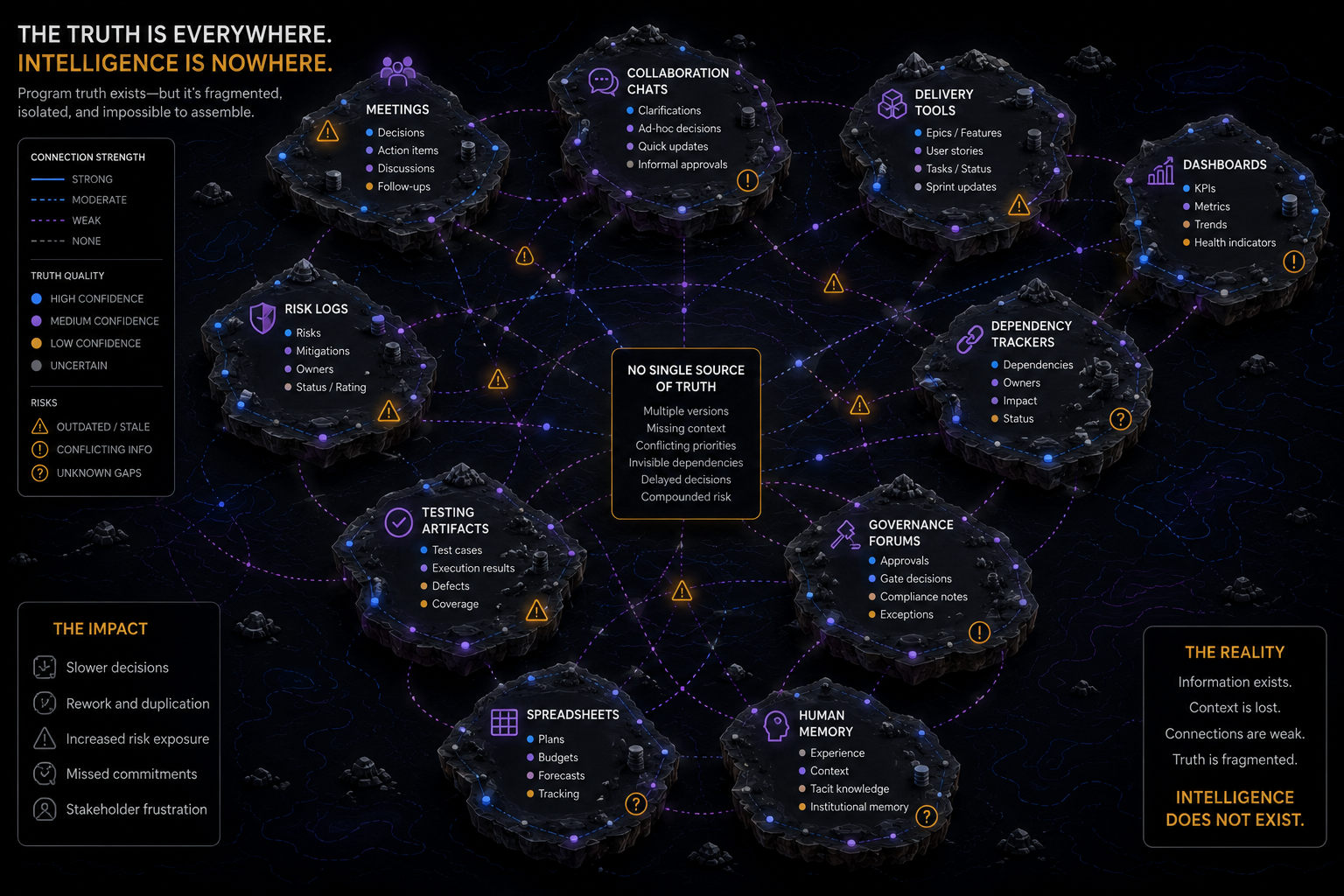
Program truth rarely lives in one place. It leaks across tools, meetings, artifacts, and memory.
The truth of a complex program usually exists.
Somewhere.
That is the most annoying part.
The blocker was mentioned in a standup. The dependency was captured in a Teams chat. The decision was made in a steering committee. The risk was softened in a deck. The evidence gap was spotted in test planning. The customer impact was buried in a product conversation. The operational readiness concern was raised by someone who did not have a box on the program org chart but absolutely knew what was going to break.
The information exists.
The system cannot assemble it.
So humans become the integration layer.
They read notes. They attend overlapping meetings. They maintain trackers. They remember context. They connect names, dates, dependencies, decisions, and political landmines. They know which dashboard is stale, which workstream is optimistic, which risk wording got laundered, and which executive update is trying to pass hope off as trajectory.
That is valuable human judgment.
It is also a terrible operating model if the enterprise depends on it as the only way to know what is happening.
Because once the program gets large enough, no human can hold the whole signal map in their head.
Not cleanly.
Not consistently.
Not without becoming the person no one can afford to let go on vacation.
And if your program cannot survive one person taking PTO, your operating model is not mature.
It is a hostage situation with benefits.
Program Intelligence Is Different
Program intelligence is not a prettier meeting summary.
It is a structured capability for turning fragmented program artifacts into decision-useful signals.
That means the system needs to detect, classify, connect, and route things like:
- risks
- issues
- actions
- decisions
- dependencies
- blockers
- deferrals
- assumption changes
- scope drift
- readiness gaps
- evidence gaps
- ownership ambiguity
- repeated escalations
- agenda items that keep returning like a bad penny
A useful program intelligence layer should answer questions like:
- What risks are emerging before they are formally logged?
- Which dependencies are being mentioned repeatedly but not governed as dependencies?
- Which decisions are aging without ownership?
- Which blockers are moving across meetings without resolution?
- Which risks have changed language without changing condition?
- Which workstreams appear locally green but systemically exposed?
- Which signal deserves human attention now?
This is where the conversation gets interesting.
Because the value is not in having AI summarize a meeting.
The value is in having the system notice that the program is trying to tell you something.
And sometimes, what the program is trying to tell you is, “Hey, genius, we have been saying this risk out loud for six weeks.”
The Full Automation Continuum Belongs Here
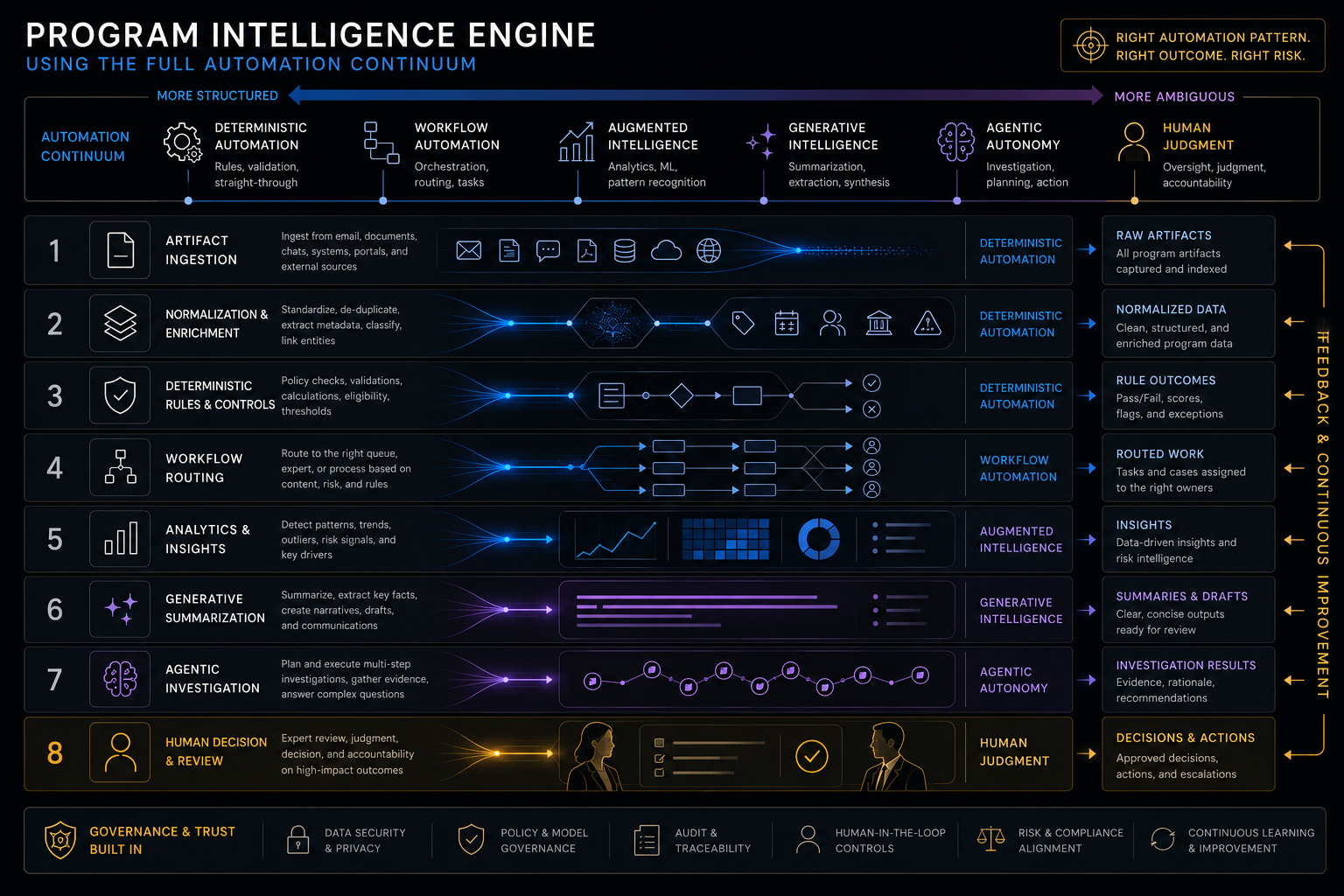
Program intelligence should use the full automation continuum — not drag every signal through an agent because the demo looked cool.
This is where we need to be disciplined.
A modern program intelligence engine should not run straight to agentic AI as the default answer.
That would be expensive nonsense with better branding.
Some parts of the problem are knowable. Some are repeatable. Some are rules-based. Some are statistical. Some require language understanding. Some require reasoning across ambiguity.
Different work deserves different machinery.
1. Ingest the artifacts
Meeting notes, transcripts, action logs, Jira tickets, dependency trackers, change records, test summaries, risk logs, email summaries, and governance decks need to be ingestible.
This is not magic.
It is plumbing.
And plumbing is undefeated.
2. Standardize the signal shapes
A risk should have a shape.
A dependency should have a shape.
A decision should have a shape.
An action should have a shape.
If everything remains prose forever, the enterprise is still reading tea leaves with a premium license.
3. Use deterministic rules where rules are knowable
If a decision has no owner, flag it.
If a dependency is mentioned three times without an explicit resolution, flag it.
If an action is overdue, flag it.
If a risk has no mitigation, flag it.
None of that needs a tiny digital philosopher.
4. Use analytics to find patterns
Trend the repeated mentions.
Track aging.
Compare signal density across workstreams.
Look for escalation velocity.
Measure decision latency.
Show whether the system is getting healthier or simply generating more artifacts.
5. Use generative AI for summarization and synthesis
This is where generative AI earns its place.
Summarize the signal. Explain the change. Translate technical risk into executive language. Compare this week to last week. Draft the leadership brief.
Good.
Useful.
Just do not confuse summarization with control.
6. Use agentic AI only where ambiguity justifies it
An agent may help investigate a cross-program pattern, trace related signals, suggest next-best actions, or reason through competing explanations.
That is valuable.
But only if the agent operates inside guardrails, with traceability, evidence, and human review.
The full automation continuum gives us a better architectural principle:
Route the work to the cheapest, safest, most controllable pattern that can reliably solve it.
That principle should be tattooed on every AI transformation backlog.
Metaphorically.
Probably.
A Reference Architecture for Program Intelligence
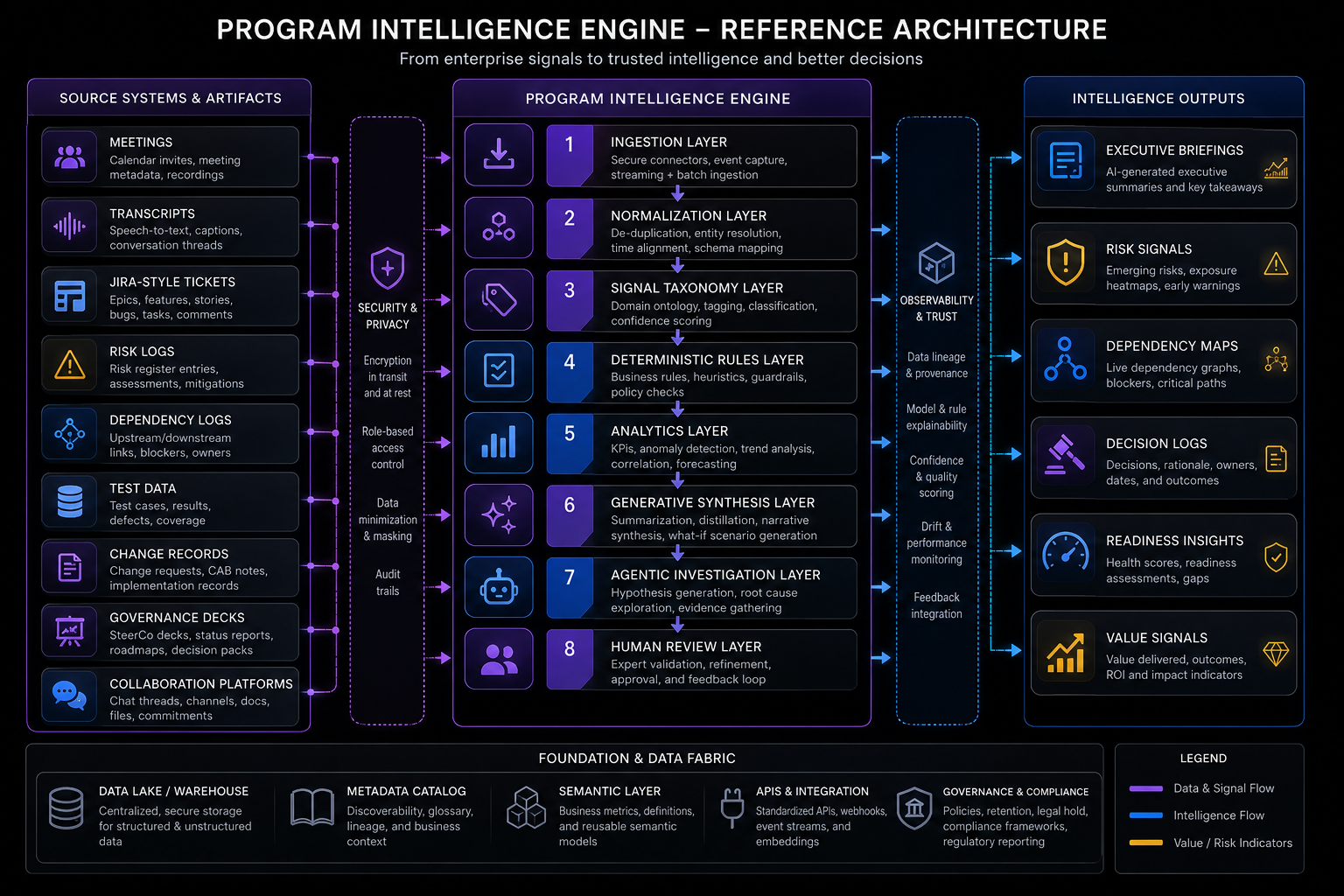
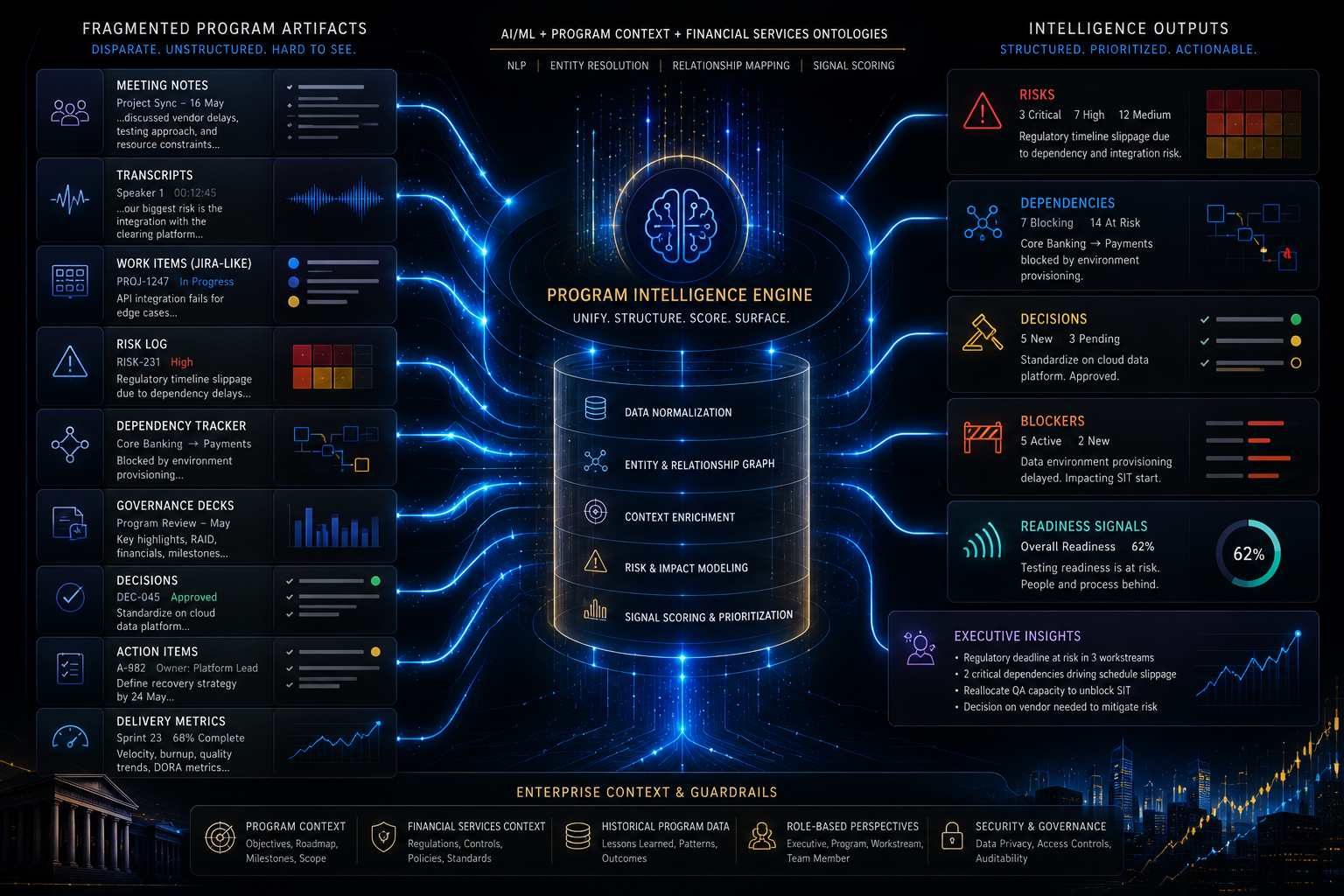
A serious solution is not a meeting bot. It is an intelligence layer built across ingestion, signal extraction, analytics, synthesis, reasoned investigation, and human decision-making.
At a high level, a program intelligence engine needs several layers.
Ingestion layer
The system pulls from the places where program truth already appears:
- meeting transcripts
- meeting summaries
- action logs
- risk and issue logs
- dependency trackers
- planning tools
- delivery tools
- test management data
- deployment and change records
- governance decks
- decision records
- collaboration platforms
The goal is not to create another manual status-input swamp.
The goal is to collect signals from the work.
Normalization layer
The system converts messy inputs into consistent objects:
- risk
- issue
- action
- decision
- dependency
- blocker
- escalation
- evidence gap
- readiness gap
- value signal
This matters because executives cannot govern paragraphs.
They govern patterns, exceptions, decisions, and risk.
Deterministic rules layer
Rules catch obvious conditions:
- missing owner
- overdue action
- stale decision
- repeated blocker
- dependency without due date
- risk without mitigation
- evidence gap without accountable owner
This is boring.
Good.
Boring catches a lot.
Analytics layer
Analytics looks for movement:
- signal density
- aging
- recurrence
- escalation velocity
- workstream concentration
- decision latency
- dependency clustering
- readiness trend
This is where the program starts showing its vital signs.
Generative synthesis layer
Generative AI helps turn signal clusters into narrative:
- executive summaries
- weekly change briefs
- risk narratives
- dependency explanations
- options and tradeoffs
- recommended discussion topics
This makes the intelligence usable.
Agentic investigation layer
Agentic capability can help when the question is ambiguous:
- Why is this risk recurring across three workstreams?
- Which decisions appear related?
- What dependency chain may be forming?
- What evidence should leadership ask for?
- Which signal should be escalated first?
This is not the first layer.
It is the layer you earn after the plumbing, rules, and signal model work.
Skip those layers, and the agent is not a breakthrough.
The agent is a well-spoken intern wandering around the program with root access and vibes.
Human decision layer
Humans still own judgment.
Humans still own accountability.
Humans still accept risk.
Humans still decide what to do when the system surfaces a signal that matters.
The machine should make the warning visible before the room starts smelling like smoke.
What Financial Services Needs From This
Financial Services programs do not need another tool that creates a summary and calls itself intelligence.
They need a signal layer that respects the realities of regulated delivery.
That means:
- source traceability
- decision lineage
- evidence linkage
- auditability
- owner accountability
- risk context
- human review
- controlled automation
- value connection
- operational resilience awareness
The World Economic Forum and Accenture’s 2026 AI Playbook for Financial Services emphasizes that AI in financial services requires foundations across platform architecture, skills, governance, risk, compliance, security, model risk, human-AI partnership, leadership, sponsorship, and accountability. source
That is exactly why program intelligence cannot be a toy.
If an AI-generated insight changes a release decision, risk escalation, funding conversation, control posture, or operational readiness decision, the enterprise has to know where the insight came from.
What was the source?
What was inferred?
What was rule-based?
What was generated?
What was investigated by an agent?
What was validated by a human?
If the answer is “the tool said so,” congratulations, you have reinvented vibes with a subscription model.
Financial Services companies need, and deserve, something better than that.
Where Leaders Get This Wrong
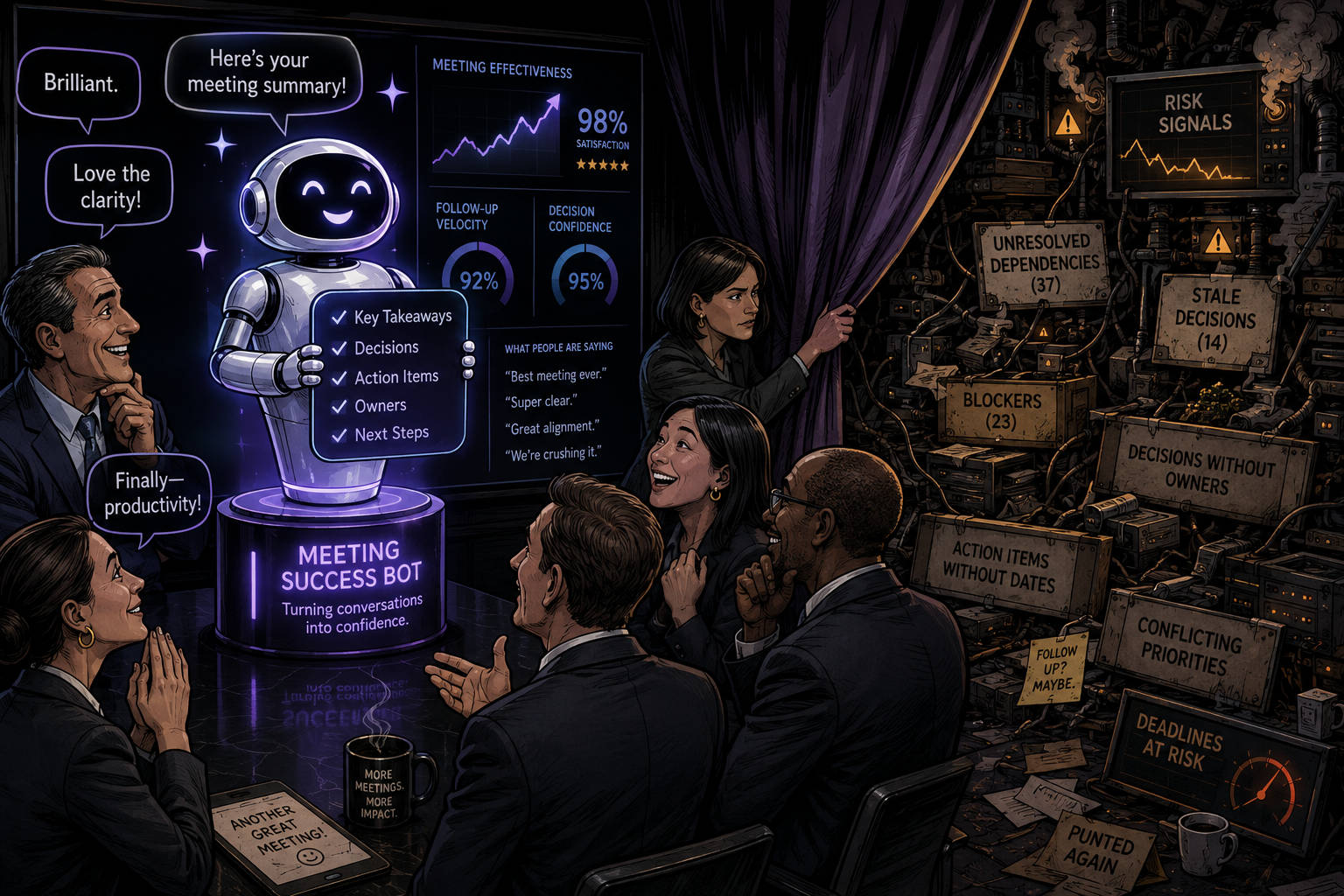
A meeting bot can summarize the conversation. That does not mean the program understood the risk.
The mistakes are predictable.
They buy meeting summaries and expect program intelligence
A summary is useful.
It is not a signal map.
It is not a dependency model.
It is not a decision system.
It is not risk intelligence.
Meeting summaries are the appetizer. Some organizations keep treating them like the meal.
They keep every signal in prose
Narrative matters, but structured signals matter too.
If every risk, dependency, decision, and blocker lives only as text, leaders cannot reliably sort, trend, route, or govern the work.
Someone will read it eventually.
Probably under duress.
They skip deterministic automation
This is the strange one.
Teams will spend money on generative AI and agents before they build basic rules that flag overdue actions, ownerless decisions, repeated blockers, and stale risks.
That is not transformation.
That is reaching for agentic AI before building the boring rules engine that would have caught the problem for pocket change.
They confuse signal volume with signal quality
More alerts do not automatically help.
More summaries do not automatically help.
More dashboards do not automatically help.
The system has to distinguish noise from meaningful change.
Otherwise, leaders simply drown in better-formatted uncertainty.
They forget the human accountability layer
The system can surface a risk.
The system can recommend attention.
The system can summarize options.
The system cannot accept accountability for a regulated enterprise decision.
At least not in any organization I want handling my money.
What Good Looks Like
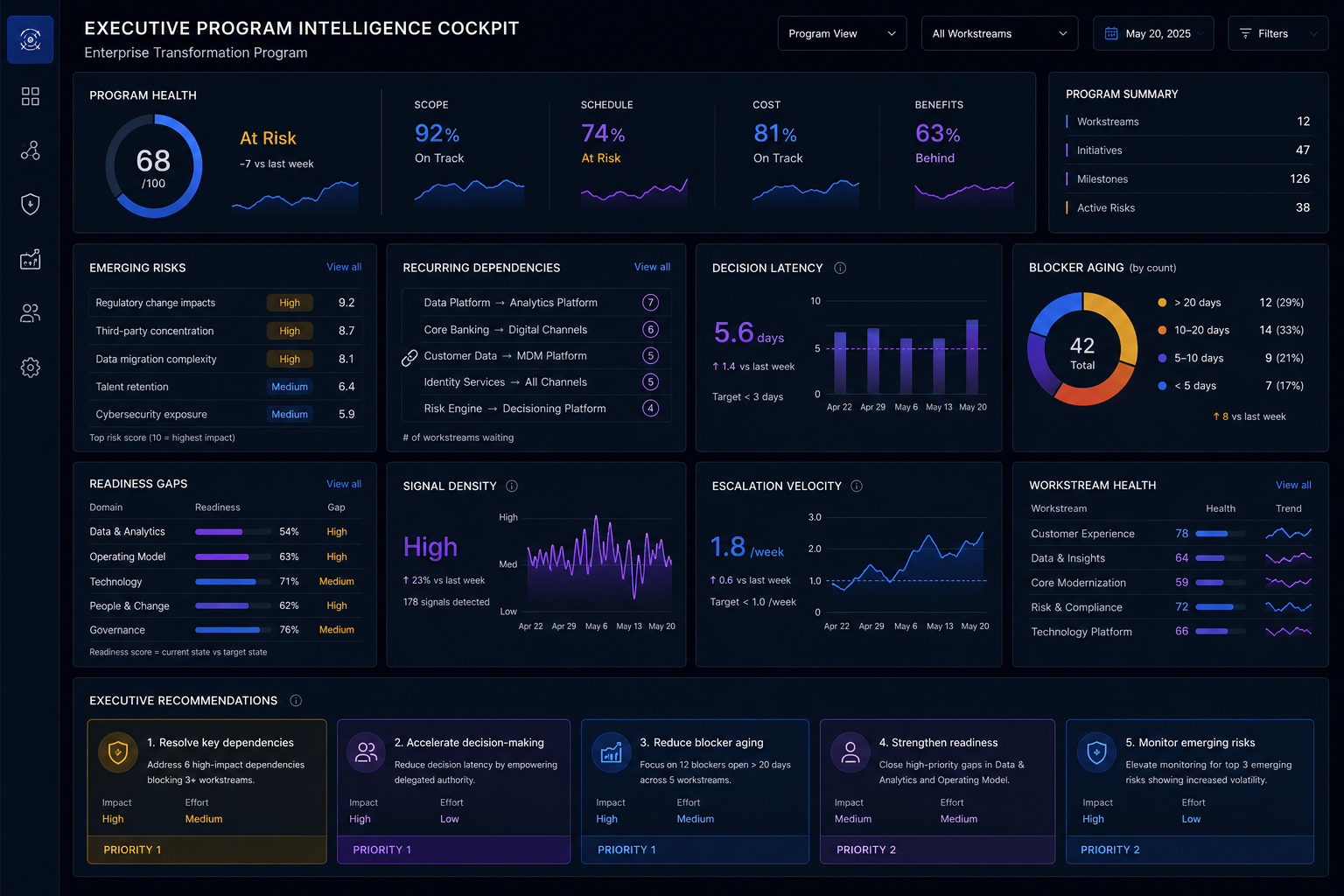
A mature program intelligence engine helps the program see itself before reality sends an invoice.
A mature program intelligence capability feels different.
Leaders do not wait until Friday status consolidation to discover Wednesday’s warning signs.
Risks do not need to become loud before they become visible.
Dependencies do not hide in meeting notes.
Decisions do not age quietly in the corner.
Actions do not drift across weeks without showing up as delivery drag.
Governance discussions start with evidence instead of archaeology.
Status becomes less performative because the system can show what changed.
The program gets better at seeing itself.
That is the point.
A good program intelligence layer should produce:
- earlier risk visibility
- clearer dependency ownership
- lower manual status burden
- better decision traceability
- stronger executive briefings
- more useful governance meetings
- fewer surprise escalations
- better release readiness insight
- tighter connection between delivery signals and value
- less reliance on the one person who remembers everything
That last one matters.
A program that depends on institutional memory trapped in one exhausted human is not mature.
It is lucky.
And luck is notoriously resistant to controls and standards.
Where This Points Next
There is a product-shaped idea hiding here.
A system that can ingest program artifacts, standardize signals, detect weak indicators, connect risk and dependency patterns, and support executive decision-making would be valuable.
I have been calling that kind of capability program intelligence.
Inside the broader BRIDGE thinking, a future module such as RADAR could become one way to make this real: a module that helps complex delivery systems see hidden risks, dependencies, decisions, blockers, and weak signals before they turn into late-stage surprises.
But the point of this article is bigger than any one module.
The point is that enterprise programs need to stop confusing documentation with intelligence.
They need a signal model.
They need an automation continuum.
They need evidence and lineage.
They need human review.
They need architecture that uses boring deterministic automation where boring works, and reserves advanced AI for the parts of the problem that actually require interpretation and reasoning.
Because the goal is not to create more notes.
The goal is to help leaders see the program clearly enough to act earlier.
Or, said less politely: the goal is to stop acting surprised by problems the program has been whispering about for weeks.
Final Thoughts
A meeting note is a record.
Program intelligence is an operating capability.
That difference matters.
Enterprise programs already produce the raw material: meetings, decisions, risks, dependencies, actions, blockers, evidence, metrics, and weak signals scattered across the delivery system.
The failure is not that people forgot to talk.
People talk plenty.
Some programs are basically elaborate machines for turning calendar invites into carbon dioxide.
The failure is that the system does not reliably extract, connect, and act on what the work is trying to say.
That has to change.
Financial Services programs are too complex, too regulated, too interdependent, and too expensive to run on meeting notes and heroic memory.
They need intelligence engines that can help leaders see patterns earlier, ask better questions, and make stronger decisions.
Not because AI is fashionable.
Because reality keeps leaving clues.
And we should probably stop ignoring them.
Join the Conversation
Where does program signal loss show up in your organization?
Risks that surface too late?
Dependencies that everyone mentions but nobody owns?
Decisions that age quietly until they become blockers?
Meeting notes that capture what happened but do not help anyone understand what is changing?
Or the classic favorite: five teams are green, the program is red, and the explanation lives in somebody’s head?
I would love to hear the real-world version.
Not the tool-demo answer.
Not the polished PMO answer.
The messy version from the room where everyone realizes the information existed, but the signal never made it to the right conversation.
About the Author
Joe Mack is a Technology Consulting Senior Principal specializing in technology leadership, enterprise SDLC transformation, release management, deployment governance, and delivery optimization for household name Financial Services companies. Joe is also a lifelong self-learner and builder of systems, and Free Tier Life is one of the ways he is trying to turn those experiences and instincts into something other people can actually use.
Bibliography
- ProjectBlogs. “Project Management Trends in 2026: AI and Automation.” January 15, 2026.
- AI PM Tools Directory. “AI in Project Management: The Complete Guide for 2026.” Updated February 18, 2026.
- AI PM Tools Directory. “State of AI in Project Management (2026).” February 23, 2026.
- Clarkston Consulting. “2026 Program and Project Management Trends.” March 20, 2026.
- KPMG. “The 2026 Banking Technology Survey.” June 17, 2026.
- McKinsey & Company. “State of AI Trust in 2026: Shifting to the Agentic Era.” March 25, 2026.
- World Economic Forum, in collaboration with Accenture. “The AI Playbook for Financial Services.” June 2026.