CLEAR: Before You Automate Anything, Capture Intent
Published on Sep 7, 2026
CLEAR: Before You Automate Anything, Capture Intent
Why Enterprise Automation Needs a Front Door Before It Gets a Steering Wheel
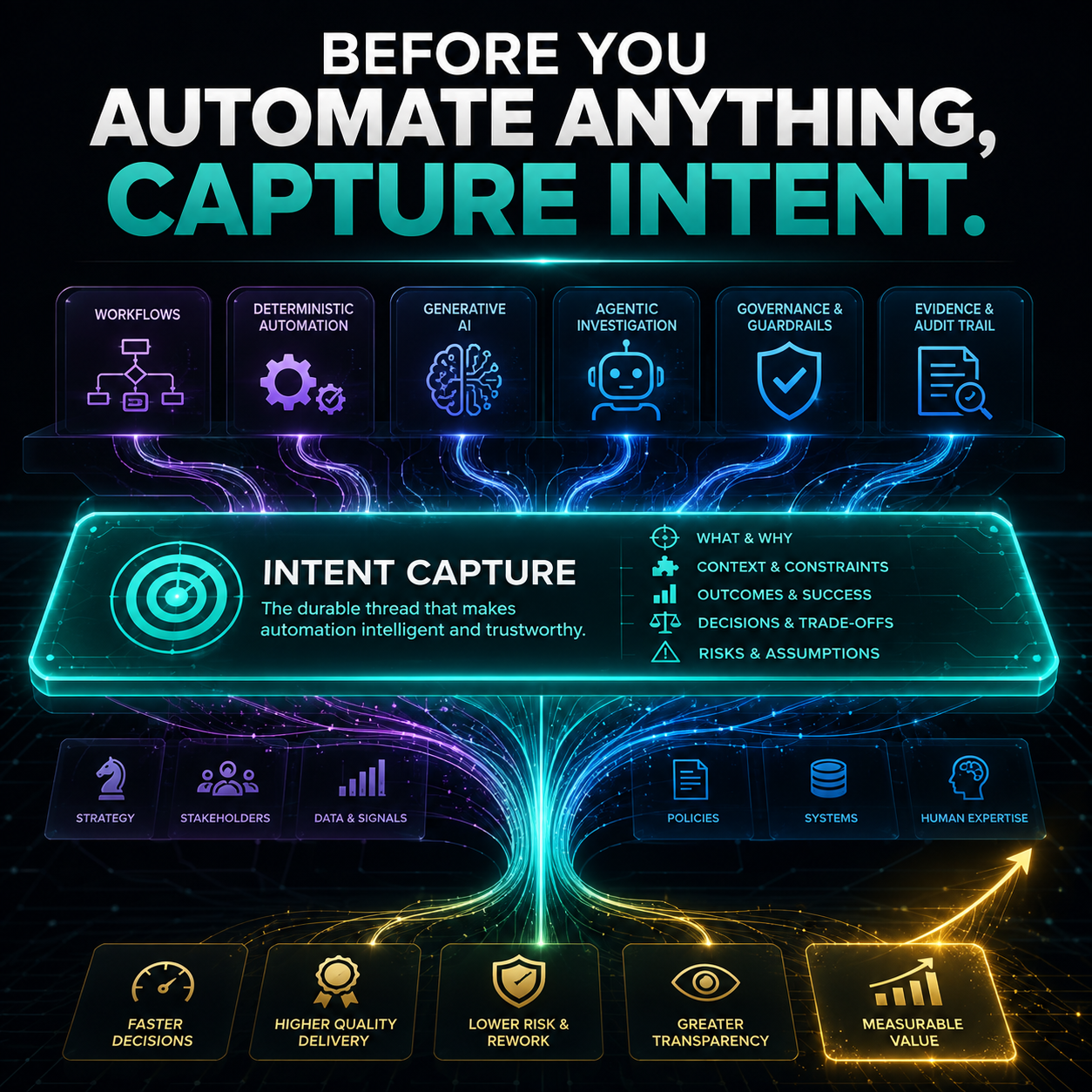
Automation without intent is how enterprises get very efficient at doing the wrong thing.
Every modern transformation program eventually develops a dangerous appetite for motion.
More automation.
More dashboards.
More AI.
More agents.
More workflows.
More integration.
More reporting.
More ceremonies where someone says “operating model” with the confidence of a person who has never had to reconcile three conflicting status decks at 11:37 p.m.
The machinery grows.
The question gets simpler and more uncomfortable:
What was this work supposed to accomplish in the first place?
That question should be easy.
It rarely is.
Because enterprise work has a nasty habit of losing its original intent somewhere between strategy, funding, intake, requirements, delivery, testing, governance, release, adoption, and the executive update where everyone pretends the green box means the same thing to every person in the room.
Intent starts clean.
Then reality gets involved.
A strategic objective becomes an initiative.
The initiative becomes a backlog.
The backlog becomes stories.
Stories become tickets.
Tickets become meetings.
Meetings become decisions.
Decisions become exceptions.
Exceptions become emails.
Emails become folklore.
Folklore becomes the thing everyone swears was agreed to, except nobody can find where.
Then the enterprise automates the workflow.
Fantastic.
Now the forgetting happens faster.
That is the problem CLEAR — Consolidated Launch and Engineering Alignment Relay — is meant to address.
Before automation, governance, reporting, program intelligence, or agentic investigation can help, the enterprise needs a durable record of what the work is supposed to mean.
Not just what task was created.
Not just what ticket moved.
Not just what requirement was written.
The intent.
The “why this exists” thread.
The thing automation should serve instead of accidentally burying under a pile of polished activity.
The Short Version
If you only remember six things from this article, make them these:
- Automation should not begin with execution. It should begin with intent.
- Enterprises lose value when strategic intent fragments across intake forms, backlogs, meetings, decisions, risks, exceptions, and release artifacts.
- Intent capture gives governance, automation, AI, reporting, and program intelligence a durable reference point.
- CLEAR stands for Consolidated Launch and Engineering Alignment Relay: a front door for capturing what the work is supposed to accomplish, connecting it to evidence and signals, and relaying that thread through execution.
- This matters even more in Financial Services, where delivery work has to survive controls, regulatory expectations, operational risk, cyber concerns, and complex release governance.
- If the system cannot explain why the work exists, what value it supports, who owns it, and what evidence proves it is ready, the rest of the automation stack is mostly expensive choreography.
What CLEAR Actually Stands For
Let us fix an important piece of the story before the acronym starts wandering around unsupervised.
CLEAR stands for Consolidated Launch and Engineering Alignment Relay.
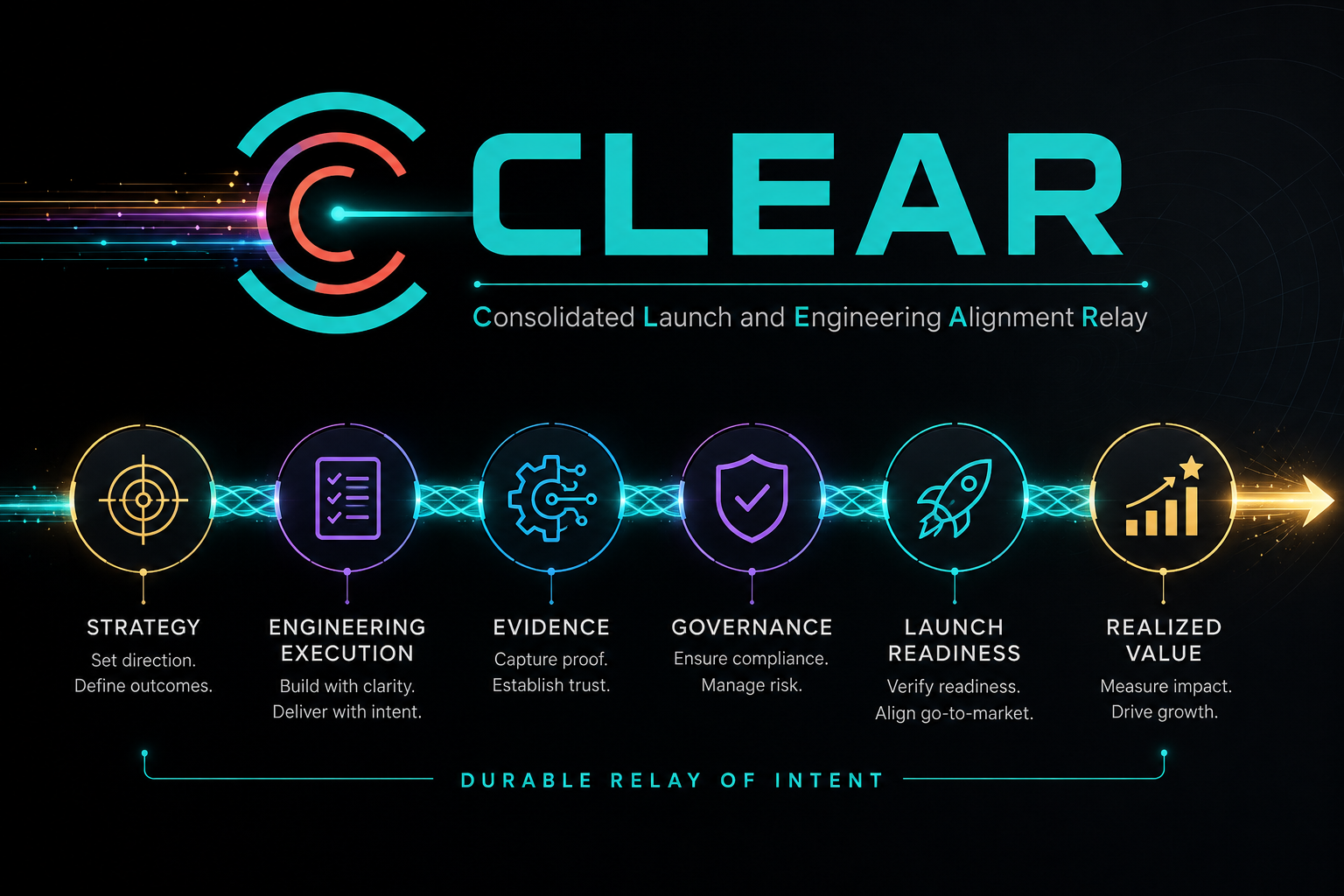
CLEAR preserves the thread between why work exists, how engineering delivers it, what evidence supports it, and whether the launch creates value.
The name is not decorative acronym gymnastics. Each word describes part of the job.
Consolidated
Intent already exists across the enterprise.
It lives in strategy decks, intake requests, business cases, epics, work items, meeting notes, control discussions, release plans, and the memory of somebody who is already late for another call.
Consolidated does not mean forcing every source system into one giant replacement platform. That would be a fantastic way to spend three years modernizing the intake problem while the work keeps moving without you.
It means bringing the important pieces of intent into a coherent, durable record that downstream systems can use.
Launch
CLEAR is concerned with work that is moving toward a real outcome.
A launch may be a production release, a process change, a control implementation, a customer capability, an operational improvement, or another meaningful enterprise change.
The point is movement from intention into reality.
That is where forgotten context starts getting expensive.
Engineering Alignment
Business intent and engineering execution have an unfortunate tendency to become distant relatives.
Engineering Alignment keeps the outcome connected to the actual delivery work: repositories, pull requests, work items, dependencies, decisions, tests, environments, evidence, risks, and release readiness.
The goal is not to make engineers fill out another form.
The goal is to stop asking engineering teams to reverse-engineer the business purpose from a ticket written four translations ago.
Relay
CLEAR should not become a black hole where intent goes to be admired.
It should relay intent through the delivery lifecycle.
The captured thread informs automation, governance, evidence collection, program intelligence, readiness, and value measurement. As events occur and conditions change, CLEAR helps keep those events correlated to the original purpose.
That word matters because CLEAR is not trying to own every artifact or replace every workflow tool.
It is trying to keep meaning moving.
Put together, the name describes the operating idea:
Consolidate the intent. Align it to engineering execution. Relay the thread through launch.
That is CLEAR.
And if the enterprise cannot do those three things, adding more automation will mostly help the confusion arrive earlier.
The Enterprise Has an Intent Leakage Problem
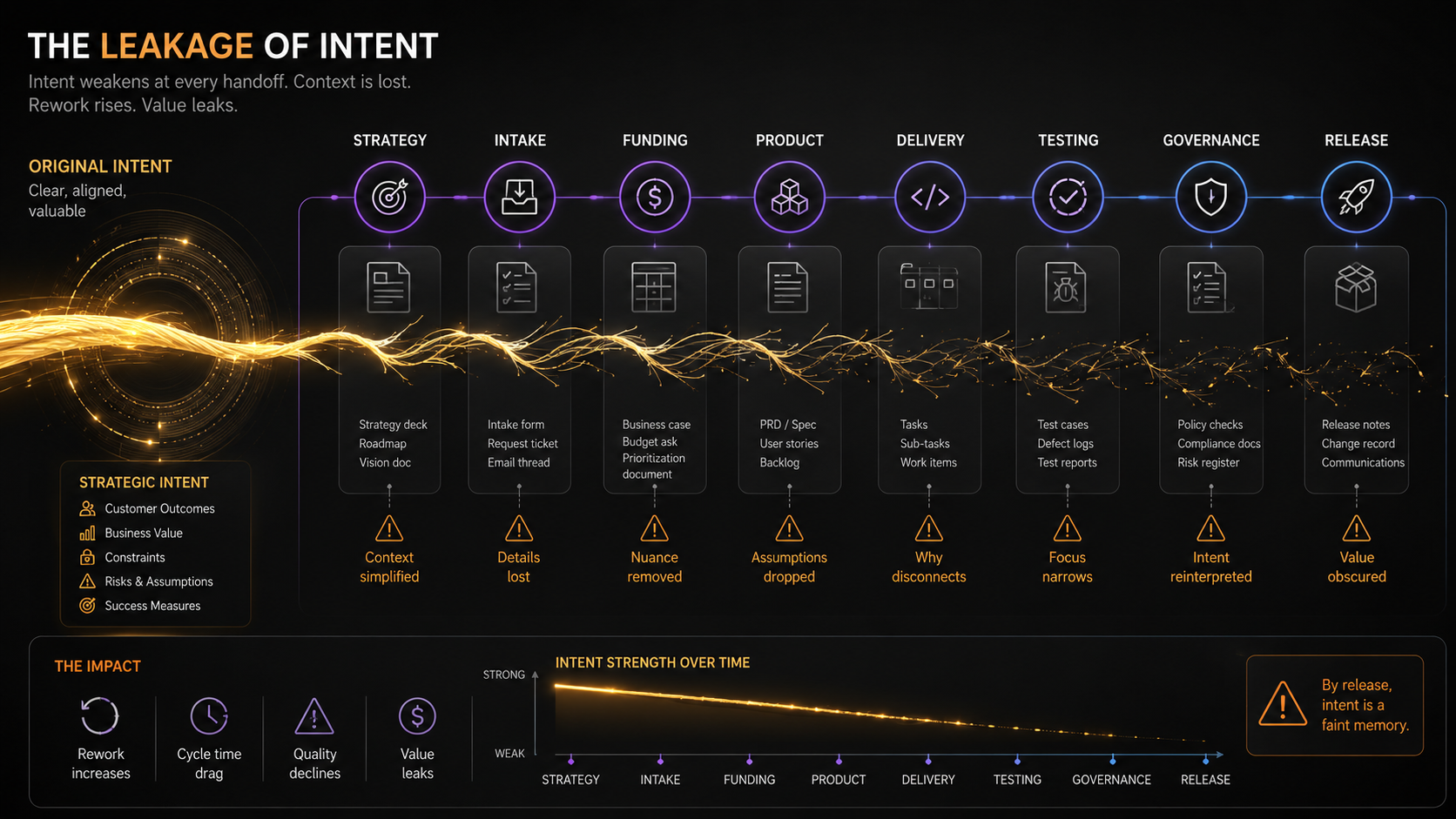
Intent leakage is what happens when the enterprise keeps the activity and loses the reason.
Most organizations do not lose intent all at once.
They sand it down gradually.
A business leader describes a customer problem.
A product team translates it into scope.
A delivery team translates scope into work.
A testing team translates work into acceptance evidence.
A release team translates readiness into go/no-go criteria.
Governance translates all of it into a deck with a lot of green, amber, and red boxes that somehow feel both official and suspiciously incomplete.
No single handoff is malicious.
No single artifact is useless.
But the chain gets weaker.
The original customer outcome becomes a feature description.
The feature becomes a dependency.
The dependency becomes a blocker.
The blocker becomes a risk.
The risk becomes something nobody wants to say out loud because everyone is already too committed to the date.
That is intent leakage.
And once intent leaks, everything downstream gets harder:
- prioritization gets fuzzy
- governance gets performative
- testing gets disconnected from value
- release readiness gets reduced to checklist theater
- automation optimizes local tasks instead of enterprise outcomes
- AI summarizes symptoms without understanding what changed
- leaders ask why the program is green if the business outcome is still smoking in the ditch
The frustrating part is that the enterprise usually has the answer somewhere.
It is just scattered across the work.
And scattered truth is not a control.
It is a scavenger hunt with funding.
Why Intent Matters More in the Age of AI and Automation
Automation amplifies whatever it is pointed at.
Point it at clarity, and it can remove friction.
Point it at confusion, and it industrializes confusion.
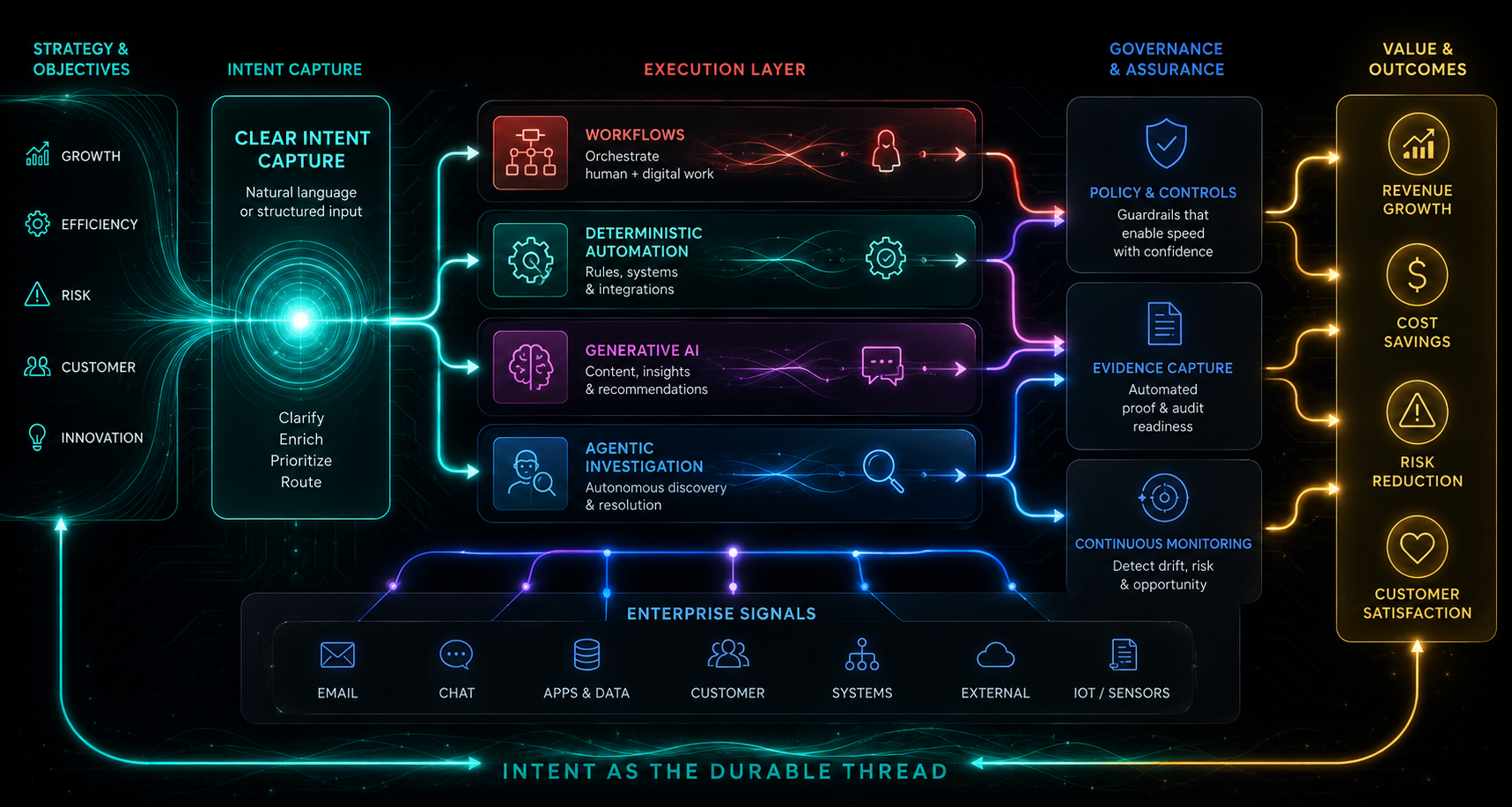
This becomes much more serious as organizations move from deterministic automation into generative and agentic patterns. A script follows instructions. A workflow routes steps. A model can summarize language. An agent may investigate, recommend, and eventually act.
Each step up the automation continuum creates more leverage.
It also creates more ways to move quickly in the wrong direction.
McKinsey’s 2026 AI trust research frames this shift clearly: as AI systems become more autonomous, organizations have to manage systems doing the wrong thing, not only systems saying the wrong thing. That raises the importance of strategy, risk management, governance, data, technology, and agentic controls. source
That is exactly why intent matters.
If an AI-assisted workflow is going to recommend action, route an exception, flag a readiness issue, summarize risk, or investigate a dependency chain, it needs a stable reference point.
What outcome is being pursued?
What value is expected?
What risk is acceptable?
What evidence matters?
What decision rights apply?
What control obligations exist?
What would make this work no longer worth doing?
Without that context, the enterprise is building faster machinery around weaker understanding.
That is not transformation.
That is strapping a rocket to a shopping cart and calling it mobility modernization.
CLEAR as the Front Door for Work
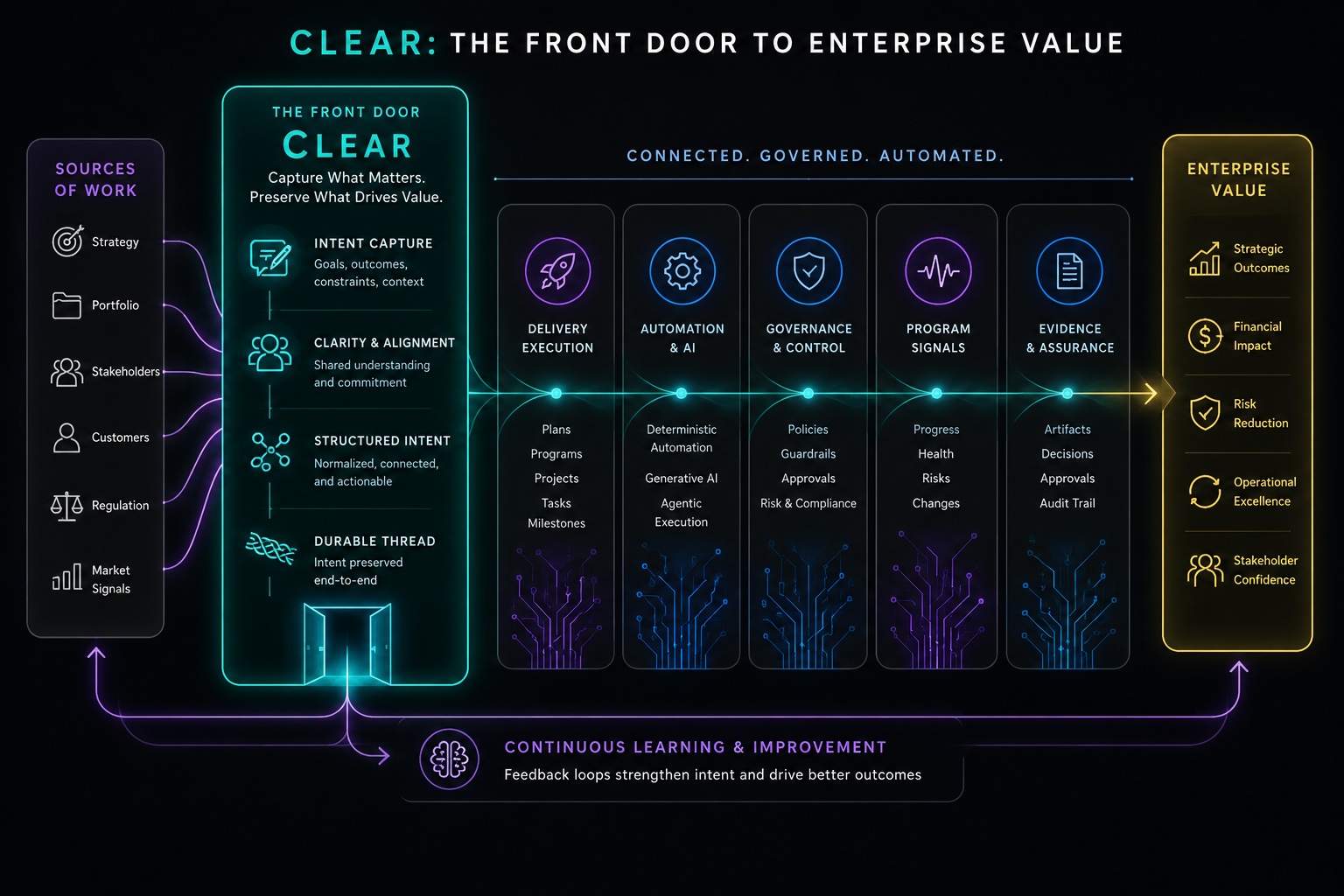
CLEAR is the front door for work that deserves to be governed, automated, measured, or learned from.
CLEAR is not meant to be another place for people to type the same information badly.
Nobody needs another enterprise intake swamp.
The point is different.
CLEAR is the concept of a structured intent capture layer: a front door where work is described in terms that can survive the rest of the delivery system.
At minimum, intent capture should help answer:
- What are we trying to accomplish?
- Who owns the outcome?
- What value is expected?
- What customer, colleague, operational, or regulatory impact is involved?
- What systems, processes, or value streams are affected?
- What evidence will prove readiness?
- What risk or control obligations apply?
- What assumptions are being made?
- What dependencies are already visible?
- What would make this work a bad idea?
That last question deserves more airtime.
A mature enterprise should know what would make an initiative stop, change, or slow down.
Instead, many organizations treat intake like a commitment ceremony.
Once the work enters the machine, every system starts asking how to move it forward.
Very few ask whether the original intent still makes sense.
CLEAR should preserve that thread.
It should make intent inspectable.
It should connect intent to work, evidence, signals, governance, and outcomes.
It should make it harder for the enterprise to forget why something exists while still spending money on it.
That is a feature.
Possibly a public service.
What Intent Capture Should Include
Intent capture does not need to be a 47-field form designed by a committee that has confused completeness with punishment.
It needs the right shape.
A useful intent record should include:
Business intent
What outcome is expected?
This is the basic “why.”
Customer improvement. Operational resilience. Cost reduction. Risk mitigation. Regulatory response. Revenue enablement. Process simplification. Better decision support.
If nobody can say the outcome clearly, stop there.
The automation can wait in the lobby.
Value hypothesis
What value should change if the work succeeds?
This does not need fake precision.
It does need a hypothesis.
Less manual review. Reduced cycle time. Fewer exceptions. Lower failure rate. Better control evidence. Faster onboarding. Better release confidence. Improved customer outcome.
A value hypothesis is not a guarantee.
It is a direction of accountability.
Ownership
Who owns the outcome?
Not who updates the ticket.
Not who runs the meeting.
Who owns whether this work creates the value it claims to create?
If everyone owns it, nobody owns it.
And if nobody owns it, congratulations, you have created a governance piñata.
Impact surface
Where will this work touch the enterprise?
Systems. Customers. Colleagues. Data. Controls. Vendors. Environments. Release trains. Operational teams. Reporting. Cyber posture. Downstream processes.
Complex work rarely stays politely inside the box where it was funded.
Intent capture should make the impact surface visible early.
Evidence expectations
What evidence will matter later?
Test results. Control approvals. Operational readiness. Data validation. Security review. User acceptance. Production support readiness. Rollback plans. Training evidence. Dependency closure.
If evidence matters at release readiness, it should be named at intent capture.
Waiting until the end to discover evidence expectations is how grown adults end up having deeply unfortunate checkpoint meetings.
Risk and control context
What risk is being introduced, reduced, or moved?
Financial Services work is never “just delivery.”
Risk moves through the system.
Operational risk. Cyber risk. Model risk. Data risk. Customer impact. Regulatory exposure. Third-party dependency. Production stability.
Intent capture should make risk visible before the work becomes emotionally committed to its own timeline.
The Automation Continuum Needs Intent
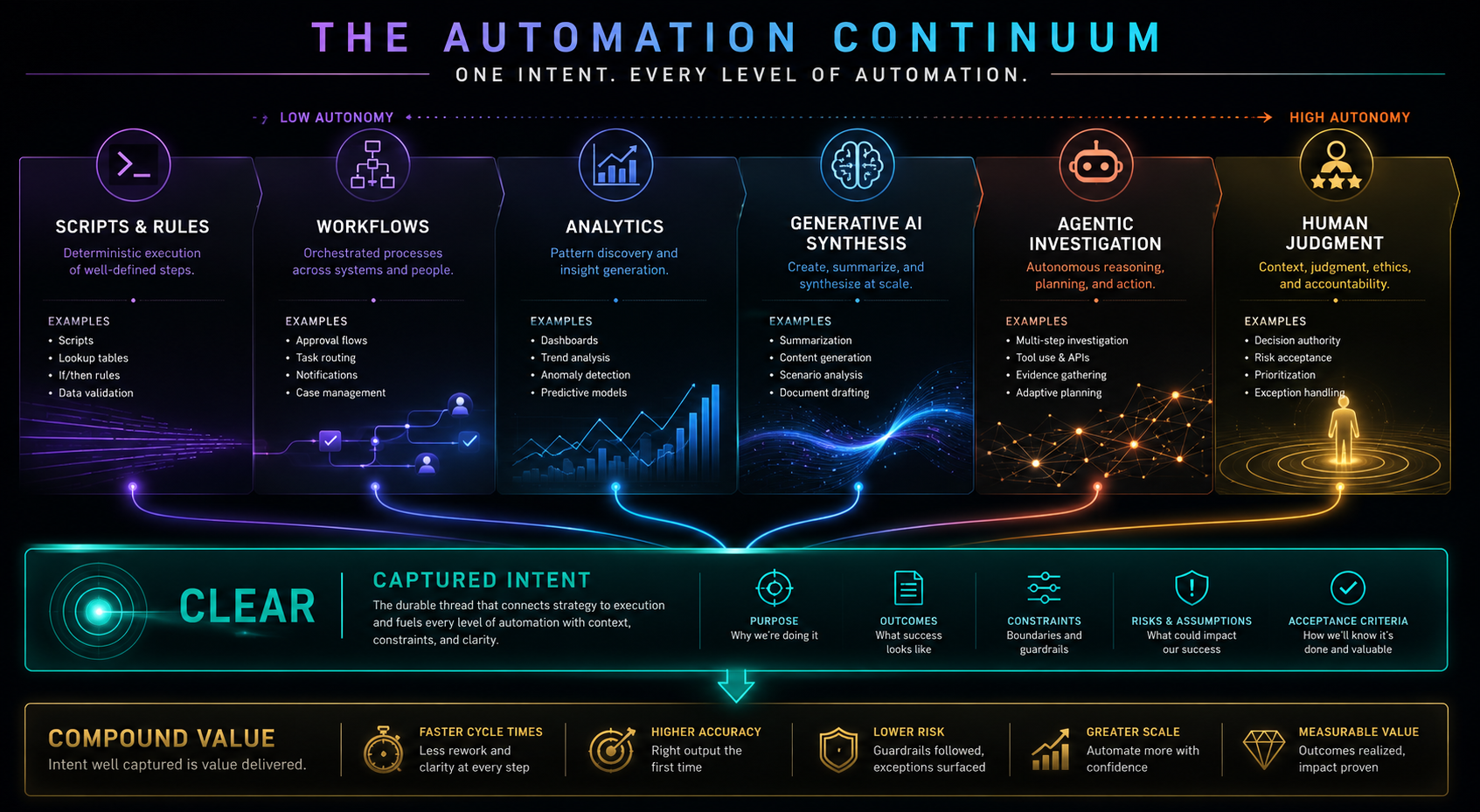
The more powerful the automation pattern, the more important intent becomes.
The full automation continuum depends on intent.
A deterministic rule needs to know what condition matters.
A workflow needs to know what state change matters.
A dashboard needs to know what signal matters.
A generative summary needs to know what context matters.
An agentic investigation needs to know what outcome matters.
Otherwise, the automation stack becomes a very expensive improvisational theater troupe.
Scripts can catch missing fields.
Workflows can route approvals.
Analytics can show aging, recurrence, drift, and concentration.
Generative AI can synthesize narrative.
Agents can investigate ambiguity.
But the system still needs to know what the work was supposed to accomplish.
That is the spine.
Without it, every automation pattern is just operating on fragments.
Fragments can be useful.
They can also be misleading.
A risk looks smaller when disconnected from the business intent it threatens.
A dependency looks less urgent when disconnected from the release outcome it blocks.
A green status looks better when disconnected from the value nobody has validated.
A beautiful AI summary can still be beautifully wrong.
Intent is how the enterprise keeps the thread.
Financial Services Cannot Afford Intent Amnesia
Financial Services delivery has a special relationship with consequences.
A missed dependency is not just annoying.
It may delay a release tied to customer communications, regulatory commitments, fraud controls, payment operations, claims handling, trading workflows, advisor productivity, financial crime operations, or operational resilience.
KPMG’s 2026 Banking Technology Survey reported that 80% of banking executives expect AI to significantly disrupt business and operating models in the next three to five years, while 92% are increasing cybersecurity budgets and 84% are increasing cybersecurity investment specifically to address AI-related risks. source
That is the environment.
More AI.
More automation.
More cyber concern.
More complexity.
More pressure to modernize.
More ways for intent to get shredded between ambition and execution.
Financial Services leaders do not need another tool that makes fragments move faster.
They need a way to preserve the reason the fragments exist.
Intent capture creates the context that lets later systems behave intelligently:
- governance can evaluate alignment
- automation can route based on actual meaning
- evidence can be tied to value and risk
- program intelligence can classify signals against the right outcome
- leadership can ask better questions
- auditability improves because the thread is visible
This is not administrative hygiene.
This is enterprise memory.
And enterprise memory is underrated because nobody notices it until it fails.
Like backups.
Or ankles.
What Leaders Get Wrong
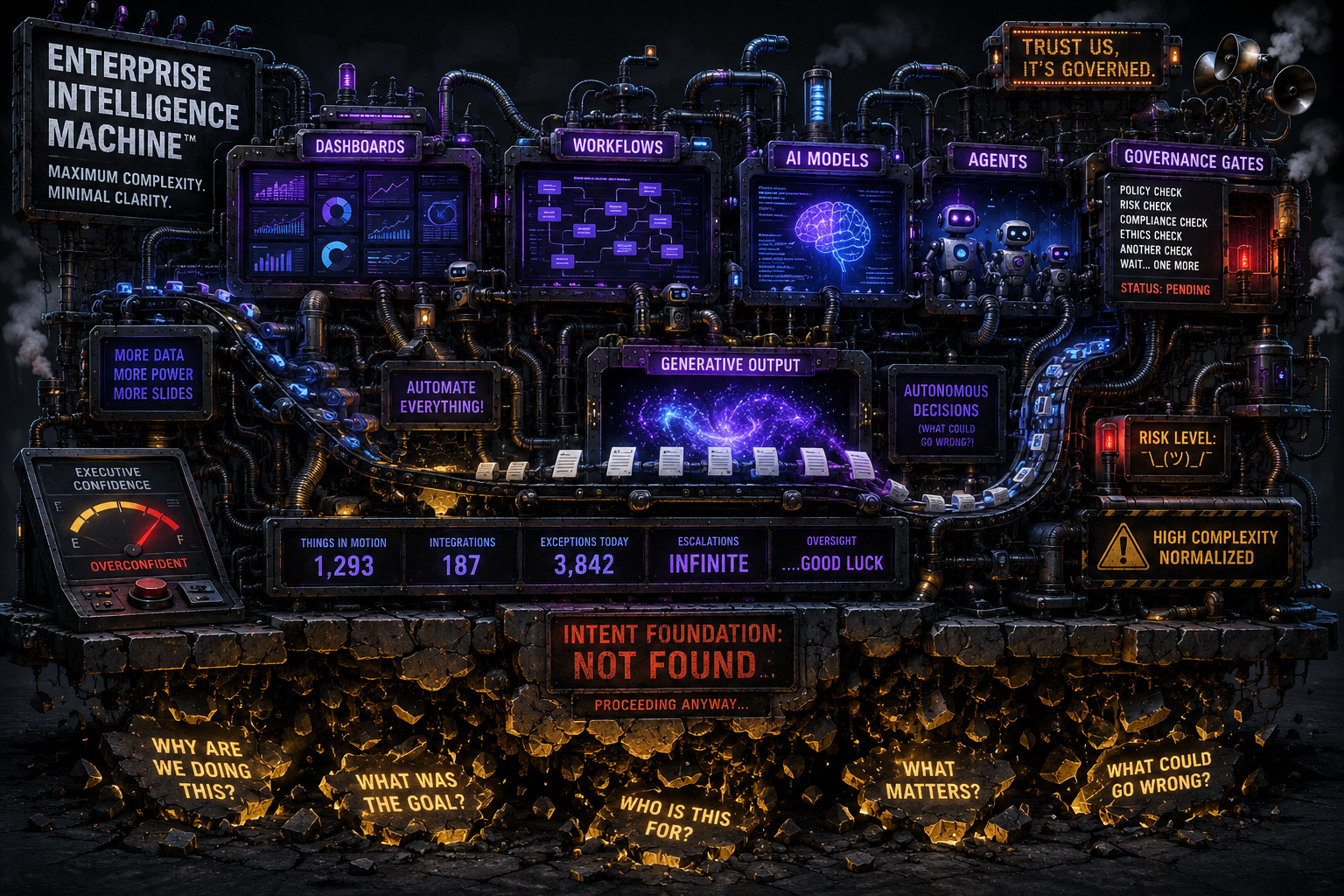
When leaders skip intent capture, the rest of the delivery machine starts mistaking motion for meaning.
The failure patterns are predictable.
They start with the tool
The conversation begins with a platform, an AI capability, a workflow engine, or an automation opportunity.
Wrong starting point.
Start with the work.
What is it supposed to accomplish?
Who owns the outcome?
What would prove success?
What should make us slow down?
They treat intake as clerical
Intake becomes a form.
The form becomes a hurdle.
The hurdle becomes something teams learn to complete with the least amount of useful information possible.
That is not intent capture.
That is enterprise Mad Libs.
They confuse requirements with intent
Requirements matter.
But a requirement is not always the same as intent.
A requirement says what someone thinks should be built.
Intent says why the work exists and what outcome should be protected.
Both matter.
Only one tends to survive the backlog grooming session with its soul intact.
They let governance arrive too late
Governance should not discover intent at the end.
By then, delivery teams have already made assumptions, built dependencies, negotiated scope, and emotionally bonded with the date.
Late governance turns intent into archaeology.
Nobody enjoys archaeology with a deployment calendar.
They automate the path of least resistance
Automation often starts where the data is easiest, not where the value is highest.
That is understandable.
It is also dangerous.
If the automation path is disconnected from intent, the enterprise may optimize whatever is easiest to measure.
That is how dashboards become decorative speedometers on vehicles with no steering wheel.
What Good Looks Like
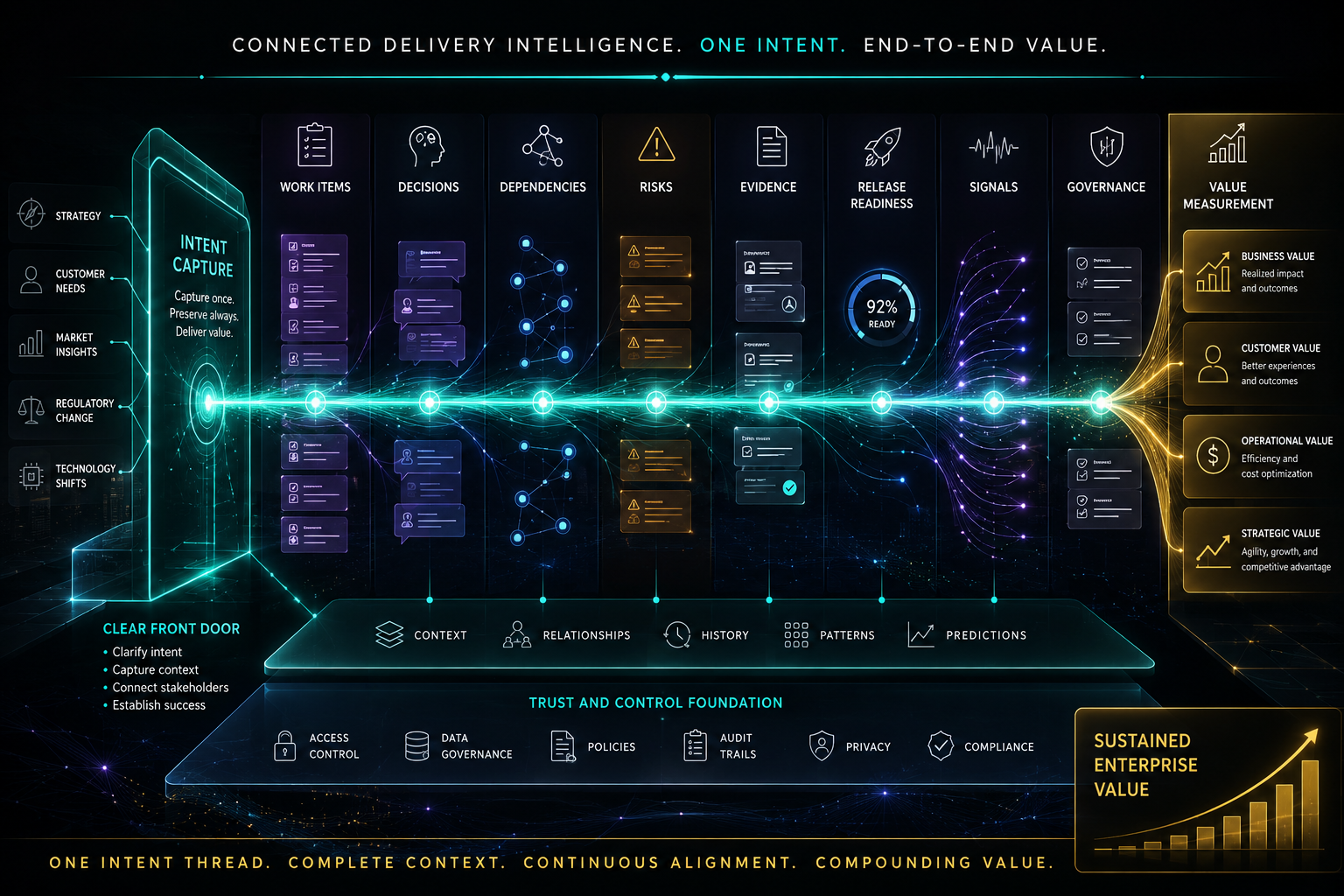
Intent becomes useful when it stays attached to the work long enough to govern, automate, measure, and learn from it.
The future state is not a prettier intake form.
It is a connected delivery-intelligence model where intent remains attached to the work as the work changes shape.
The original purpose follows the initiative into delivery. Decisions remain visible. Dependencies stay connected. Risks and signals can be interpreted against the outcome they threaten. Evidence accumulates against expectations established early. Release readiness has context. Governance can see the thread. Value measurement can reach back to the reason the work was funded in the first place.
That connected thread is the point.
Without it, every downstream capability is left reconstructing meaning from whatever fragments survived the trip.
With it, the enterprise can govern, automate, measure, and learn without conducting another round of executive archaeology every time someone asks whether the work still makes sense.
A mature intent capture capability feels practical.
Not heavy.
Not ceremonial.
Not another process tax wearing governance perfume.
It should make the work clearer from the beginning.
A good intent layer should:
- capture why the work exists
- identify accountable ownership
- connect work to expected value
- record assumptions and constraints
- identify affected systems and value streams
- surface early dependencies
- name evidence expectations
- flag risk and control context
- create stable source references
- issue correlation identifiers for downstream events and signals
- preserve the original intent as the work evolves
That last part matters.
Intent is not a museum artifact.
It may change.
The market changes. Policy changes. Risk changes. Dependencies change. A regulatory deadline moves. A vendor slips. A customer impact becomes clearer. A better solution appears.
Fine.
Change the intent record.
But make the change visible.
The enterprise should know when intent evolved, who approved the change, what evidence supported the change, and what downstream work was affected.
That is how intent becomes operational.
That is how governance becomes useful.
That is how automation stops being a leaf blower pointed at a paper pile.
Where CLEAR Points Next
CLEAR — Consolidated Launch and Engineering Alignment Relay — is the first step in a broader delivery intelligence idea.
Capture the intent.
Watch the work.
Extract the signals.
Route governance.
Collect evidence.
Measure value.
Learn from the pattern.
That does not require a giant reveal.
It requires a simple discipline:
Before you automate anything, know what the work is supposed to mean.
Eventually, intent capture can support program intelligence, signal extraction, governance routing, release readiness, evidence traceability, and value measurement.
But the first job is humbler.
Create a durable front door for meaning.
Because if the enterprise cannot preserve intent, everything else gets weird.
Dashboards get weird.
Governance gets weird.
AI gets weird.
Automation gets weird.
Reporting gets weird.
And then someone asks why the transformation is expensive, slow, and strangely disconnected from the business outcome everyone remembers discussing six months ago.
The answer is usually somewhere in the intent that leaked out along the way.
Final Thoughts
Automation is not the enemy.
AI is not the enemy.
Dashboards are not the enemy.
Governance is not the enemy.
The enemy is disconnected activity pretending to be progress.
Before enterprises automate more work, they need to capture what the work is supposed to accomplish.
Before agents investigate signals, the system needs to know what the signals threaten.
Before governance evaluates readiness, the system needs to know readiness for what.
Before leaders celebrate delivery, they need to know whether the original intent survived execution.
CLEAR is one answer to that problem.
A front door.
A memory layer.
A way to keep the why attached to the work before the machinery starts moving.
Because the future is going to have more automation, more AI, more agents, more signals, more dashboards, and more ways to move faster.
That makes intent more important, not less.
Move fast if the work deserves it.
Automate where it helps.
Use AI where it earns its keep.
But capture the intent first.
Otherwise, the enterprise may get exactly what it automated.
And still not get what it needed.
Join the Conversation
Where does intent leak out in your organization?
During intake?
Backlog refinement?
Funding?
Testing?
Release readiness?
Governance?
Status reporting?
Or the classic favorite: the original business outcome is still technically alive, but only one person remembers what it was and that person is on vacation?
I would love to hear the real-world version.
Not the clean operating model version.
The messy version where everyone is working hard, the tools are full, the dashboards are green, and someone quietly asks:
Wait. Why are we doing this again?
About the Author
Joe Mack is a Technology Consulting Senior Principal specializing in technology leadership, enterprise SDLC transformation, release management, deployment governance, and delivery optimization for household name Financial Services companies. Joe is also a lifelong self-learner and builder of systems, and Free Tier Life is one of the ways he is trying to turn those experiences and instincts into something other people can actually use.
Bibliography
- McKinsey & Company. “State of AI trust in 2026: Shifting to the agentic era.” March 25, 2026.
- KPMG. “The 2026 Banking Technology Survey.” June 17, 2026.
- Clarkston Consulting. “2026 Program and Project Management Trends.” March 20, 2026.
- ProjectBlogs. “Project Management Trends in 2026: AI and Automation.” January 15, 2026.
- AI PM Tools Directory. “AI in Project Management: The Complete Guide for 2026.” Updated February 18, 2026.