The Leadership Debt Always Comes Due
Published on Aug 3, 2026
The Leadership Debt Always Comes Due
Why Transformation Fails When Leaders Underinvest in Trust, Clarity, Accountability, and Human Touch
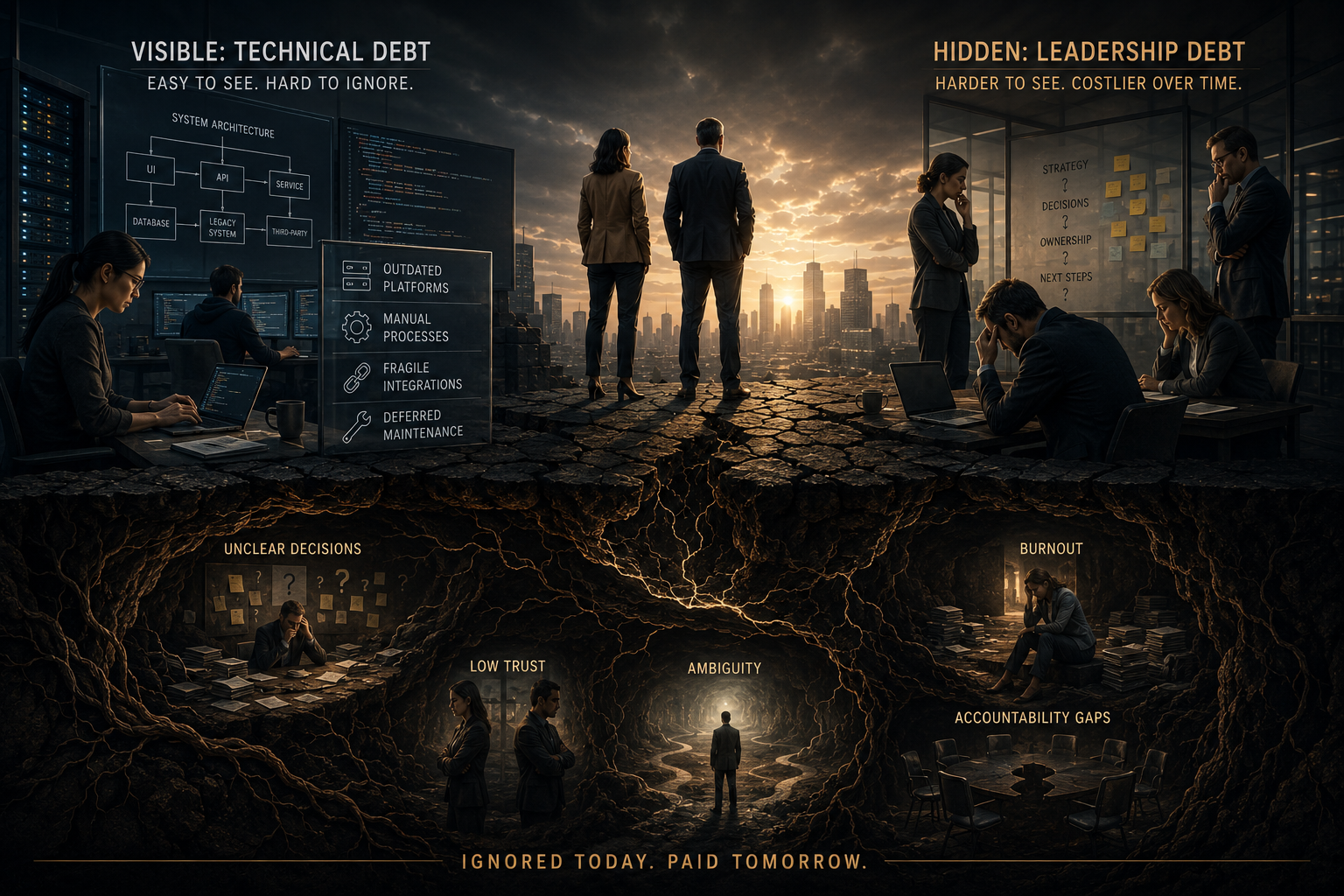
Technical debt slows systems. Leadership debt slows organizations. Ignore either long enough and the bill arrives with interest.
Every transformation has two ledgers.
The first one is easy to name.
Technical debt.
Everyone knows that one. It lives in brittle integrations, aging platforms, half-retired systems, undocumented jobs, manual workarounds, abandoned architecture principles, and code nobody wants to touch unless there is hazard pay and snacks.
Technical debt is real.
It is expensive.
It compounds.
But there is another ledger.
Most organizations do not manage it with the same discipline. They rarely put it in the status deck. Nobody creates a heat map for it. It does not get its own backlog, steering committee, or remediation funding line.
That ledger is leadership debt.
Leadership debt is what accumulates when leaders delay hard conversations, avoid tradeoffs, issue vague direction, tolerate unclear ownership, confuse activity with progress, reward rescue behavior, underinvest in trust, and pretend people can absorb endless ambiguity without cost.
At first, leadership debt is quiet.
A decision gets deferred.
A priority gets softened.
A conflict gets politely parked.
A team gets told to “stay aligned,” which is often executive dialect for “please keep moving while we avoid saying who loses.”
Everyone nods.
The meeting ends.
The debt stays.
Then it starts charging interest.
The work slows down. Teams create workarounds. People attend more meetings because nobody trusts the last meeting. Status gets polished. Risks get sanded down. Escalations arrive late. Strong performers become human routers. Middle managers become shock absorbers. The organization calls it complexity.
Sometimes it is complexity.
Sometimes it is unpaid leadership debt wearing a better suit.
The Short Version
If you only remember six things from this article, make them these:
- Leadership debt is the accumulated cost of unclear decisions, weak trust, poor accountability, vague priorities, low empathy, and avoided conversations.
- Technical debt breaks systems. Leadership debt breaks momentum.
- Ambiguity does not stay at the top. It rolls downhill until teams turn it into rework, meetings, emotional labor, and delay.
- Human touch is not soft. Empathy, clarity, steadiness, and trust reduce the operating cost of uncertainty.
- In an age of AI disruption, restructures, job insecurity, and constant change, leaders cannot treat people like infinitely elastic delivery capacity.
- The best leaders absorb ambiguity, create clarity, tell the truth with care, and refuse to export every unresolved tradeoff onto the people doing the work.
The Debt Nobody Tracks
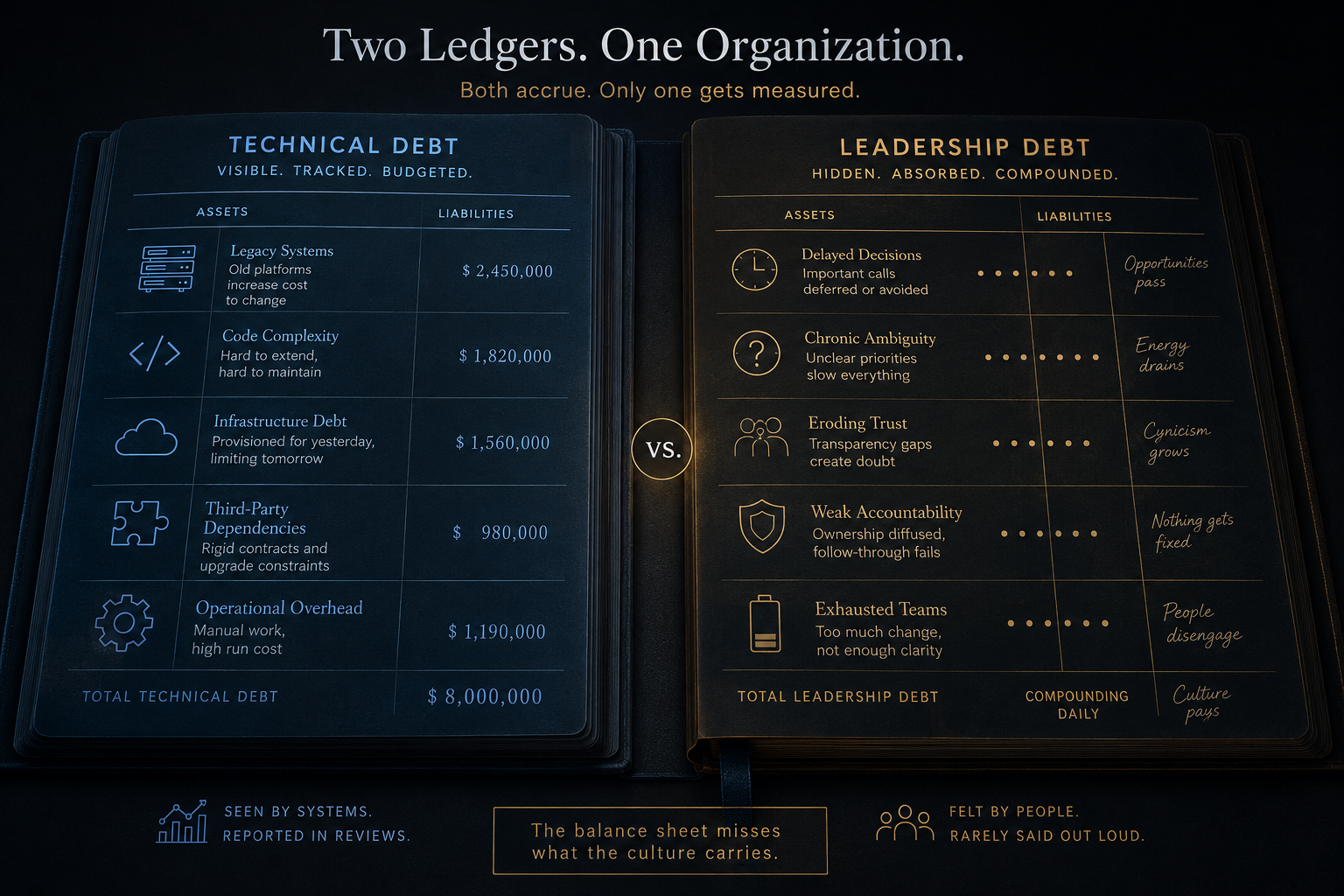
Technical debt is visible in systems. Leadership debt is visible in behavior.
Organizations are comfortable talking about technical debt because technical debt sounds objective.
A platform is old.
A service is fragile.
A batch job is undocumented.
A dependency is unsupported.
A migration is overdue.
Good. Name it. Measure it. Fund it.
Leadership debt is harder because leadership debt points back at people with titles.
It asks uncomfortable questions.
Who allowed five strategic priorities to become twenty-three?
Who keeps reopening decisions everyone thought were closed?
Who says “empower the teams” while requiring seven approvals for lunch money and a PowerPoint footnote?
Who lets the loudest stakeholder become the operating model?
Who expects transparency from teams while offering carefully laminated fog in return?
That is why leadership debt often hides behind neutral language.
Alignment gap.
Execution challenge.
Stakeholder complexity.
Change fatigue.
Capacity constraint.
Governance friction.
Those phrases may describe real conditions. They may also describe leadership debt that nobody wants to put on the bill.
The irony is that leadership debt is not mysterious.
Teams can feel it.
They know when priorities are fake.
They know when an escalation will be punished instead of solved.
They know when a decision is theater.
They know when a leader says “we are listening” but already knows exactly which feedback will be ignored.
They know when the organization is asking for honesty and rewarding optimism.
You do not need a maturity model to detect that.
You need a pulse.
Ambiguity Is Not Alignment
One of the great corporate myths is that if enough people nod in the same meeting, alignment happened.
Please.
A room full of nodding heads can mean many things.
It can mean agreement.
It can mean fatigue.
It can mean fear.
It can mean “I understand the political weather and have decided not to die in this conference room.”
Alignment is not achieved when people stop talking.
Alignment is achieved when people can explain the decision, the tradeoff, the owner, the next move, the consequence, and what will not be done because of what was chosen.
That last part is where the bodies are usually buried.
Leaders love priorities until priorities require subtraction.
Then suddenly everything is important.
Everything is strategic.
Everything is urgent.
Everything is “must win.”
That is not leadership.
That is a denial-of-service attack on the organization’s ability to think.
Ambiguity has a cost. The American Psychological Association’s 2026 workplace uncertainty analysis notes that economic instability, policy change, and AI disruption have contributed to workers feeling disengaged, replaceable, and invisible; the same analysis emphasizes transparency, clear communication, and cooperation-oriented skills as ways organizations can help employees navigate uncertainty. source
That matters because ambiguity does not remain abstract.
Ambiguity becomes rework.
Ambiguity becomes duplicate meetings.
Ambiguity becomes defensive documentation.
Ambiguity becomes unofficial decision rights.
Ambiguity becomes the team spending three weeks building Version A while someone powerful quietly expected Version B.
Then leadership asks why delivery is slow.
Delivery is slow because the organization is paying interest on unclear thinking.
The Cost of Unmade Decisions
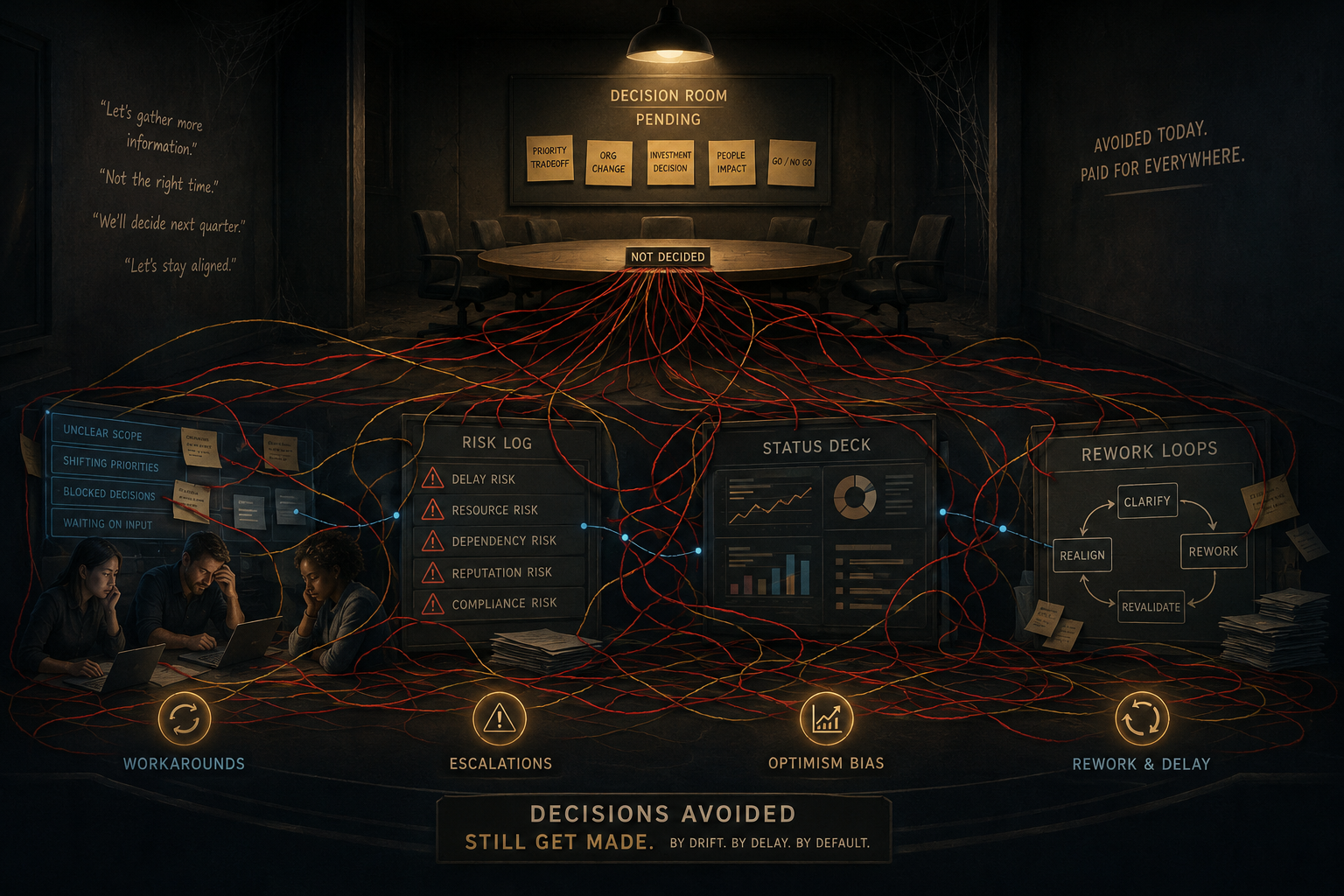
Decisions avoided still get made. They get made by delay, drift, workaround, or escalation.
There is no such thing as a decision-free environment.
A decision avoided still gets made.
It gets made by delay.
It gets made by the loudest stakeholder.
It gets made by the team that has to keep moving.
It gets made by the vendor timeline.
It gets made by the system constraint nobody wanted to discuss.
It gets made by a workaround that becomes permanent because “temporary” is enterprise Latin for “welcome to production.”
Leaders sometimes avoid decisions because they want more data.
Fair.
Sometimes they avoid decisions because the tradeoff is politically expensive.
Less fair.
Sometimes they avoid decisions because making the decision would force them to disappoint someone important.
Now we are at the cash register.
Unmade decisions create organizational drag.
The work still moves, but it moves through mud.
Teams hedge.
Roadmaps bloat.
Dependencies multiply.
Risks get phrased like weather reports.
Everybody becomes a little less direct because nobody wants to be the first person to say the obvious thing out loud.
This is leadership debt collecting interest.
Strong leaders do not make perfect decisions. That is not the job.
Strong leaders make timely decisions, explain the tradeoff, create room for dissent before the call, and protect the team after the call.
They understand the difference between being decisive and being reckless.
They also understand that “we need to socialize this again” is sometimes just fear with a calendar invite.
When Teams Become the Integration Layer
Every large organization depends on invisible human integration.
Some of that is normal.
Work is messy. People connect dots. Teams adapt. Experienced operators know how to navigate the edges.
The problem starts when human integration becomes the primary operating model.
That happens when teams must compensate for unclear strategy, shifting priorities, weak ownership, unresolved stakeholder conflict, fragmented communication, and leadership decisions that arrive late, sideways, or not at all.
Then the people closest to the work become translators.
They translate executive language into actual work.
They translate stakeholder anxiety into scope.
They translate old decisions into new narratives.
They translate “we are still evaluating options” into “nobody wants to own this yet.”
They become therapists, archaeologists, air traffic controllers, hostage negotiators, and occasionally emotional support animals with Jira access.
Then leadership calls them high performers.
Sometimes they are.
Sometimes they are just the people absorbing the leadership debt nobody else wants to acknowledge.
This is where the human side matters.
A few decades ago, words like empathy, psychological safety, belonging, and emotional intelligence were often dismissed as touchy-feely corporate wallpaper.
That was lazy thinking then.
It is malpractice now.
DDI’s leadership trends for 2026 describe a landscape shaped by AI, uncertainty, and rising human expectations; DDI also reports that 71% of leaders are under increased stress, 40% are considering leaving their jobs, and 77% of CHROs lack confidence in bench strength for critical roles. source
That is not a soft-skills sidebar.
That is the operating environment.
If leaders are stressed, teams are uncertain, and the leadership bench is thin, then human touch is not an optional leadership accessory.
Human touch is load-bearing.
Trust Is an Operating Asset
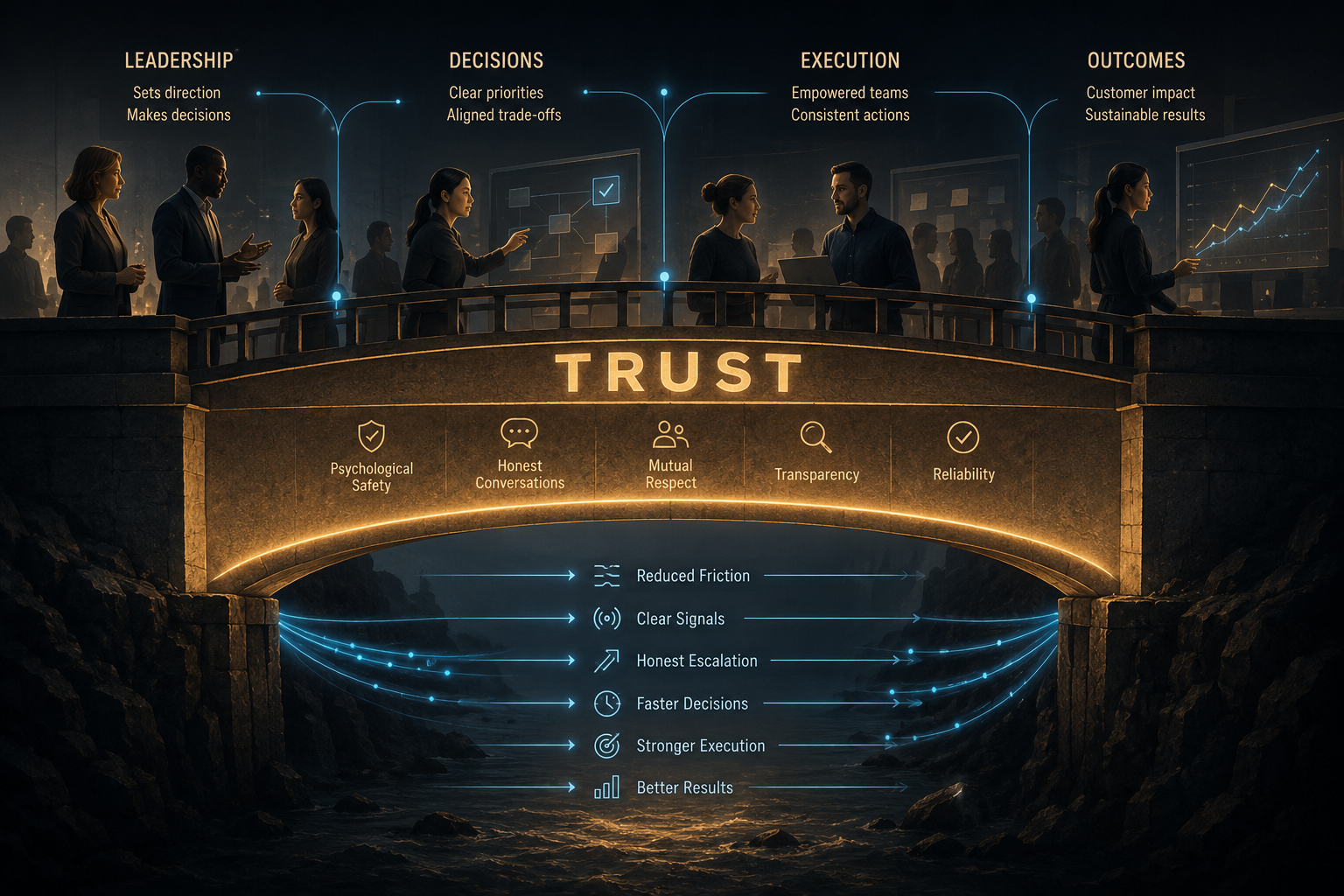
Trust is not softness. Trust is the cheapest operating system an organization will ever install.
Low-trust organizations are expensive.
They require more meetings.
More approvals.
More status.
More follow-ups.
More escalation paths.
More defensive documentation.
More “just checking in” messages that somehow make everyone less calm.
Low trust creates a tax on every interaction.
People hedge.
People protect themselves.
People hold back information until it is safe.
People hide uncertainty because uncertainty gets punished.
People wait to see which way the executive wind is blowing before saying what they already know.
Then leaders wonder why truth arrives late.
Truth arrives late because the organization trained truth to travel with a helmet.
Trust changes the economics.
When trust is high, people surface risks earlier.
They ask for help sooner.
They challenge work without turning every disagreement into a loyalty test.
They admit what they do not know.
They can hear hard news without immediately looking for someone to blame.
Trust does not remove accountability.
Trust makes accountability possible.
A 2026 Psychology Today piece on leading through uncertainty argues that ambiguity erodes focus, fuels burnout, and chips away at trust; it recommends transparent communication, clear goals, predictability, and connection as leadership practices that reduce uncertainty’s toll. source
That is the practical side of empathy.
Empathy is not a leader lowering standards so everybody feels nice.
Empathy is understanding the human cost of the operating environment and leading in a way that reduces unnecessary friction.
It is noticing when people are overloaded before they become brittle.
It is explaining the why, not just barking the what.
It is telling the truth without making truth unsafe.
It is knowing the difference between pressure that focuses a team and pressure that slowly turns people into ash with laptops.
That is leadership.
No scented candle required.
The Human Touch Is Now Strategic
The old-school view treated human-centered leadership like a personality preference.
Some leaders were “people leaders.”
Other leaders were “results leaders.”
That distinction was always suspicious.
Results come from people.
If the people are confused, exhausted, mistrustful, cynical, or quietly scanning job boards during the all-hands, the results problem is already in motion.
The modern workplace has raised the stakes.
Employees are navigating AI uncertainty, restructuring risk, economic pressure, political tension, hybrid work friction, career anxiety, and the general sense that the future keeps arriving with fewer instructions and worse lighting.
ATD’s 2026 talent development forecast describes organizational uncertainty and AI recalibration as drivers of employee anxiety, and argues that soft skills and the quality of employee-to-employee relationships will be critical to organizational success. source
This does not mean leaders need to become therapists.
It means leaders need to stop pretending emotion is outside the operating model.
People bring uncertainty to work because people are not warehouse equipment.
People notice layoffs.
People notice vague executive language.
People notice when AI is described as empowerment in one sentence and cost reduction in the next.
People notice when values get quoted during town halls and ignored during tradeoffs.
People notice when leaders say “we care about burnout” while adding another priority with no subtraction.
The human touch is strategic because people are watching for coherence.
They are asking:
Do leaders mean what they say?
Do decisions match stated values?
Will honesty be punished?
Does my work matter?
Am I safe enough to tell the truth?
Is there a plan, or are we just renaming panic as agility?
If leaders do not answer those questions through behavior, employees will answer them through self-protection.
And self-protection is a very expensive culture.
Leadership Debt in the Age of AI
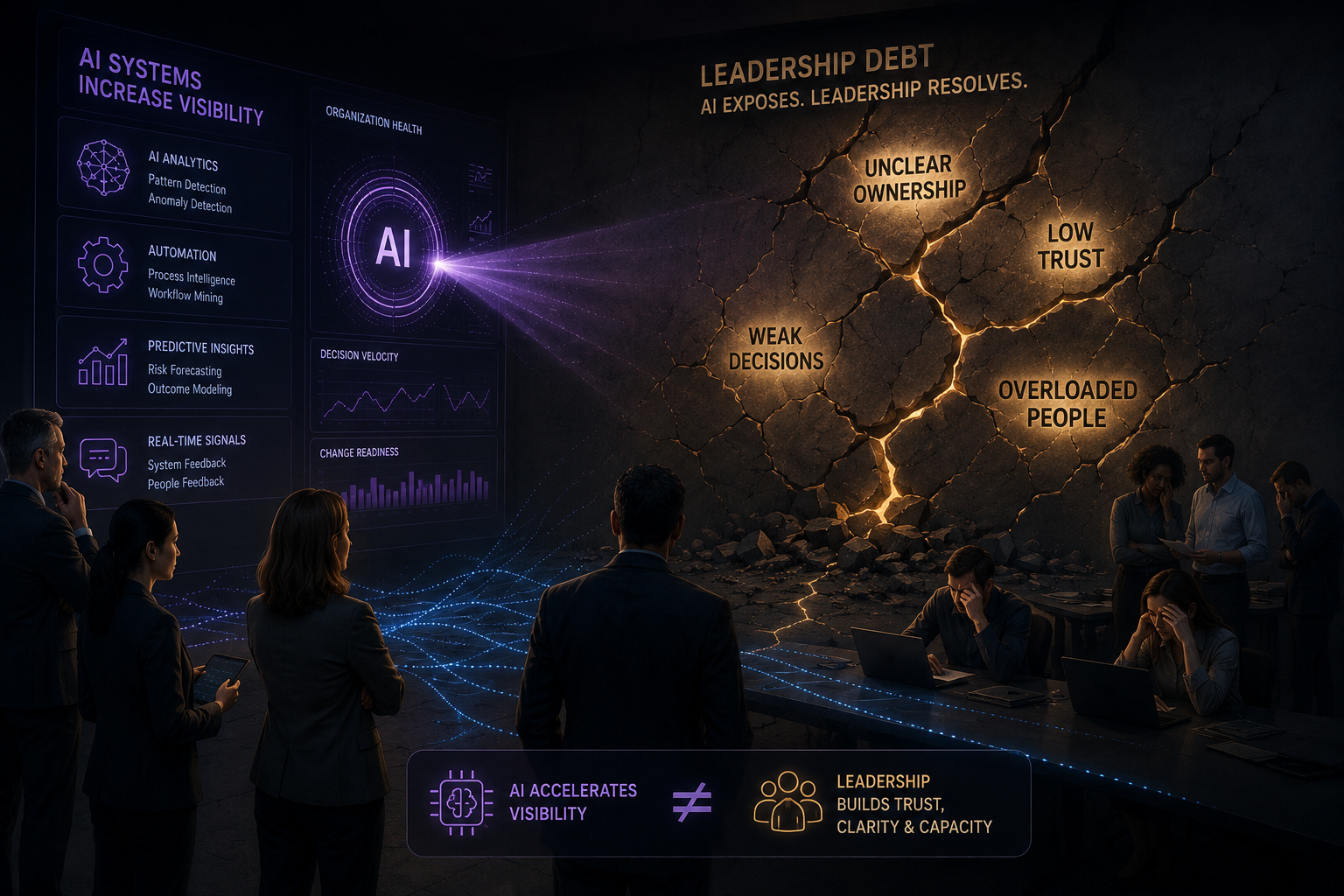
AI will expose leadership debt faster than it will fix it.
AI will not make leadership debt disappear.
AI will reveal it.
Faster.
With charts.
A team with unclear decision rights will not become aligned because someone added copilots.
A low-trust culture will not become candid because a model summarized the meeting.
A leader who avoids tradeoffs will not become courageous because an agent generated three options.
A governance process built on theater will not become disciplined because the dashboard now has purple gradients and a confidence score.
AI can accelerate work.
AI can improve visibility.
AI can summarize, classify, detect, draft, compare, and recommend.
Useful.
Powerful.
Worth learning.
But AI does not absolve leaders from the human work.
If anything, AI makes the human work more important.
Because as more work becomes automated, the remaining human work becomes more judgment-heavy, trust-heavy, context-heavy, and ambiguity-heavy.
Leaders will need to decide what should be automated and what should remain human.
They will need to explain why.
They will need to help people learn without making every learning curve feel like a performance threat.
They will need to create environments where people can question AI outputs, challenge assumptions, and escalate risk without being labeled blockers.
They will need to lead through the awkward middle, where AI is powerful enough to change work but not magical enough to fix broken leadership.
That middle is where leadership debt comes due.
What Good Looks Like
A low-debt leadership system feels different.
It does not feel perfect.
Perfect is not available.
It feels clearer.
People know what matters.
People know who owns what.
People know which decisions have been made.
People know which decisions are still open.
People know what was deprioritized.
People know how to escalate without performing a ritual sacrifice to the governance gods.
Leaders explain tradeoffs.
They do not hide every hard truth behind optimism paste.
They give context before asking for commitment.
They do not confuse pressure with clarity.
They listen early enough for listening to matter.
They are predictable in values, even when the plan changes.
They absorb ambiguity where they can and translate ambiguity where they must.
They do not export every unresolved executive tension downward and call it empowerment.
A low-debt leadership system produces:
- fewer fake priorities
- faster decisions
- clearer ownership
- better escalation hygiene
- less defensive status reporting
- more honest risk conversations
- fewer mystery meetings
- stronger follow-through
- more resilient teams
- less heroic rescue behavior
- better trust between strategy and execution
The test is simple.
When pressure rises, does the organization get clearer or foggier?
When bad news surfaces, does leadership get curious or punitive?
When priorities collide, does someone make a tradeoff or does everyone pretend physics has been suspended?
When people are tired, does the organization adjust or decorate the exhaustion with wellness language?
That is where leadership debt shows up.
Not in the slogan.
In the behavior.
The Practical Test
Before blaming execution, leaders should ask themselves a few uncomfortable questions:
- Have we made the real decision, or are we managing around the decision we avoided?
- Can teams explain the priority in the same way without a translator?
- What did we explicitly stop doing when we added this new priority?
- Who owns the outcome?
- Who owns the tradeoff?
- Where is ambiguity being absorbed, and where is ambiguity being exported?
- What bad news are people afraid to tell us?
- Are we rewarding honesty or optimism theater?
- Do our values survive contact with resource decisions?
- Are our strongest people performing leadership integration work that should not depend on heroics?
- Do people trust that escalation will lead to help instead of punishment?
- Where are we using process to avoid courage?
- Where are we calling exhaustion commitment?
- Where are we calling confusion agility?
- Where are we calling silence alignment?
Those questions are not soft.
Those questions are operational.
They are also uncomfortable, which is how you know they are probably worth asking.
Where This Points Next
The next generation of leadership will require more than strategic language and delivery pressure.
Leaders will need the range to operate in two modes at once.
They will need to be commercially sharp and deeply human.
They will need to move fast and create steadiness.
They will need to embrace AI while protecting judgment.
They will need to demand accountability without making honesty unsafe.
They will need to hold the line on outcomes while understanding that people are carrying more uncertainty than many organizations want to admit.
That is the art and science of leadership.
The science is the operating discipline: decisions, roles, metrics, governance, feedback loops, incentives, and execution rhythms.
The art is the human read: timing, tone, trust, empathy, courage, presence, and knowing when the room is saying yes because the room is afraid to say anything else.
Ignore the science and leadership becomes vibes.
Ignore the art and leadership becomes machinery with a pulse.
Neither is enough.
Final Thoughts
Leadership debt always comes due.
You can hide it for a while.
You can rename it.
You can bury it under dashboards, transformation updates, leadership offsites, and the kind of strategy language that sounds expensive but somehow says nothing.
But eventually, the debt shows up in the work.
It shows up in slow decisions.
It shows up in risk discovered too late.
It shows up in exhausted teams.
It shows up in leaders who say everything is important and then act surprised when nothing moves fast enough.
It shows up in the meeting after the meeting.
It shows up in the silence after someone asks for concerns.
It shows up when the strongest people get tired of being the glue.
Technical debt slows systems.
Leadership debt slows organizations.
Both can be managed.
Both require honesty.
Both require investment.
Both punish denial.
The difference is that technical debt usually waits for the system to break.
Leadership debt walks into every meeting with you.
And if leaders do not pay it down on purpose, the organization pays it down through friction, delay, cynicism, and churn.
That is a terrible financing model.
Join the Conversation
Where have you seen leadership debt show up?
Unmade decisions?
Fake priorities?
Exhausted high performers serving as the glue?
Teams afraid to surface bad news?
“Alignment” that was really just silence with better manners?
Or the classic favorite: a transformation program that had enough dashboards to land a plane but not enough trust to tell the truth?
I would love to hear the real-world version.
Not the leadership poster version.
The version from the room where everyone knew the decision was dead, but the meeting still had twenty-three minutes left.
About the Author
Joe Mack is a Technology Consulting Senior Principal specializing in technology leadership, enterprise SDLC transformation, release management, deployment governance, and delivery optimization for household name Financial Services companies. Joe is also a lifelong self-learner and builder of systems, and Free Tier Life is one of the ways he is trying to turn those experiences and instincts into something other people can actually use.
Bibliography
- DDI. “Leadership Trends 2026: What’s Next for Leaders and Organizations.” November 21, 2025.
- American Psychological Association. “Workers are facing an age of uncertainty.” January 1, 2026.
- Psychology Today. “Leading Through Uncertainty at Work.” January 8, 2026.
- Association for Talent Development. “2026: A Year of Uncertainty and Anxiety in Talent Development.” March 9, 2026.