
Orchestrators, Not Operators: What Financial Services Needs from Technology Leaders Right Now
Published on Jul 20, 2026
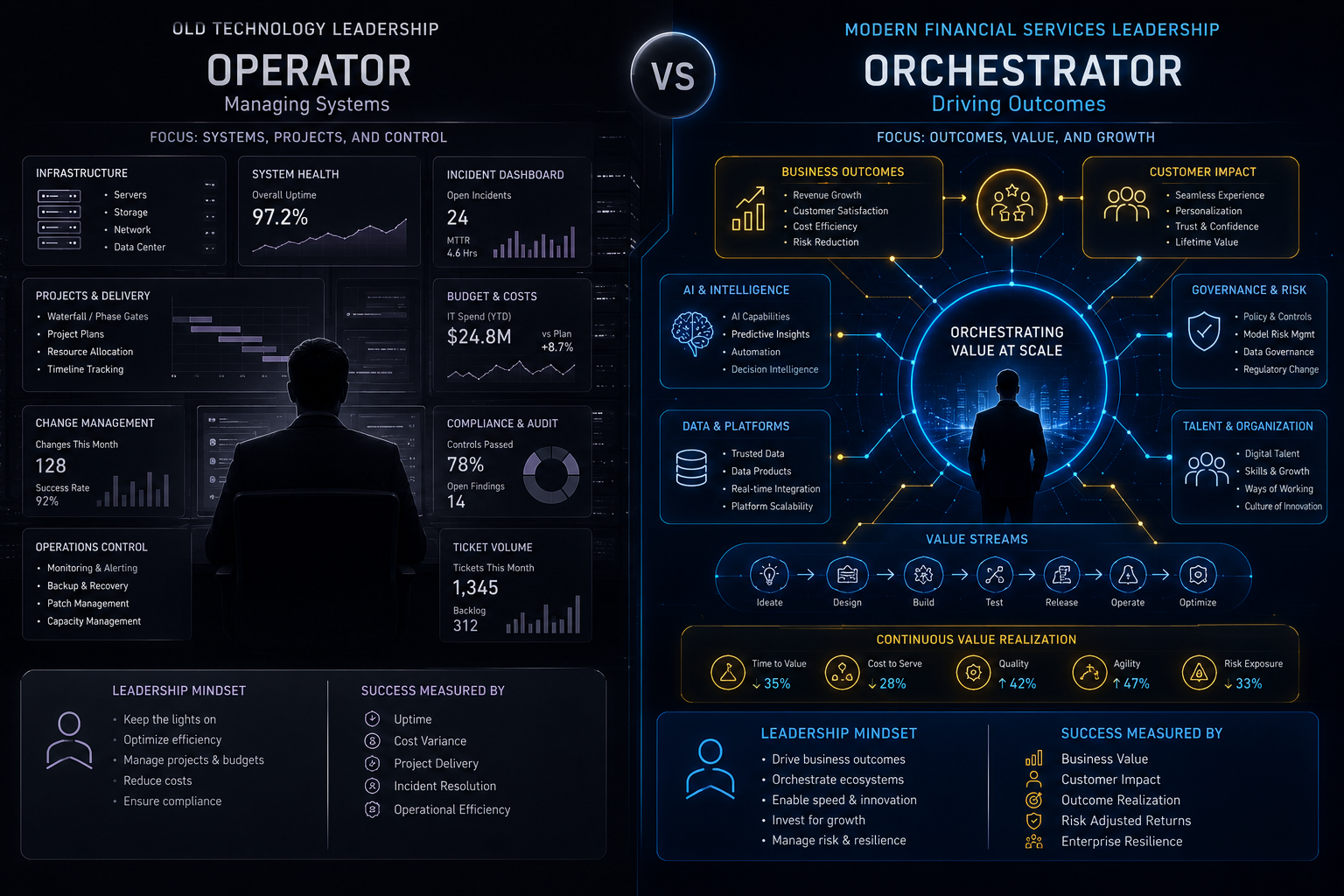
Orchestrators, Not Operators
What Financial Services Needs from Technology Leaders Right Now
The technology leader’s job has moved from operating the machine to orchestrating the system.
There was a time when a technology leader could be considered successful by keeping the lights on, managing delivery, controlling cost, avoiding major outages, and making sure the board did not learn a new acronym during an incident call.
That time is gone.
Financial Services technology leaders are now being asked to do something much harder.
They have to modernize legacy platforms, scale AI responsibly, protect operational resilience, manage cyber risk, reduce cost, improve customer experience, accelerate delivery, satisfy regulators, attract talent, and prove business value.
Preferably by Friday COB.
The old job was difficult. The new job is weirdly unreasonable.
It is also the job now.
Deloitte’s 2026 Global Technology Leadership Study puts language around the shift: 79% of technology leaders cite driving business outcomes as their top priority, 81% express confidence that they can scale AI, and 75% say their operating model must fundamentally change to drive greater value. Deloitte also frames the leadership shift as moving from “operators to orchestrators,” with leadership becoming less about authority and more about coordination across a distributed technology C-suite. source
That is the right word.
Orchestration.
Not because it sounds shiny in a keynote.
Because the modern Financial Services technology leader is no longer leading one function, one platform, one portfolio, or one transformation lane.
The leader is coordinating an enterprise system that wants to fragment by default.
Business strategy pulls one way. Risk pulls another. Cyber has concerns. Operations wants stability. Product wants speed. Finance wants proof. Regulators want evidence. Delivery teams want clarity. AI wants data. Legacy platforms want everything to slow down and respect their age.
Somewhere in the middle, a technology leader is expected to turn all of that into enterprise value.
Good luck, and please enjoy all the dashboards.
The Short Version
If you only remember five things from this article, make them these:
- Financial Services technology leadership has shifted from operating systems to orchestrating outcomes.
- AI raises the stakes because it forces decisions about work, governance, risk, data, talent, operating model, and value at the same time.
- Authority alone is too slow for the modern enterprise. Leaders need orchestration mechanisms that connect teams, decisions, signals, and accountability.
- The best technology leaders reduce organizational drag: unclear decision rights, fragmented ownership, slow approvals, tool silos, status theater, and fear-driven escalation.
- The future belongs to leaders who can connect strategy to execution without becoming the bottleneck everyone is secretly routing around.
The Mandate Changed. The Operating Model Did Not.
Here is the problem in one sentence:
Technology leaders are being asked to deliver AI-era enterprise outcomes through operating models built for an earlier age.
That sentence should make a few people uncomfortable.
Good.
Most Financial Services institutions have spent years adding specialized leadership roles: CIO, CTO, CDO, CDAO, CISO, Chief Architect, Head of Engineering, Head of Platforms, Head of AI, Head of Transformation, Head of Whatever We Needed After The Last Steering Committee.
Specialization can help. Financial Services is too complex for one heroic technology leader with a cape and an inbox full of escalations.
But specialization also creates fragmentation when decision rights, funding, governance, delivery, and accountability do not connect.
Deloitte reported that 71% of organizations have five or more technology leaders in the C-suite or equivalent leadership structure. That can bring expertise closer to the business, but without clear coordination mechanisms and decision rights, it can make AI scale harder rather than easier. source
This is where the operator paradigm starts to crack.
The operator paradigm asks:
- Are the systems running?
- Are projects on track?
- Are budgets controlled?
- Are risks reported?
- Are incidents managed?
- Are platforms stable?
Those questions still matter.
Nobody wants visionary leadership from a person who cannot keep the payments platform alive.
But those questions are no longer enough.
The orchestrator model asks a different set of questions:
- Are technology investments tied to measurable business outcomes?
- Are decision rights clear enough to move at enterprise speed?
- Are AI use cases connected to value, risk, and operating model change?
- Are dependencies visible before they become executive escalations?
- Are teams aligned around outcomes instead of local deliverables?
- Are humans and AI being composed into accountable workflows?
- Are governance and resilience designed into delivery rather than discovered at the end?
That is a bigger job.
It is also a different job.
Operators run the machine. Orchestrators connect the system to outcomes.
Why Financial Services Raises the Difficulty Level
Financial Services is not a clean laboratory for leadership theory.
It is a dense, regulated, aging, highly integrated, risk-sensitive operating environment filled with brilliant people, old platforms, new platforms, customer expectations, regulatory obligations, shared services, third-party dependencies, and an irresponsible number of spreadsheets that all claimed to be temporary.
Modern technology leaders in this industry are not just “driving transformation.” That phrase is way too clean.
They are trying to move a living institution into the right future, while actively serving customers, satisfying regulators, fighting fraud, defending against cyber threats, modernizing core systems, and absorbing AI faster than the operating model can digest it.
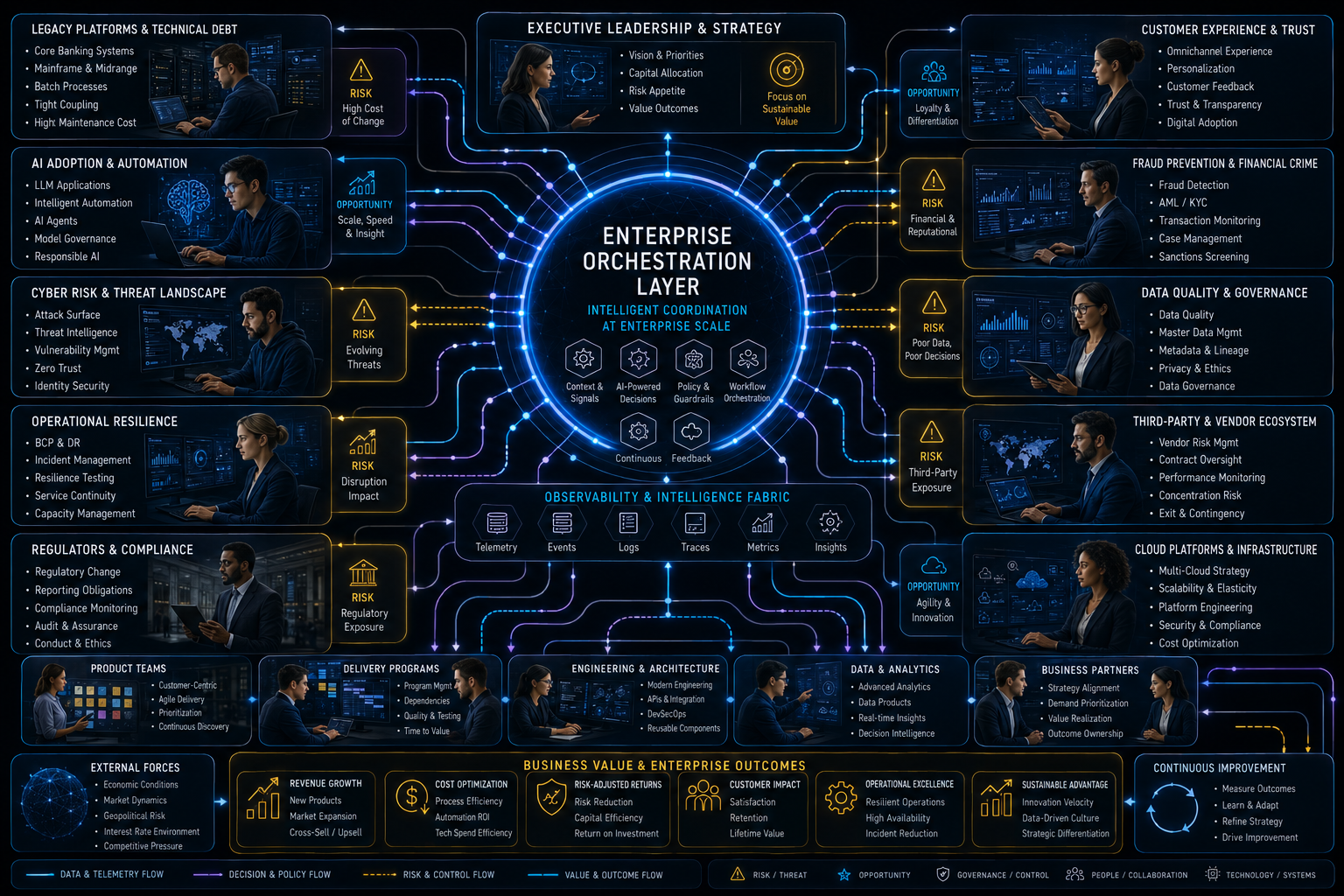
Financial Services does not give leaders one transformation problem. It gives them a system of competing constraints.
The World Economic Forum’s 2026 AI Playbook for Financial Services describes AI as a structural disruption that reaches beyond efficiency gains, reshaping how work is organized, how decisions are made, how value is created, and how firms compete and collaborate. It also argues that the biggest benefits will come from holistic redesign of workflows, organization design, and technology architecture rather than layering AI onto fragmented legacy structures. source
That is, exactly, today’s leadership challenge.
AI is not arriving as a tidy new tool category.
It is pushing on the seams of the enterprise.
Data quality. Model risk. Customer trust. Skills. Funding. Governance. Cyber. Vendor dependency. Auditability. Operating resilience. Workforce design. Technology architecture.
All at once.
Because apparently one transformation at a time was too easy.
Financial Services leaders also have to balance innovation with evidence. AI adoption in a bank, insurer, payments platform, wealth business, or claims environment is not the same as adding a novelty chatbot to a harmless internal wiki.
A bad AI-enabled decision can affect customers, capital, conduct, compliance, operational resilience, fraud exposure, and trust.
That is why “move fast and see what happens” is not a strategy.
It is a liability waiting to happen.
AI Does Not Remove the Need for Leadership. It Exposes the Gaps.
There is a lazy version of the AI leadership conversation that says leaders need to “embrace AI.”
Fine.
They should.
But that is barely the cover charge.
The real question is whether leaders can redesign the system around AI without losing control of value, risk, trust, and accountability.
Deloitte’s operating model research argues that scaling AI is no longer simply a technology challenge; it requires redesigning how the enterprise makes decisions, allocates capital, governs risk, and gets work done. The research also identifies shifts toward integrated technology leadership, human-AI work orchestration, portfolio-based funding, ecosystem co-innovation, and continuous operating model refreshes. source
That is not “install tool, harvest value.”
That is enterprise surgery.
Accenture’s 2026 Financial Services AI leadership perspective makes a similar point from inside the industry: leadership is a decisive factor in AI outcomes, AI cannot sit with one function, the full C-suite must own how AI is used and governed, and leaders need business fluency rather than narrow technical specialization. source
That is where orchestration becomes the leadership muscle.
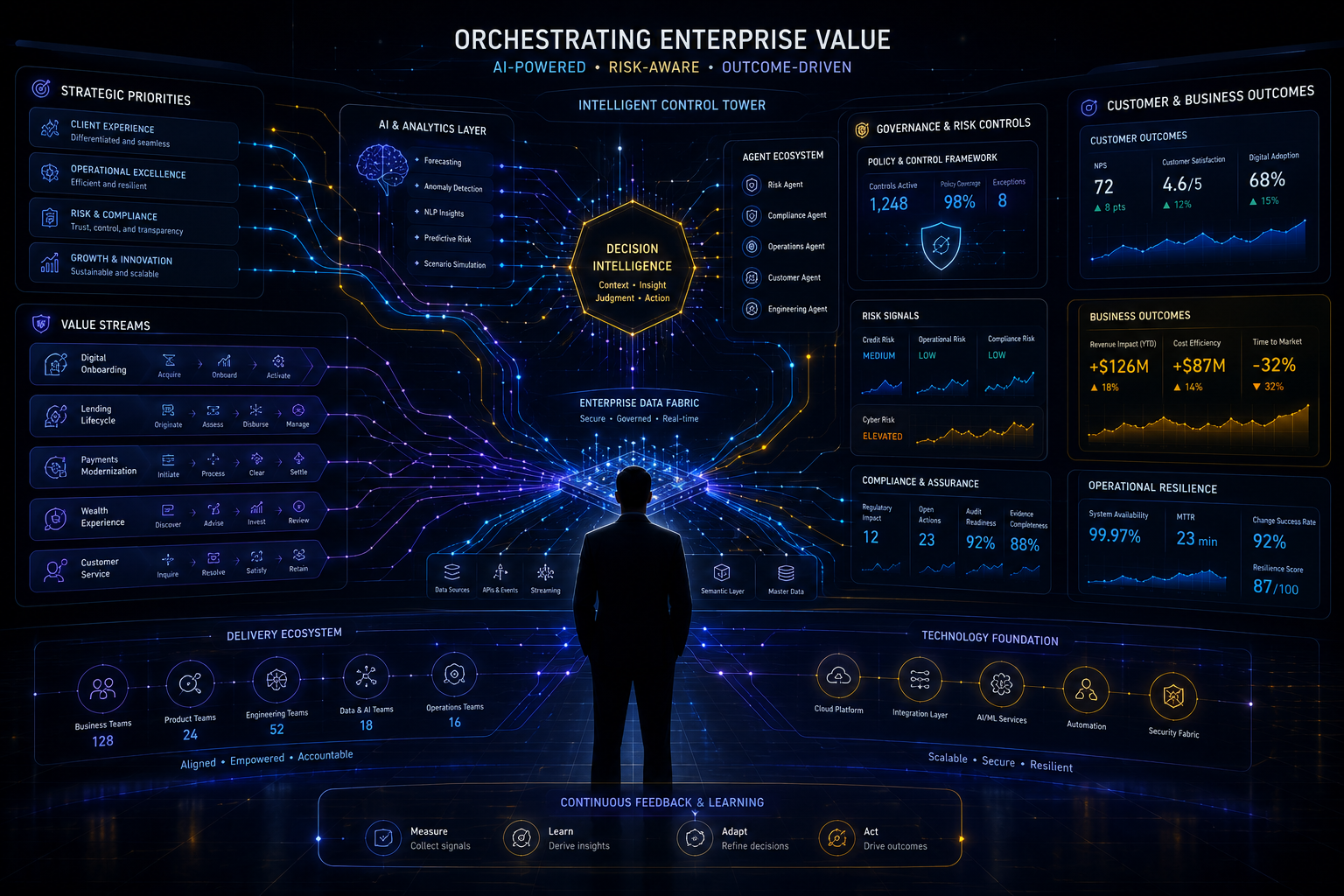
The leader has to connect:
- business ambition
- customer value
- platform realities
- AI capability
- data foundations
- risk appetite
- governance controls
- talent readiness
- operating model change
- adoption behavior
- measurable outcomes
Leave any one of those disconnected and the AI program starts growing strange limbs.
A chatbot here.
A pilot there.
A model risk concern floating in the hallway.
A vendor demo with suspiciously good lighting.
A dashboard full of “productivity gains” nobody can reconcile to the P&L.
That is how AI transformation becomes AI theater.
And Financial Services already has enough theater. Oh, and some of it comes with potential audit consequences.
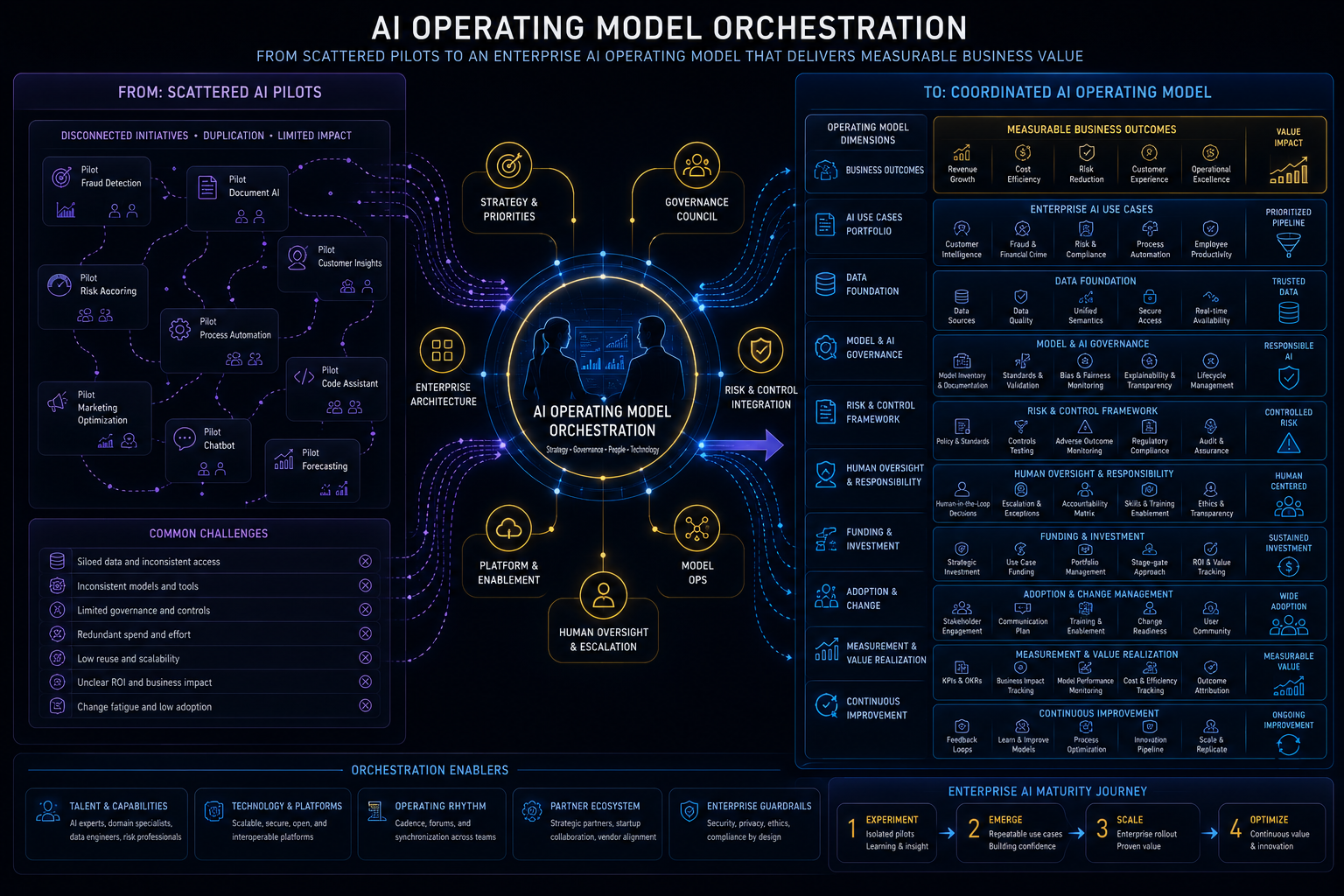
AI value does not come from scattered pilots. It comes from coordinated operating model change.
Authority Is Too Slow. Orchestration Is the Work.
The old leadership instinct is to clarify who owns what and then drive accountability through escalation.
That still has a place.
Decision rights matter. Accountability matters. RACI charts, despite their ability to make the human spirit leave the body, serve a purpose.
But authority alone is too slow in a complex enterprise.
By the time every issue works its way up the hierarchy, gets reframed for executive consumption, comes back down with instructions, and then gets interpreted by seven teams with different local constraints, the original issue has already evolved into a larger, uglier animal.
Orchestration works differently.
It gives the system mechanisms to coordinate without waiting for every decision to become an escalation.
That means:
- shared intent
- clear decision rights
- visible dependencies
- common outcome measures
- risk-based governance
- reusable platforms
- fast feedback loops
- disciplined AI guardrails
- trustable delivery signals
- leadership forums that solve problems instead of admiring status
Authority says, “I approve.”
Orchestration says, “The system knows how to move.”
That distinction matters.
A leader who has to personally unblock every dependency is not leading a high-performing system.
That leader is the system.
And that system is one vacation away from becoming a news story.
The Five Jobs of the Modern Financial Services Technology Leader
The title says “technology leader,” but the job is now much broader than technology.
The modern Financial Services technology leader has at least five jobs, as it see it.
1. Translate technology ambition into business outcomes
The business does not need AI “activity.”
It needs better outcomes.
Faster claims decisions. Lower fraud loss. Better customer experience. Improved advisor productivity. Stronger operational resilience. Reduced cost-to-serve. Faster time-to-market. Better risk decisions. Less manual reconciliation nonsense quietly poisoning everyone’s calendar.
Deloitte’s 2026 study says the value mandate has shifted from uptime to outcomes, with technology leaders now expected to deliver measurable enterprise value across growth, productivity, and customer impact. It also notes that 42% report low or no ROI on AI investments, which is a polite way of saying that AI enthusiasm and AI value are not the same animal. source
The leader has to force the uncomfortable question early:
What business result changes if this works?
If nobody can answer that, there may still be a technology experiment worth running.
But please, for the love of all that is hold, stop calling it transformation.
2. Design the decision system
A large enterprise does not move at the speed of its agile teams.
It moves at the speed of its decisions.
Decision latency kills transformation quietly.
It hides in unclear ownership, duplicated governance, risk avoidance, budget ambiguity, steering committees with no steering, and leaders who confuse “alignment” with “nobody objected out loud.”
The orchestrator’s job is to design the decision system:
- who decides
- who advises
- who owns risk
- who accepts tradeoffs
- what evidence is needed
- what decisions can be delegated
- what decisions require governance
- how fast decisions need to move
- how decisions are recorded and revisited
This is not glamorous work.
Neither is plumbing.
Try living without it.
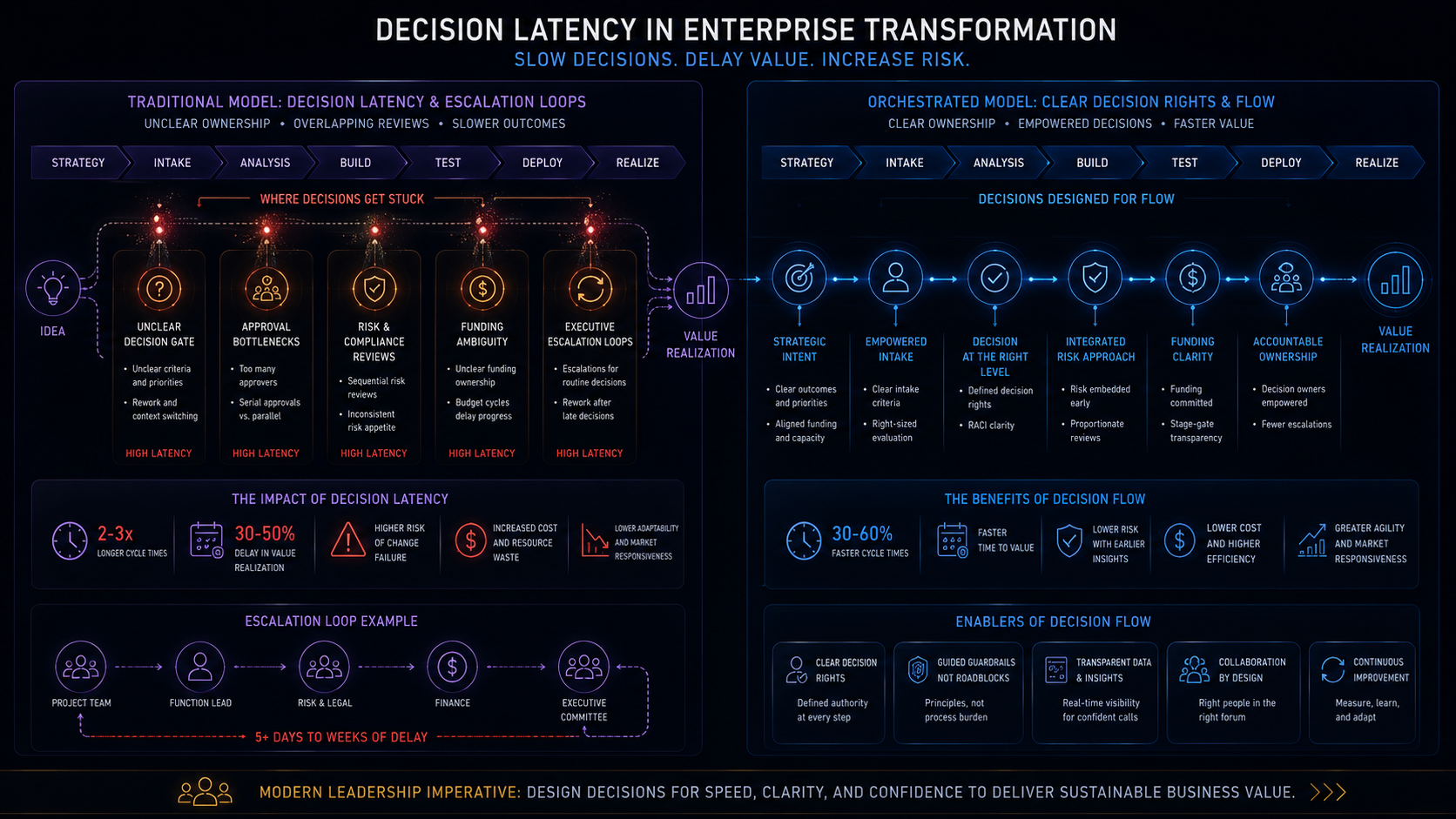
Large enterprises rarely move at the speed of their teams. They move at the speed of their decisions.
3. Build trustable AI adoption
AI adoption in Financial Services has to be fast enough to matter and disciplined enough to trust.
That is a hard balance.
The WEF AI Playbook argues that risk management and responsible AI must be embedded at every layer, with risk appetite defined early, models validated rigorously, and AI actions made explainable, traceable, and controllable. source
That is the kind of sentence that sounds obvious until someone tries to scale AI through fifteen disconnected pilots and a PowerPoint called “AI Factory.”
AI leadership demands judgment about where AI belongs, where deterministic automation is enough, where human review is non-negotiable, and where the organization is simply not ready.
Trust is not created by declaring something “responsible.”
Trust is created by evidence, controls, transparency, and behavior over time.
I know. Annoying, right?
4. Reduce organizational drag
Great technology leaders remove friction.
Not all friction. Some friction is useful. Risk review, architectural discipline, control evidence, and security scrutiny exist for reasons.
Useless friction is different.
It looks like:
- work waiting on unclear approvals
- teams maintaining duplicate status artifacts
- executives seeing five dashboards and still asking what is true
- product, risk, technology, and operations using different definitions of success
- initiatives funded as temporary projects while leaders demand enduring product outcomes
- AI teams trying to scale models without data ownership, platform standards, or adoption muscle
That is organizational drag.
It drains momentum while everyone remains technically busy.
The orchestrator does not simply yell “move faster.”
The orchestrator asks where the system is wasting energy and then redesigns the mechanism.
Less sermon. More system repair. More optimization.
5. Create conditions for people to lead with AI
AI does not only change work.
It changes how people feel about work.
Some people will be excited. Some will be skeptical. Some will quietly wonder whether the new “coworker” is actually a polite eviction notice for their job.
A leader who ignores that human layer will get compliance, not adoption.
Accenture’s Financial Services AI leadership perspective emphasizes that leaders must build AI fluency, lead people through change, create trust, and help teams apply AI to real business opportunities rather than leaving AI as a specialist topic off to the side. source
This does not mean every executive needs to become an AI researcher.
Please do not make every executive become an AI researcher.
We have enough problems.
But leaders do need enough fluency to ask better questions, define better problems, spot fake value, pressure-test vendor claims, and understand where human judgment must stay in the loop.
AI-forward leadership is not about replacing human leadership.
It is about making leadership more honest about where humans add judgment, where machines add leverage, and where the operating model needs to stop pretending the org chart is the workflow.

The modern technology leader does not own every piece. The modern technology leader makes the pieces work together.
Where Leaders Get This Wrong
The mistakes are often predictable, and always expensive.
They manage status instead of system conditions
Status is a shadow.
The entire delivery system is the thing that is casting the shadow.
A green dashboard might mean the work is healthy.
It might also mean nobody has asked a specific enough question yet.
Leaders get into trouble when they manage the dashboard instead of the conditions that produce the dashboard: decision latency, dependency friction, unclear ownership, weak evidence, overcommitted teams, fragile platforms, and incentives that reward local optimization.
Managing status is neat and clean.
Managing system conditions is messy.
Care to guess which one actually works?
They confuse AI adoption with AI value
An organization can have thousands of people using AI tools and still have no coherent AI value story.
Usage is not value.
Pilot volume is not value.
Conference-room enthusiasm is definitely not value, although it does pair nicely with branded lanyards.
Value shows up when AI changes a measurable outcome: speed, quality, risk, customer experience, operating cost, revenue, resilience, or decision effectiveness.
If the metric is “number of AI ideas submitted,” congratulations, you have measured enthusiasm.
Now measure whether anything got better.
They let governance arrive late
AI, delivery, and transformation all suffer when governance arrives as a late-stage review instead of an embedded design constraint.
In Financial Services, late governance is not just annoying.
It is expensive.
It creates rework, delays, risk acceptance theater, and one of the most depressing phrases in enterprise life: “We need to socialize this again.”
No one wants to socialize it again.
They want the system to have caught the issue earlier.
They become the bottleneck
Some leaders confuse being central with being valuable.
They want every decision routed through them.
They want every status update tailored to them.
They want every escalation to prove their importance.
That might feel powerful.
It is also a great way to build a low-throughput organization with excellent meeting attendance.
The best leaders create systems that keep moving without requiring their fingerprints on every motion.
If the system freezes when the leader is unavailable, that is not leadership.
That is dependency management with a title.
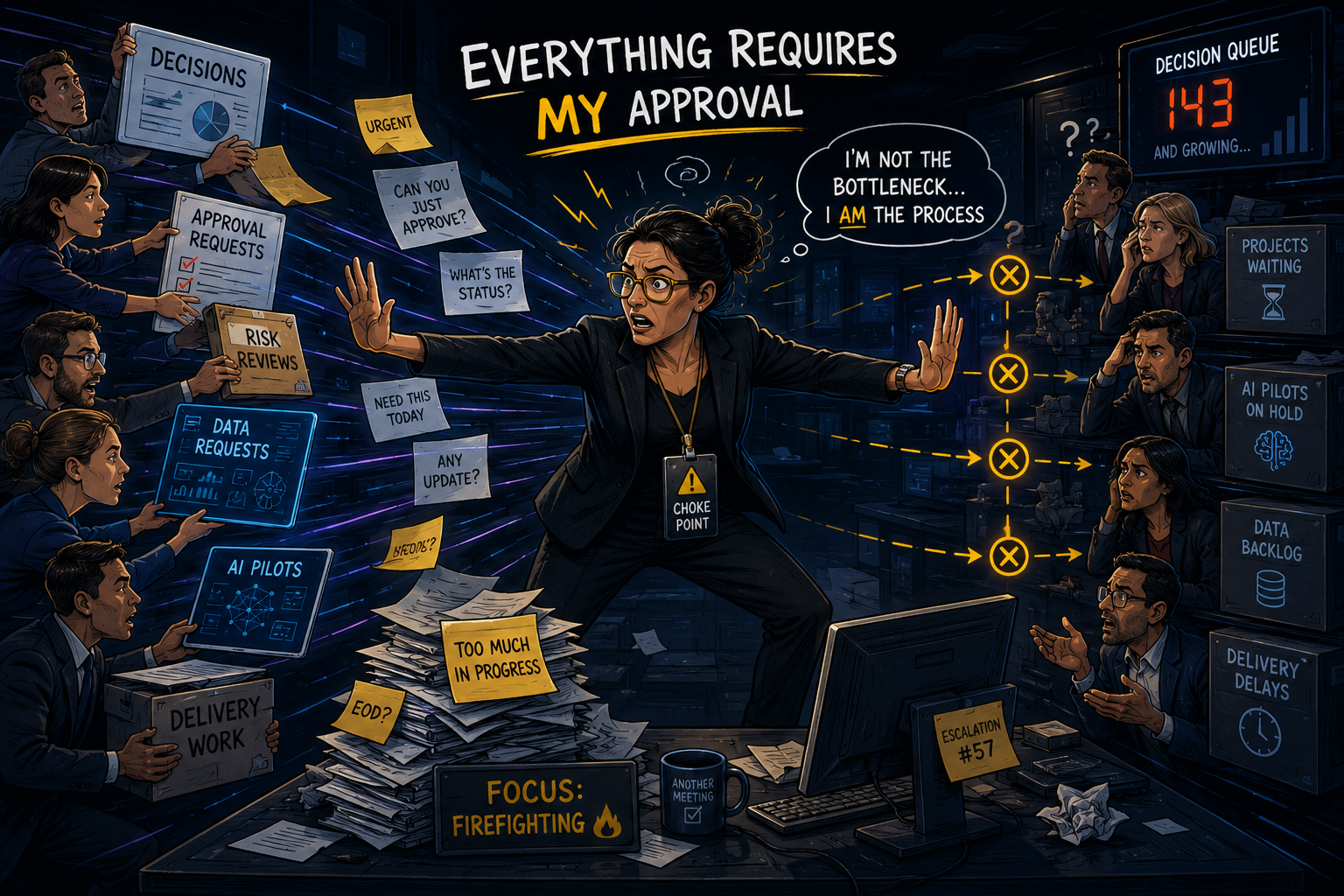
If the system freezes when one leader is unavailable, that is not leadership. That is dependency management with a title.
What Good Looks Like
A good orchestrator creates a system where people can move with clarity.
Not chaos, heroics, and endless escalations.
Clarity.
You can actually feel this when it is working.
Teams understand the outcome.
Decision rights are clear.
Risks surface early.
Dependencies do not hide in meeting notes.
Governance has teeth without becoming a paperwork swamp.
AI use cases are linked to measurable value.
Humans know where judgment matters.
The operating model teaches people how to move instead of forcing them to ask permission for every step.
Good technology leadership in Financial Services should produce:
- faster decisions
- fewer artificial handoffs
- clearer accountability
- stronger risk ownership
- better delivery signals
- more disciplined AI scaling
- less status theater
- more value traceability
- fewer heroic rescues
- more trust in the system
That last one matters.
Trust in the system is a leadership outcome.
If every important answer requires calling the one person who “just knows,” the system is not mature.
It is surviving on luck, which is, shall we say, a potentially career-limiting operating strategy.
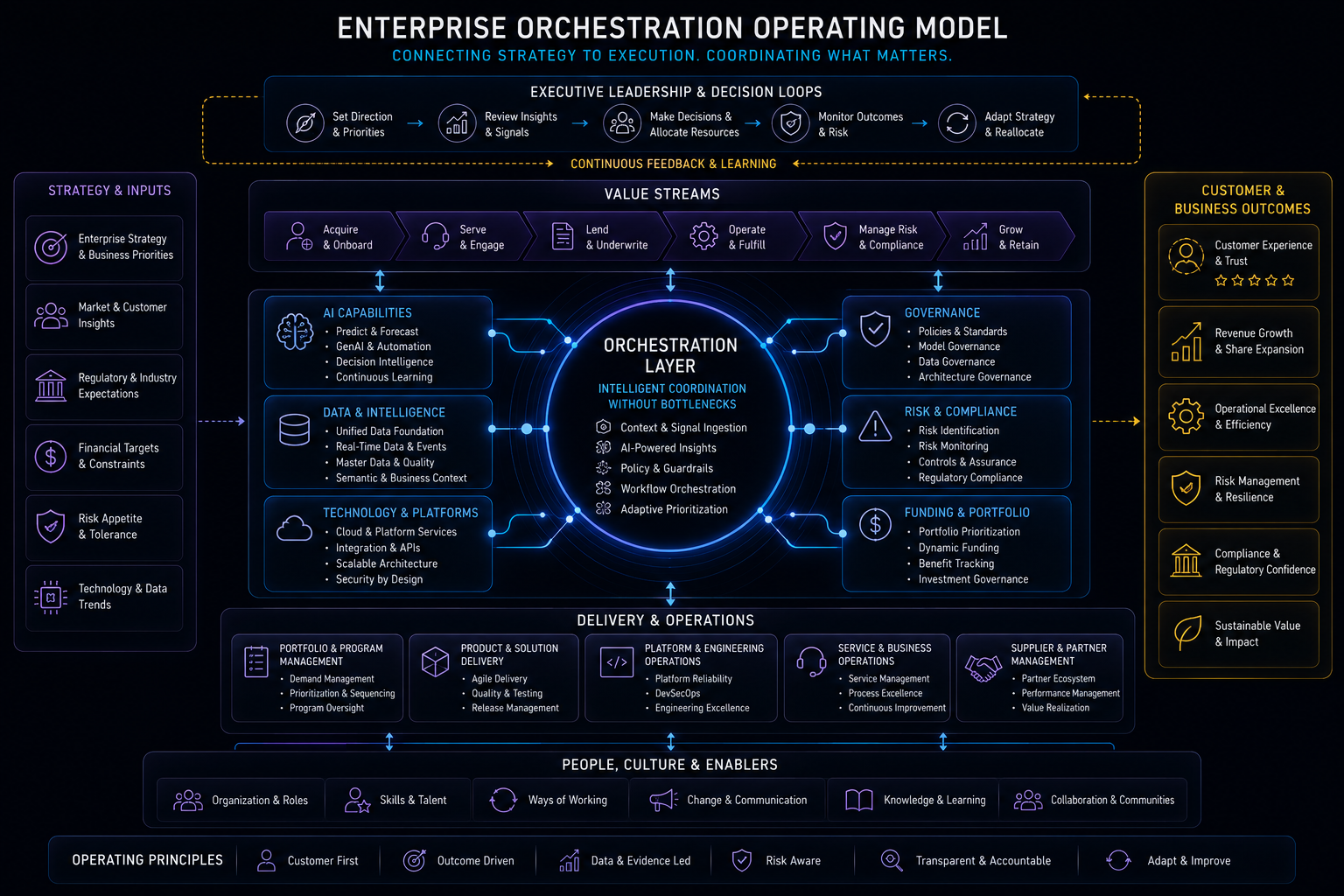
Good orchestration makes the work move without turning the leader into the workflow.
The Leadership Shift: From Control to Coordination
The best Financial Services technology leaders I have seen are not passive coordinators.
They are not calendar jockeys.
They are not ceremonial approvers floating above the delivery system waiting for status to arrive.
They are active designers of how work, decisions, risk, evidence, talent, and technology move through the enterprise.
They understand that control does not always come from holding every decision.
Sometimes control comes from designing the system so the right decisions happen closer to the work, with the right evidence, at the right time, inside the right guardrails.
That is orchestration.
Not softer leadership.
Better leadership.
The orchestra analogy is useful up to a point, but enterprise technology is not a symphony.
A symphony has sheet music.
Financial Services transformation has legacy platforms, vendor dependencies, regulator questions, underfunded data remediation, unplanned production issues, AI pilots with unclear ROI, and somebody’s spreadsheet pretending to be a portfolio management system.
So maybe the better image is less “conductor with a baton” and more like “air traffic controller during a thunderstorm.”
Still, the principle holds.
The leader does not personally fly every plane.
The leader makes sure the system knows how to land them.
Final Thoughts
Financial Services technology leadership has entered a new era.
The job is no longer just running systems.
The job is orchestrating enterprise value through systems that are becoming more interconnected, more AI-enabled, more risk-sensitive, and less forgiving of leadership drift.
That is hard.
It should be hard.
If it were easy, every institution with a transformation office and a tasteful slide template would already be winning.
The leaders who matter now will be the ones who can connect ambition to execution.
They will understand AI without worshipping it.
They will value governance without hiding inside it.
They will chase speed without sacrificing trust.
They will reduce drag instead of adding theater.
They will build systems where humans and machines both have clear roles, clear guardrails, and clear accountability.
The operator kept the machine running.
The orchestrator makes the enterprise move.
Financial Services needs a lot more skilled orchestrators.
Right now.
Join the Conversation
What does orchestration look like in your organization?
Is technology leadership still measured mostly by delivery status, cost, and platform stability?
Or is the mandate shifting toward business outcomes, AI adoption, operating model change, and enterprise value?
Where does leadership create the most leverage?
Decision clarity?
Dependency management?
AI governance?
Talent development?
Reducing organizational drag?
Or simply telling the truth before the dashboard gets creative?
I would love to hear the real-world version.
Not the leadership-book answer.
The version from the messy middle, where strategy, delivery, risk, and AI all collide before lunch.
About the Author
Joe Mack is a Technology Consulting Senior Principal specializing in technology leadership, enterprise SDLC transformation, release management, deployment governance, and delivery optimization for household name Financial Services companies. Joe is also a lifelong self-learner and builder of systems, and Free Tier Life is one of the ways he is trying to turn those experiences and instincts into something other people can actually use.
Bibliography
- Deloitte. “From Operators to Orchestrators: Deloitte’s 2026 Global Technology Leadership Study Reveals a New Mandate for Tech Leaders.” April 30, 2026.
- Deloitte. “Rewiring the Enterprise Operating Model for AI Scale.” June 29, 2026.
- World Economic Forum, in collaboration with Accenture. “The AI Playbook for Financial Services.” June 2026.
- Accenture Banking Blog. “AI Implications for Leadership, Culture and Operating Models in Financial Services.” April 1, 2026.