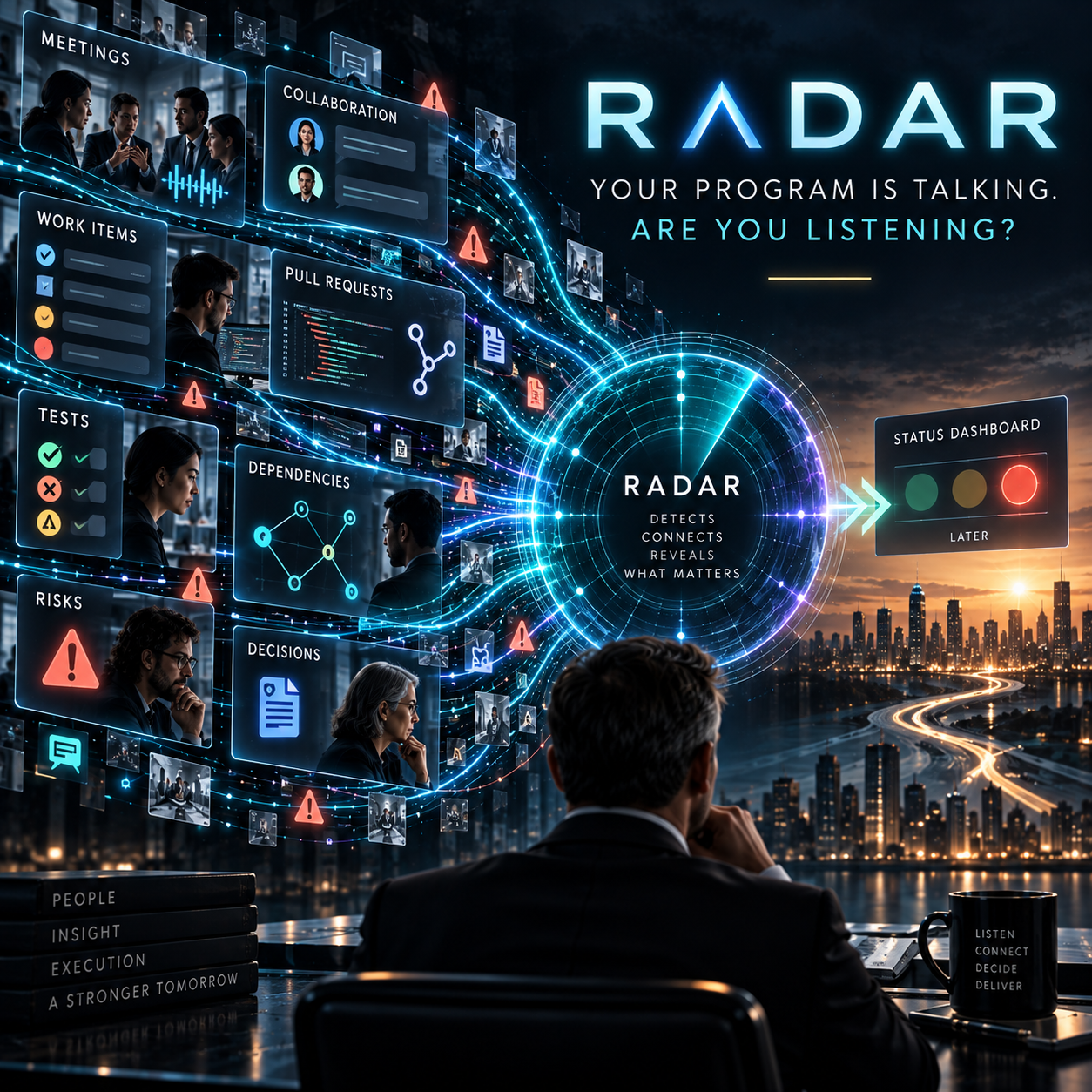
RADAR: Your Program Is Talking. Are You Listening?
Published on Sep 15, 2026
RADAR
Your Program Is Talking. Are You Listening?
The program usually tells you what is going wrong before the official status does. The problem is that the warning arrives in six tools, four meetings, and one Teams thread that everyone assumed somebody else was reading.
Every complex program has a moment when the room discovers that the surprise was not actually a surprise.
The dependency had been mentioned for three weeks.
The test environment had been “almost ready” since last Tuesday.
A developer questioned the edge case in a pull request. Operations raised a concern in a release chat. The defect trend moved in the wrong direction. A decision stayed open long enough to qualify for a service anniversary award.
Then the executive status turns red and everyone begins performing archaeology to gather evidence from multiple sources of information that the program organically produced in plain sight.
There is no shortage of information. There never is.
The problem lies in the signals.
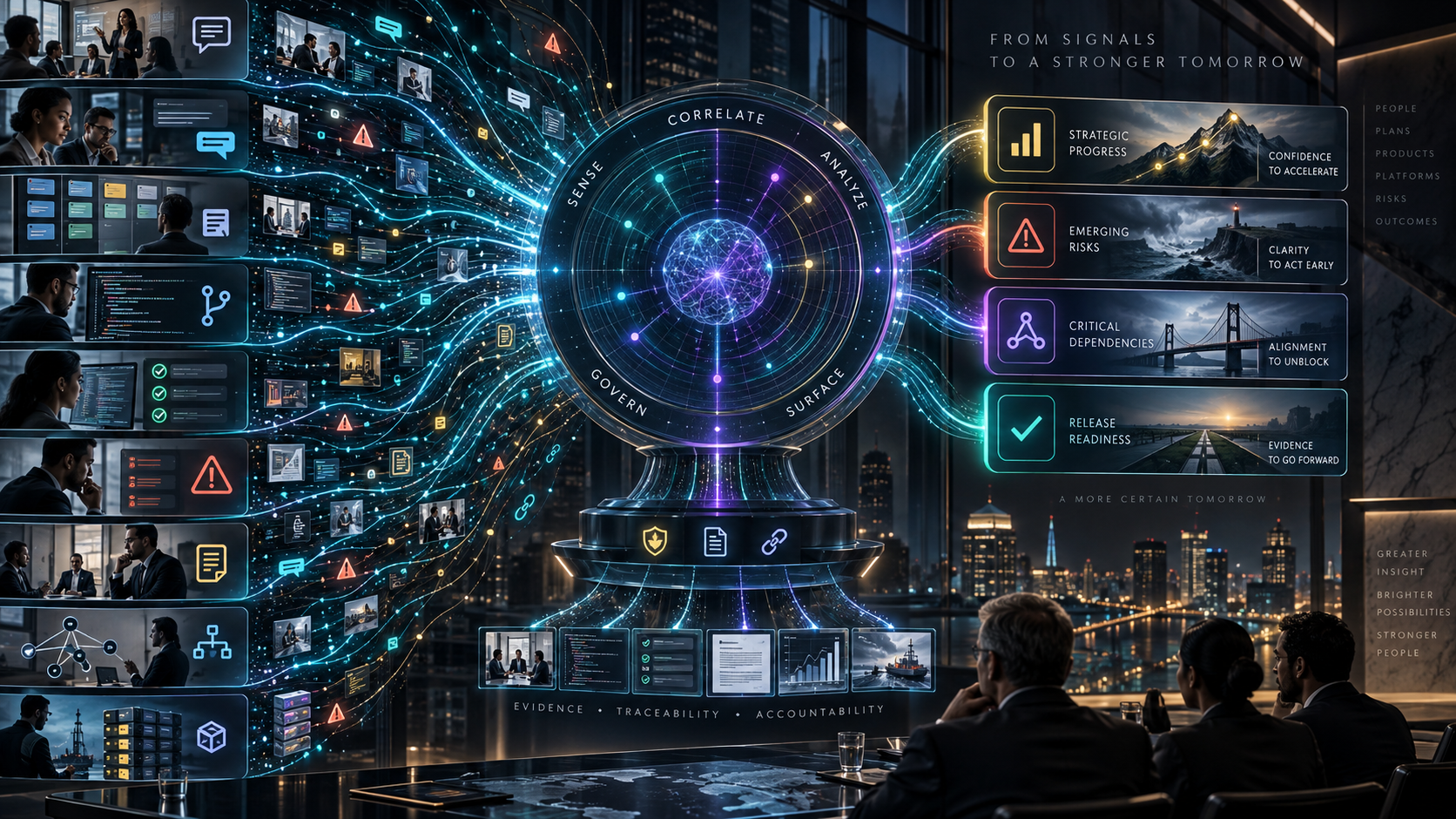
Enterprise programs generate signals all day long through meetings, work items, collaboration channels, pull requests, tests, risks, issues, decisions, dependencies, controls, release evidence, and the occasional sentence that begins with, “This is probably fine, but…”
Some of those signals are noise. Some are isolated inconveniences. Some are early warnings. A few are the first visible cracks in the thing that will break wide open while everyone pretends it is a total surprise.
The program needs a way to tell the difference.
That is the idea behind RADAR: Risk and Delivery Analytics Relay.
RADAR is an aspirational program intelligence capability designed to detect, classify, correlate, and relay delivery signals before they become late-stage surprises. It does not replace program leadership, governance, delivery tools, or human judgment. It gives those things a better chance of seeing what the work has already been trying to say.
Because the status deck is often the last place reality arrives before the steering committee.
The Short Version
If you only remember six things from this article, make them these:
- Enterprise programs rarely lack information. They lack a disciplined way to identify which information is becoming operationally meaningful.
- CLEAR preserves intent so the enterprise remembers what the work is supposed to accomplish.
- The Signal Taxonomy gives teams and systems a shared vocabulary for risks, actions, issues, dependencies, decisions, deferrals, blockers, evidence gaps, ownership gaps, intent drift, and other weak signals.
- RADAR applies that vocabulary across program artifacts to detect recurrence, aging, acceleration, concentration, and connection.
- The full automation continuum belongs in the design: deterministic rules for known conditions, analytics for patterns, generative AI for synthesis, agentic investigation for bounded ambiguity, and humans for judgment.
- BRIDGE connects the broader thread from intent through signals, governance, evidence, readiness, and realized value.
Your Program Is Already Broadcasting
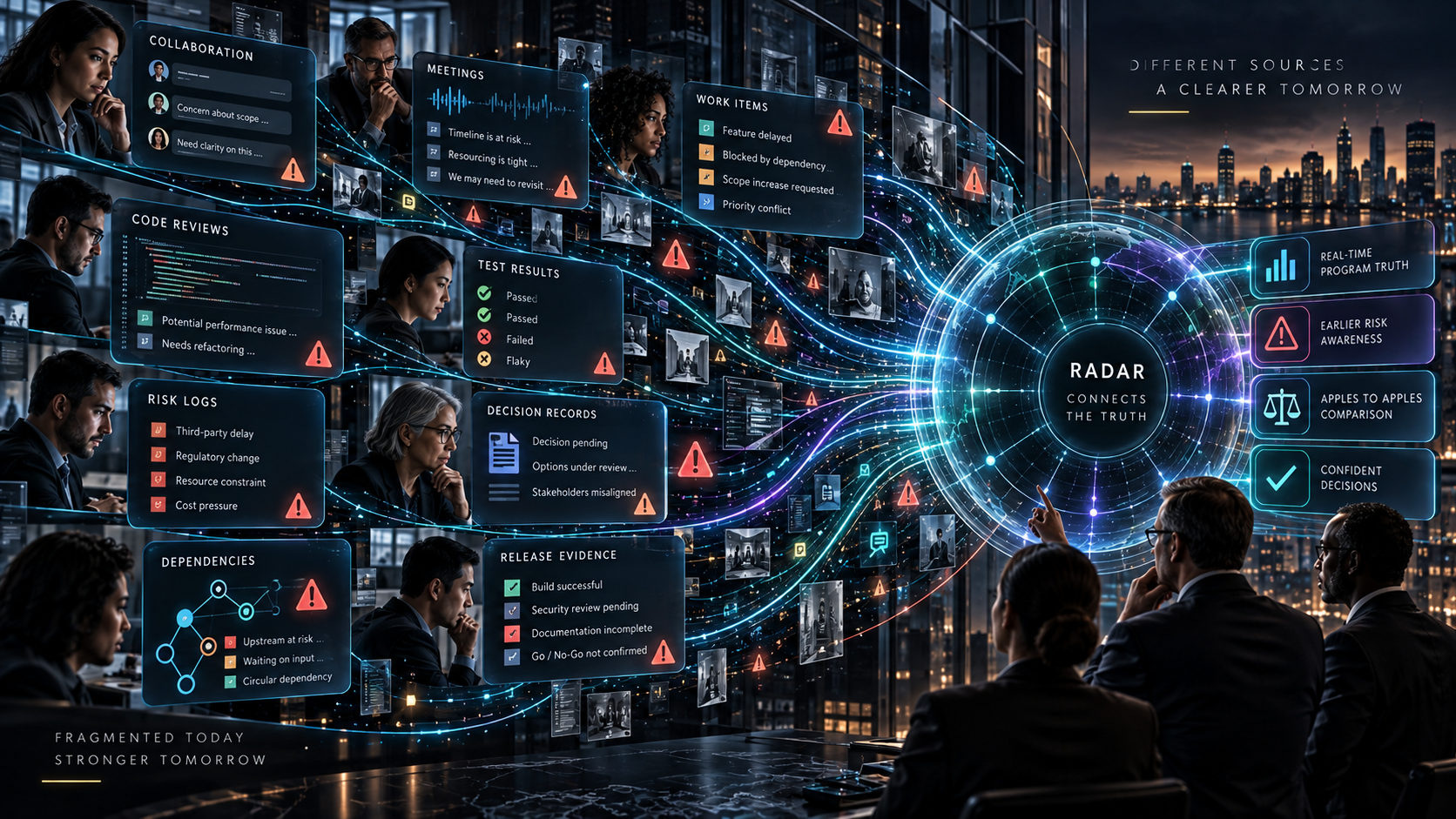
Program truth does not wait politely inside the system of record. It leaks into whatever channel the work happens to be using at the time.
The formal program system gives leaders a cleaned-up version of delivery.
The real program lives somewhere messier.
It lives in the Teams channel where someone asks whether the migration script has been tested against production-sized data.
It lives in the Slack thread where a dependency owner says, “We should know by Friday,” for the third Friday in a row.
It lives in the pull request where a reviewer notices that the rollback path was never implemented.
It lives in the test summary where one environment keeps producing failures everyone has learned to call “environmental.”
It lives in the governance meeting where the same decision returns under a slightly different title because nobody wanted to own the tradeoff the first time.
Microsoft Graph exposes structured access to Teams messages and channels through the chatMessage model and related Teams messaging APIs. Slack provides conversation history and event-driven APIs governed by channel membership and permission scopes. The technical access exists. The harder question is whether the enterprise can extract delivery meaning without turning collaboration into surveillance. source source
That distinction matters.
RADAR should not monitor people. It should identify approved delivery signals from approved program spaces for an explicit operational purpose.
No employee mood scores.
No leaderboard for who sounds insufficiently enthusiastic about the transformation.
No executive dashboard ranking which engineer used the word “concern” most often this quarter.
That is not program intelligence. That is how leadership converts collaboration into evidence for the prosecution.
The useful target is narrower:
- repeated blocker language
- unresolved ownership
- dependency recurrence
- decision aging
- shifting assumptions
- missing evidence
- readiness concerns
- control gaps
- intent drift
- escalation avoidance
- changes in signal velocity
The program is already broadcasting these conditions.
RADAR starts by learning how to listen responsibly.
CLEAR Gives the Signal Something to Threaten
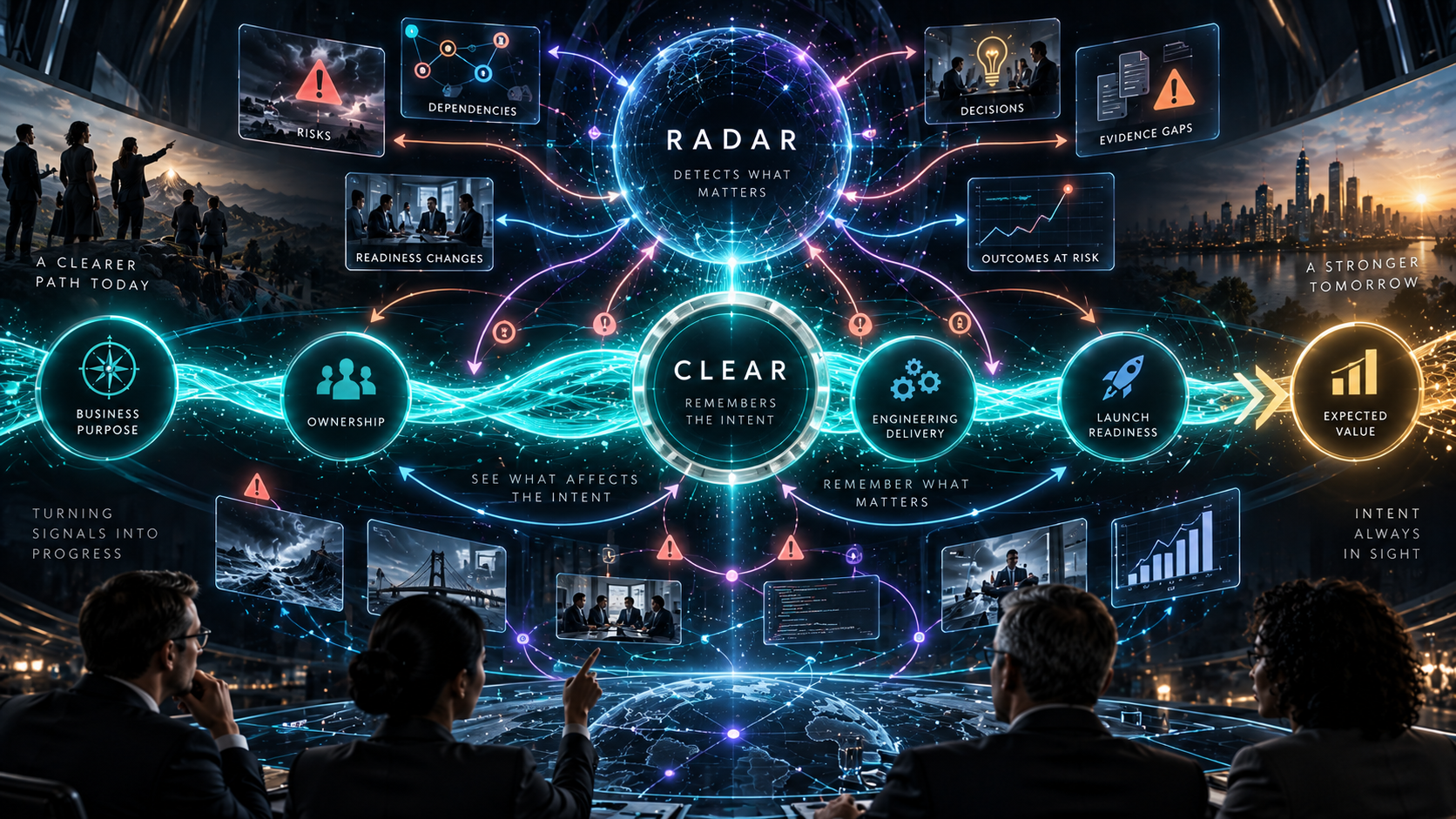
CLEAR preserves what the work is supposed to achieve. RADAR watches for conditions that could change, delay, weaken, or derail it.
A signal without context is just an interesting thing that happened.
A dependency becomes important when it threatens an outcome.
A delayed decision matters when it blocks work tied to a committed launch.
A defect trend matters when it reduces confidence in a release surface supporting customer or regulatory obligations.
An evidence gap matters when governance will eventually ask whether anyone can prove the control operated.
That is why CLEAR comes first.
CLEAR, Consolidated Launch and Engineering Alignment Relay, preserves the intent thread. It connects the original purpose of the work to engineering execution, ownership, launch readiness, evidence, and expected value.
RADAR watches the delivery system for things that may affect that thread.
This is the difference between collecting alerts and producing intelligence.
An alert says an action is overdue.
Program intelligence asks:
- Which outcome depends on the action?
- Has the same condition appeared elsewhere?
- Is the delay aging, recurring, or accelerating?
- Does the owner have enough capacity or authority to resolve it?
- What evidence supports escalation?
- Which decision forum can actually change the condition?
Without intent, the enterprise gets a larger pile of signals.
With intent, the enterprise can determine which signals deserve attention.
And yes, that sounds obvious.
So does keeping requirements connected to outcomes. Enterprises still manage to turn that into an archaeological discipline.
The Signal Taxonomy Gives RADAR a Language
The previous article in this rollout introduced the Signal Taxonomy because program intelligence needs more than keyword detection.
“Waiting on” might describe a dependency.
“Pending confirmation” might describe a decision, an assumption, an evidence gap, or a polite refusal to admit nobody owns the next move.
“Being monitored” might mean the risk is stable. It might also mean the risk has been placed in a tasteful waiting room until it becomes someone else’s emergency.
RADAR needs a shared semantic model for signals such as:
Core delivery signals
- risk
- action
- issue
- dependency
- decision
- deferral
Weak and emerging signals
- blocker
- assumption change
- ownership gap
- evidence gap
- readiness gap
- control gap
- intent drift
- commitment decay
- repeated uncertainty
- escalation avoidance
- reopened decision
- dependency churn
Signal attributes
- source
- timestamp
- affected outcome
- owner
- confidence
- age
- recurrence
- velocity
- severity
- scope
- supporting evidence
- related signals
- lifecycle state
This gives RADAR something more useful than a bag of suspicious phrases.
It gives the system a way to distinguish one-off noise from a pattern, a pattern from a condition, and a condition from something that deserves human action.
Modern AI observability is moving in the same direction. Microsoft’s 2026 guidance argues that traditional telemetry is insufficient for probabilistic and agentic systems. Organizations need richer signals around identity, context, tool usage, state, decisions, permissions, outcomes, evaluations, and production behavior. source source
Program delivery has the same semantic problem.
The enterprise cannot govern what it cannot classify.
And it cannot classify what six teams keep describing six different ways while wondering why no one acted.
RADAR Is a Relay, Not a Crystal Ball
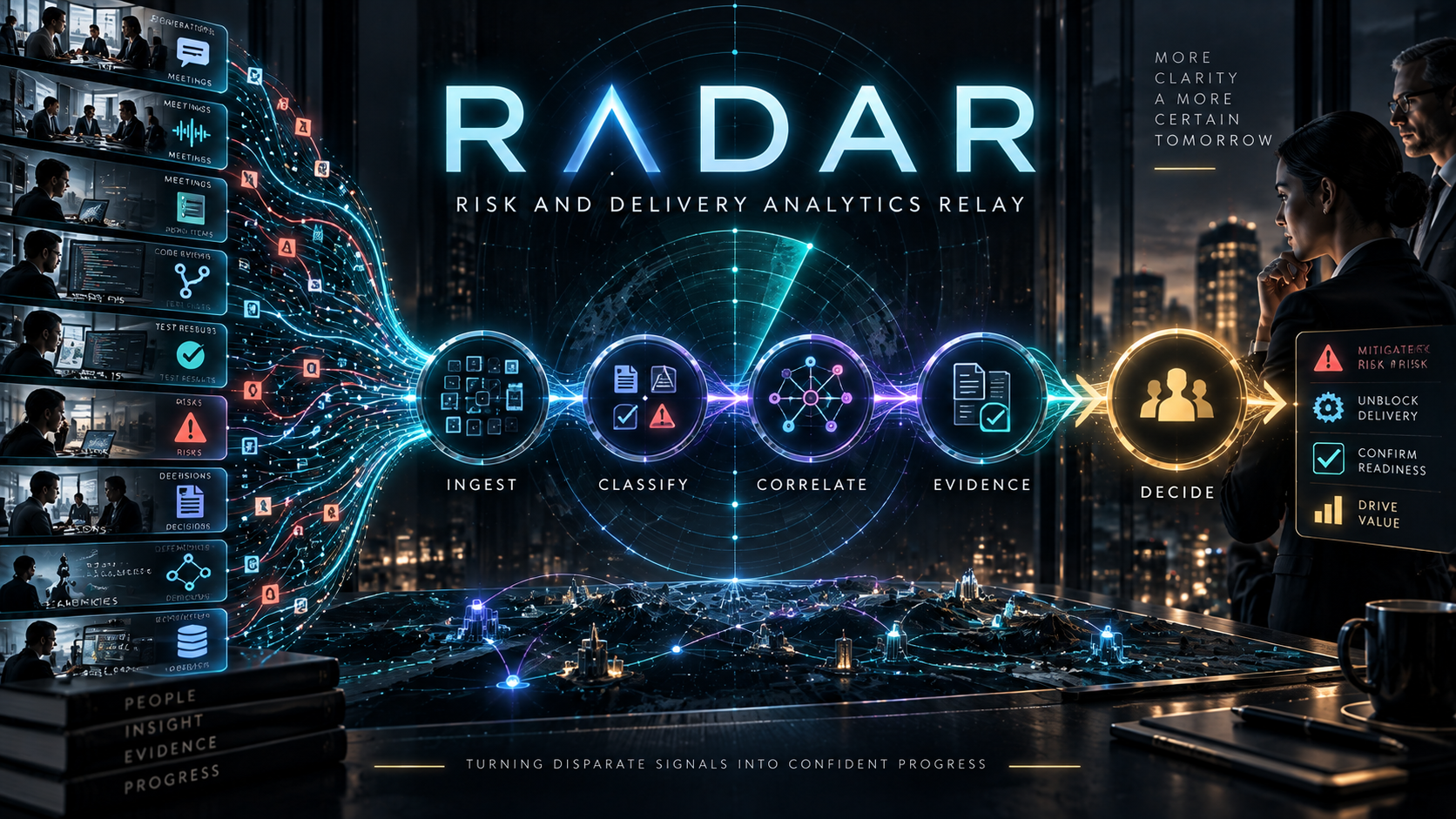
RADAR means Risk and Delivery Analytics Relay: detect the signal, preserve the evidence, connect the context, and relay it to the place where someone can act.
The name matters because each word places a boundary around the concept.
Risk
RADAR looks for conditions that could affect outcomes, readiness, resilience, governance, value, or delivery confidence.
Risk here is broader than the official risk log. It includes the small conditions that have not yet earned formal status but keep showing up in the work.
Delivery
The signals must remain connected to real execution.
Repositories. Work items. tests. decisions. dependencies. environments. controls. releases. operations. customer outcomes.
RADAR is not a separate intelligence theater floating above delivery. It should learn from the work without requiring teams to maintain another parallel universe of status artifacts.
Analytics
A single mention may be noise.
Recurrence, aging, concentration, correlation, and acceleration create analytical value.
RADAR should show whether signals are becoming more frequent, more connected, more severe, or more likely to threaten a committed outcome.
Relay
A signal that never reaches an accountable decision point is merely well-documented anxiety.
RADAR must route the signal, its context, and its evidence to the person or forum able to act.
That may be a workstream lead, product owner, architect, release manager, risk partner, control owner, program executive, or governance body.
RADAR does not predict the future with mystical certainty.
It helps the enterprise notice the present before the present becomes expensive.
A crystal ball would be easier to sell.
A relay is more useful.
The Full Automation Continuum Belongs Under the Hood
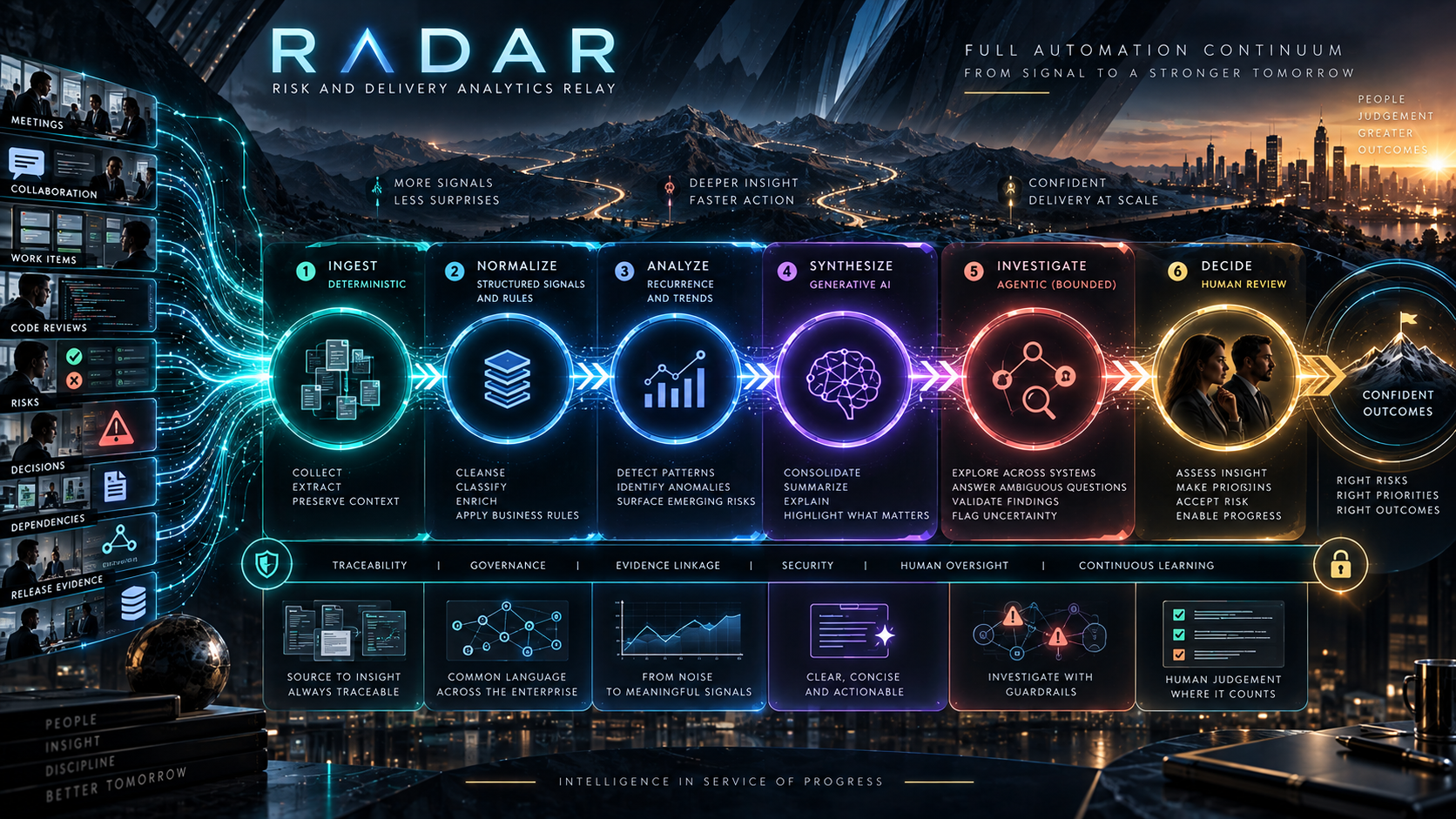
RADAR should use the cheapest, safest, most controllable pattern that can reliably handle each part of the signal lifecycle.
The worst version of RADAR would send every message, note, ticket, and test artifact into an agent and ask it to “find the risks.”
That would look impressive for approximately eleven minutes.
Then someone from Risk, Legal, Security, Finance, or basic adult supervision would ask how the system reached its conclusions.
The better design uses the full automation continuum.
Deterministic ingestion
Connect approved sources. Capture message and artifact identifiers. Preserve timestamps. Respect permissions. Track retrieval cursors. Avoid duplicates.
This is plumbing.
Plumbing remains undefeated.
Deterministic rules
Flag known conditions:
- overdue action
- ownerless decision
- dependency without a target date
- risk without mitigation
- missing evidence
- repeated blocker
- stale approval
- readiness item outside threshold
None of this requires a digital philosopher with access to production.
Analytics
Measure recurrence, aging, velocity, concentration, correlation, and trend.
A recurring weak signal across three workstreams is more interesting than the same phrase appearing once in an unusually dramatic meeting note.
Generative synthesis
Summarize the pattern. Explain what changed. Translate technical detail into executive language. Connect evidence into a concise brief.
This is where generative AI earns its seat.
Bounded agentic investigation
Use agents when the question requires a multi-step investigation across approved systems:
- Why is this dependency recurring?
- Which decisions appear connected?
- What evidence is missing?
- Which outcomes could be affected?
- What should a human investigate first?
The agent gets narrow permissions, traceable tool use, evidence linkage, observability, and a stop button.
Human judgment
People determine whether the signal is credible, what tradeoff to accept, who must act, and which risk the organization is willing to own.
The machine can bring the smoke report.
A human still decides whether to evacuate the building or ask why the smoke detector has been sitting in backlog refinement for six weeks.
The Correlation Problem Is Where the Value Lives
A risk mentioned once is a data point.
The same risk appearing in a Teams thread, a pull request review, a test summary, and a release-readiness meeting is a pattern.
That pattern becomes far more valuable when it connects to:
- one captured intent
- one committed launch
- two unresolved dependencies
- three aging decisions
- a control evidence gap
- a worsening defect trend
This is the transition from extraction to intelligence.
RADAR should not simply identify individual signals. It should build relationships among them.
One signal may reinforce another.
One may contradict the official status.
One may be downstream evidence of an earlier unresolved decision.
One may reveal that five locally green teams are collectively producing one deeply red program.
That final condition deserves special appreciation because it is one of the enterprise’s most reliable magic tricks.
Everybody is green.
Nothing is ready.
The portfolio dashboard looks festive.
Correlation also gives leaders a better way to ask questions. Instead of starting with “What is the status?” they can ask:
- What changed since the last review?
- Which signals are recurring?
- Which decisions are creating downstream drag?
- Where is ownership ambiguous?
- Which dependencies threaten more than one outcome?
- What evidence would change our confidence?
- What is the system trying to tell us before launch?
Those are decision-grade questions.
Status is a color.
Intelligence changes what someone does next.
Collaboration Signals Need Cultural Guardrails
The Teams and Slack opportunity is enormous because collaboration channels are where delivery teams actually live.
It is also where this idea can go bad quickly.
A responsible collaboration-signal model needs hard boundaries:
Approved spaces only
Ingest approved program channels, meeting artifacts, and operational forums.
Do not start with private messages or broad employee communications.
Purpose limitation
Extract delivery conditions for program intelligence.
Do not score individuals, evaluate attitudes, infer morale, or create a searchable archive of who sounded insufficiently excited about the latest enterprise reinvention.
Data minimization
Store the signal, source reference, timestamp, evidence excerpt, and necessary context.
Do not retain every raw conversation forever because storage was cheap and governance was apparently on vacation.
Transparency
Teams should know what is being analyzed, why it is being analyzed, how signals are used, and how humans validate them.
If the capability only works when employees do not know it exists, the capability is the problem.
Human review
The system proposes a signal.
A person confirms its operational meaning and decides what happens next.
Existing access boundaries
Use source permissions as a control, not an inconvenience to route around.
Slack’s conversation APIs limit access based on app membership and permission scopes. Microsoft Graph requires explicit permissions for Teams messages and channel content. That is a governance feature, not a barrier the architecture team should “temporarily” solve with one heroic service account. source source
Program intelligence should make trust stronger.
Build it like surveillance, and trust will leave before the pilot kickoff finishes introducing the steering committee.
What RADAR Should Produce
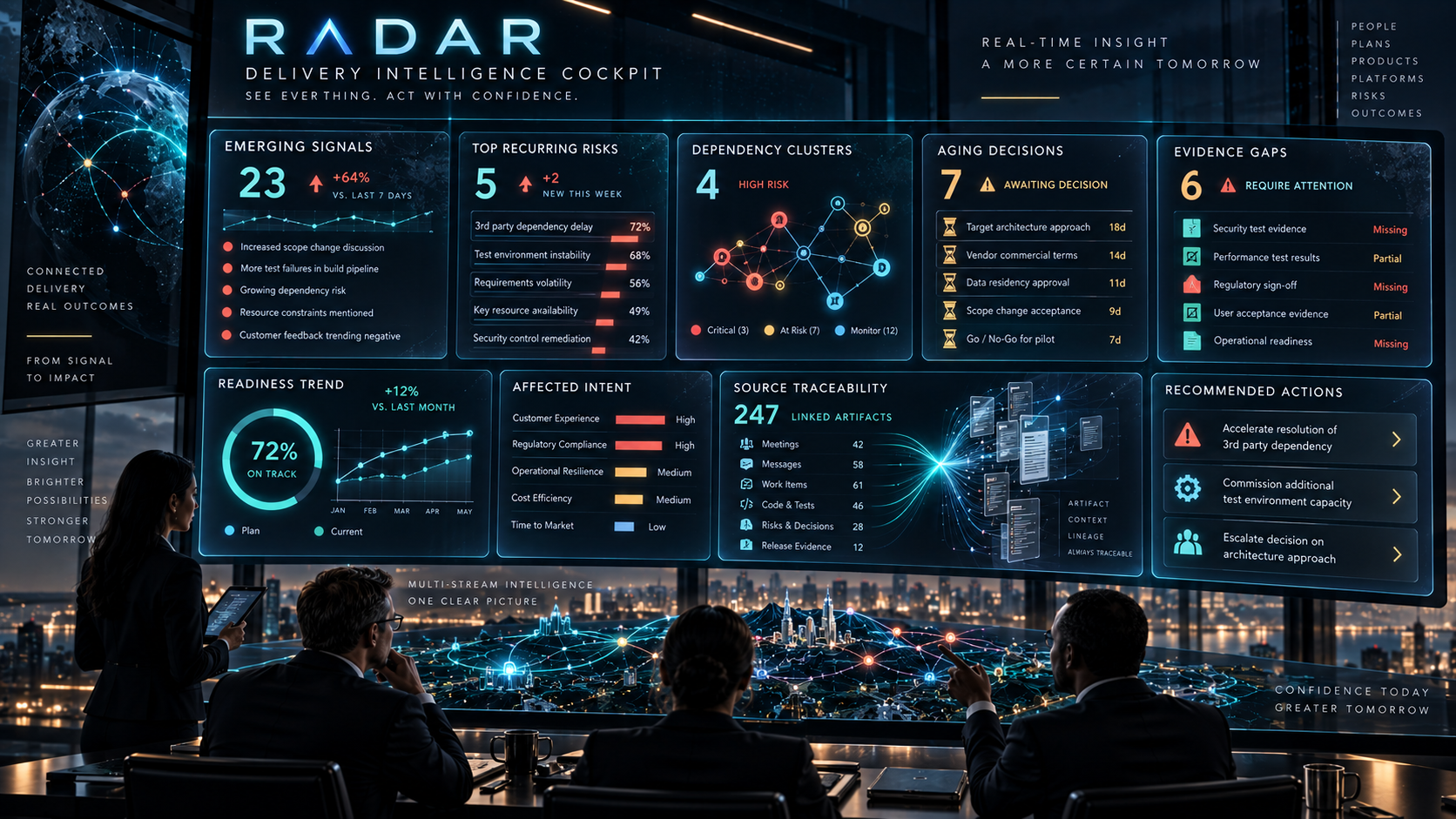
A useful program intelligence cockpit shows what changed, what connects, what is threatened, what evidence exists, and where human attention can alter the outcome.
The output should not be another dashboard packed with decorative widgets and a pie chart nobody remembers requesting.
RADAR should produce a concise, traceable view of:
- emerging signals
- recurring signals
- accelerating signals
- aging decisions
- dependency clusters
- ownership gaps
- evidence gaps
- readiness concerns
- affected intents and outcomes
- related work and artifacts
- source evidence
- confidence and rationale
- recommended human review points
The future-state experience should let a leader move from an executive signal to the underlying evidence without beginning a scavenger hunt across six systems and three calendars.
A good RADAR briefing might say:
Release confidence declined this week because an external dependency was mentioned in four approved delivery sources, the target date moved twice, the mitigation remains unowned, and two high-priority test scenarios depend on the delayed interface. The condition may affect the customer-notification launch intent captured in CLEAR. Human decision required: accept scope reduction, move the launch window, or secure an accountable dependency commitment.
That is useful.
It names the condition.
It connects the condition to intent.
It shows the evidence.
It identifies the decision.
It leaves accountability with people.
Compare that with:
Program remains amber. Teams are monitoring.
One of those supports leadership.
The other supports another meeting.
Where Leaders Get This Wrong
They buy a meeting-summary bot and declare victory
A meeting summary can help.
It cannot correlate a recurring dependency across workstreams, evidence, decisions, repositories, and readiness unless the architecture gives it the data, semantics, and operating context to do so.
A transcript is memory.
RADAR needs judgment support.
They ingest everything before defining purpose
More data produces more cost, more privacy exposure, more noise, and more opportunities to misunderstand context.
Start with approved sources and defined signal classes.
Do not build a corporate language vacuum and promise the governance team you will label the boxes later.
They treat every signal as an alert
Alert volume is not intelligence.
If every concern becomes an escalation, leaders learn to ignore the system.
RADAR needs thresholds, recurrence, relationships, confidence, and routing discipline.
They confuse inference with fact
The system should distinguish:
- direct observation
- extracted statement
- deterministic condition
- analytical pattern
- generated summary
- agentic inference
- human-validated signal
If the evidence chain disappears, the insight becomes a well-dressed rumor.
They forget intent
A signal matters because of what it could affect.
Without CLEAR or an equivalent intent layer, RADAR becomes impressively efficient at telling leaders that many things are happening.
Leaders already have calendars for that.
They automate escalation before earning trust
RADAR should begin by surfacing and explaining signals.
Autonomous escalation, workflow changes, or corrective actions require a much higher standard of evidence, governance, and control.
The first goal is better eyesight.
Do not hand the binoculars a production password.
RADAR, CLEAR, and BRIDGE
RADAR is one part of a larger operating model.
CLEAR preserves intent.
The Signal Taxonomy defines the language of delivery conditions.
RADAR detects, classifies, correlates, and relays those conditions.
BRIDGE connects intent, execution, signals, governance, evidence, readiness, and value.
The relationship looks like this:
Business intent
  → CLEAR preserves the thread
  → Delivery systems produce work and evidence
  → The Signal Taxonomy gives conditions operational meaning
  → RADAR detects and correlates emerging signals
  → Governance and leaders make decisions
  → BRIDGE connects the full path to readiness and value
BRIDGE does not need RADAR to become a surveillance platform.
RADAR does not need CLEAR to become an intake swamp.
CLEAR does not need BRIDGE to become a monolithic framework rollout.
Each capability should remain modular, useful, and proportionate.
Connected properly, the pieces give the enterprise something it rarely has:
A durable memory of why the work exists, combined with a living view of what the work is trying to tell us now.
That is the messy middle becoming visible.
What Good Looks Like
A mature program intelligence capability changes the operating rhythm.
Leaders discover material changes earlier.
Teams spend less time rebuilding status from memory.
Recurring risks stop hiding behind different language.
Dependencies become visible across workstreams.
Decisions show their age and downstream impact.
Evidence gaps appear before governance asks the expensive version of the question.
Signals remain connected to the outcomes they may affect.
Human judgment gets better inputs without surrendering accountability.
The organization still has surprises. Complex delivery will never become a perfectly illuminated aquarium where every dependency swims politely behind labeled glass.
But fewer surprises arrive wearing a fake mustache and claiming nobody had ever seen them before.
That is progress.
Final Thoughts
Your program is talking.
Through meetings.
Through channels.
Through work items.
Through pull requests.
Through test results.
Through decisions that keep returning from the dead.
Through dependencies that are somehow always “almost resolved.”
The information exists.
The enterprise needs the vocabulary, architecture, governance, and operating discipline to hear it.
CLEAR preserves the intended destination.
The Signal Taxonomy defines the warning language.
RADAR listens for the conditions that threaten the path.
BRIDGE connects that intelligence to governed execution and value.
The goal is not more alerts.
The goal is earlier understanding.
Because by the time the status deck admits the problem, reality has usually been leaving clues for weeks.
Join the Conversation
Where does your program reveal the truth first?
Meeting notes?
Teams or Slack channels?
Pull request comments?
Test results?
Dependency trackers?
The one person who quietly knows the official status is fiction?
Which signals appear early but fail to reach the right decision forum?
And where would better program intelligence create the most value without crossing the line into employee surveillance?
I would love to hear the real-world version.
The version from the messy middle, where the information existed, the signal was visible, and the status stayed green until somebody finally asked a question specific enough to ruin lunch.
About the Author
Joe Mack is a Technology Consulting Senior Principal specializing in technology leadership, enterprise SDLC transformation, release management, deployment governance, and delivery optimization for household name Financial Services companies. Joe is also a lifelong self-learner and builder of systems, and Free Tier Life is one of the ways he is trying to turn those experiences and instincts into something other people can actually use.
Bibliography
- Microsoft Learn. “Working with Microsoft Teams messaging APIs in Microsoft Graph.”
- Slack Developer Docs. “conversations.history method.”
- Slack Developer Docs. “Using the Conversations API.”
- Microsoft Learn. “Observability for Generative AI and agentic AI systems.” March 17, 2026.
- Microsoft Security Blog. “Observability for AI Systems: Strengthening visibility for proactive risk detection.” March 18, 2026.
- Microsoft Foundry Blog. “Build 2026: From observability to ROI for AI agents on any framework.” June 3, 2026.
- National Institute of Standards and Technology. “AI Risk Management Framework.”