
Stop Blaming the Handoff — Your Delivery Model Is Broken

Published on Jun 30, 2026
Stop Blaming the Handoff — Your Delivery Model Is Broken
The handoff problem is a design failure, not a communication problem.
Every large enterprise technology program has a favorite villain.
Sometimes it is the requirements process.
Sometimes it is testing.
Sometimes it is release governance.
Sometimes it is the mysterious “business stakeholder” who enters the room once every six weeks, says something catastrophic, or demands something unrealistic, and then fades back into the fog like a governance cryptid.
Spend enough time around large Financial Services technology programs, though, and one complaint shows up more than almost any other:
The handoff is broken.
Development hands off to testing.
Testing hands off to release.
Release hands off to deployment.
Deployment hands off to production support.
Somewhere in that chain, things get weird.
Intent disappears. Context evaporates. Defects show up late. Ownership turns fuzzy. Everyone insists they did their part.
Then leadership starts asking why the integrated release looks like a hostage negotiation conducted through Jira comments, spreadsheets, three separate status meetings, and a 17-hour war room.
Here is the uncomfortable truth:
The handoff takes the blame because that is where the damage becomes visible.
The deeper failure sits upstream. The delivery system was never designed to preserve intent, accountability, readiness, traceability, and risk awareness across the full lifecycle.
So naturally, the handoffs look terrible and culpable.
In reality, they are carrying more weight than they were ever designed to hold.
You cannot fix a broken delivery system by polishing the handoff between broken parts.
The Short Version
If you only remember four things from this article, make them these:
- The handoff problem is usually a symptom, not the root cause.
- Fragmented delivery models destroy context as work moves across phases.
- Regulated industries need traceability, evidence, and release governance. Those controls need to be designed into the flow, not stapled on at the end like compliance garnish.
- The goal is fewer artificial handoffs because the system preserves continuity by design.
Why This Article Comes Next
In the first article in this series, I argued that Financial Services technology delivery should stop pretending pure agile is the destination.
Delivery on the ground is hybrid. That reality is not inherently bad.
Hybrid delivery makes sense in environments where teams must balance speed, adaptability, governance, documentation, testing evidence, release controls, auditability, and production risk.
Recent research on hybrid Agile–Waterfall delivery in regulated Financial Services makes the same basic point: hybrid models exist because firms need both Agile adaptability and Waterfall-style structure for compliance, documentation, and risk control. source
So the preference for hybrid delivery is not the real issue.
The real issue is that most organizations never fully acknowledged the hybrid model they were already running. As a result, they never designed it intentionally.
They inherited it.
They patched it.
They wrapped ceremonies around it.
They gave it dashboards.
Then everybody acted surprised when it behaved like a collection of disconnected parts.
This article is about one of the most visible symptoms of that design failure: the handoff.
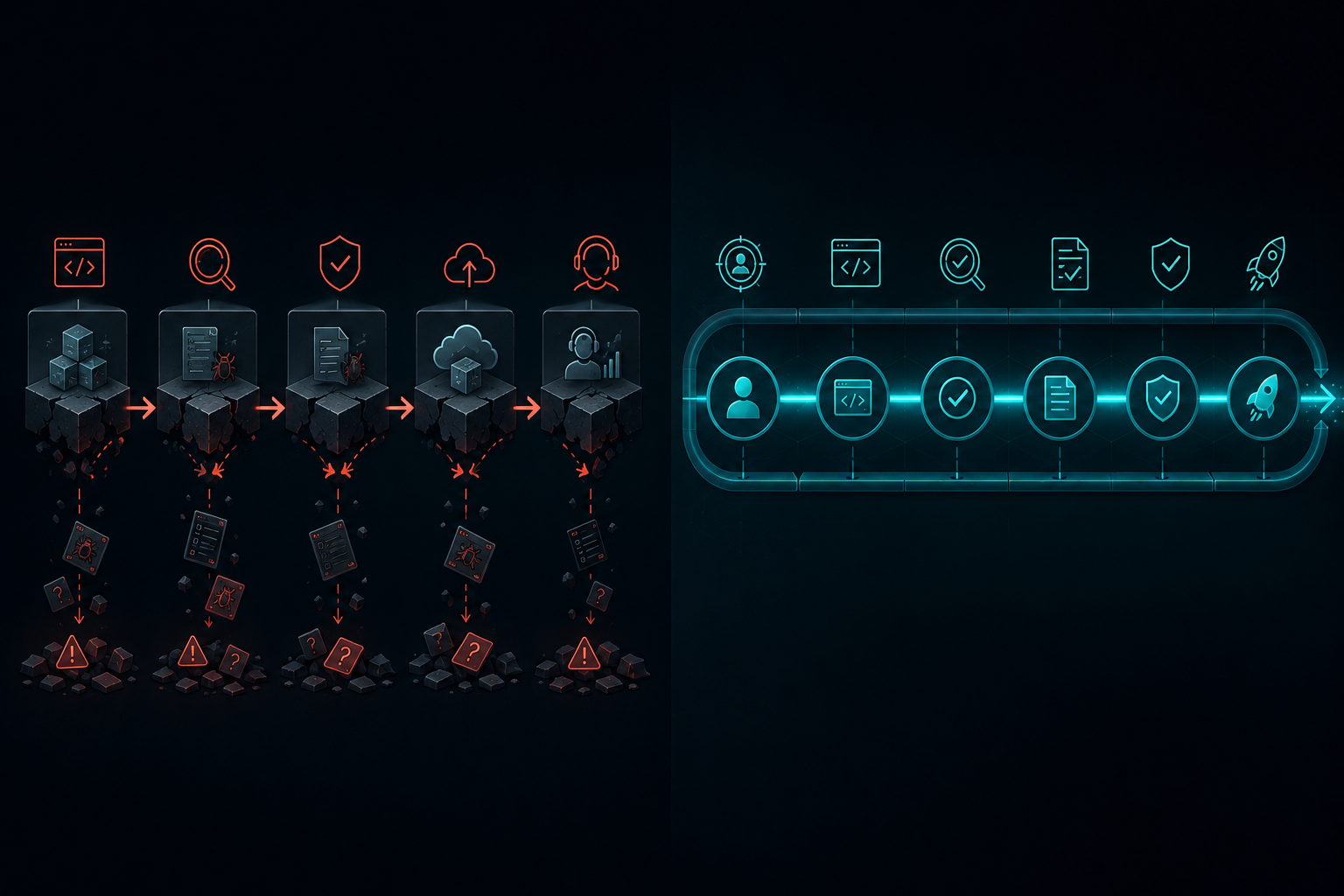
Which methodology looks more fun to use?
Let’s Understand the Handoff Problem
Most organizations describe the handoff problem in familiar ways:
- Development throws code over the wall.
- Testing gets involved too late.
- Requirements are unclear.
- Defects are found downstream.
- Release teams do not get enough notice.
- Production readiness turns into a scramble.
- Nobody knows who owns the mess.
Some of that is true.
It is also incomplete.
When people say “the handoff is broken,” they often mean something more specific:
The moment work crosses from one team, phase, tool, or governance model into another, the delivery system loses information.
That information loss is the real problem.
The handoff is where the sins of hybrid operating-model design finally show up with receipts.
The Handoff Is Where Context Goes to Die
Let’s walk through the normal enterprise pattern.
A business capability becomes an epic.
The epic becomes features.
Features become stories.
Stories become code.
Code becomes test scope.
Test scope becomes defects.
Defects become triage items.
Triage items become release risks.
Release risks become executive status bullets lit up so red that somebody should probably break out the crime scene tape.
By the time the work reaches release governance, the original intent may have been translated so many times that the system no longer has a clean line of sight from:
- why the change mattered, to…
- what was built, to…
- how it was validated, to…
- what risk remains, to…
- whether it is safe to release.
That is a continuity failure. Documentation is part of it, but documentation alone does not rescue a broken thread.
Continuity is also not like technical debt. You do not recover it at the end with hero ball, a readiness checklist, and three people who remember what happened in March.
It has to be designed into the system from the beginning.

Intent rarely disappears all at once. It gets translated to death.
The Real Cost of Handoffs
Handoffs are not just coordination moments.
They are risk multipliers.
Every handoff introduces the possibility of:
- lost context
- delayed feedback
- misinterpreted intent
- fragmented ownership
- duplicated work
- incomplete evidence
- late risk discovery
- local optimization at the expense of system flow
Scrum.org describes handoffs as an anti-pattern that increases delays, creates ambiguity, reduces quality, and fragments communication across silos. source
That might sound like a purely agile coaching perspective. In a regulated Financial Services environment, the consequences land harder than slower velocity.
The consequences show up as release risk.
Audit gaps.
Environment conflicts.
Regression surprises.
Go/no-go drama.
Production support confusion.
And the worst one of all:
A room full of smart people spending expensive hours reconstructing context that should never have been lost in the first place.
In the worst environments, the team finally collaborates at this point.
Unfortunately, collaborating to perform forensic archaeology on lost history and risk signals is a fairly expensive way to discover the operating model forgot how to remember.

When the delivery system forgets, the release team becomes an archaeological expedition.
Why Financial Services Makes This Worse
The handoff problem exists everywhere.
Financial Services adds gravity.
Delivery work usually has to pass through a dense operating environment:
- legacy systems
- shared test environments
- regulatory expectations
- downstream operational impacts
- third-party integrations
- data controls
- release windows
- audit evidence requirements
- executive governance
- production stability expectations

Financial Services does not add one constraint. It adds a gravitational field.
Testing in Financial Services involves more than proving the code works. It also involves producing evidence: what was tested, against which build, by whom, when, with what result, and with what approval path. source
That matters.
When evidence matters, traceability matters.
When traceability matters, handoff design matters.
If the delivery system cannot preserve the relationship between intent, code, tests, defects, approvals, and release decisions, every handoff becomes a potential risk super-spreader event.
The people may be doing their best.
The system is still leaking. A lot.
The Myth of “Throwing It Over the Wall”
The phrase “throwing it over the wall” is useful because everyone understands it.
It is also a little too convenient.
It makes the problem sound like bad behavior.
Developers are careless.
Testers are slow.
Release managers are bureaucratic.
Business stakeholders are unclear.
DevOps is overloaded.
Quality gates are annoying.
Everybody gets at least one villain. Nobody has to redesign the system.
That is the trap.
A system design failure turns into a personality critique.

“Throwing it over the wall” is a useful phrase. It is also a convenient way to avoid redesigning the wall.
Bad handoff behavior exists. Some teams really do operate like their only job is to push work to the next group and walk away whistling.
But in most large enterprise programs, the deeper issue is this:
The operating model gives every group a local definition of success, then acts shocked when the global system performs badly.
Development optimizes for story completion.
Testing optimizes for validation confidence.
Release management optimizes for production readiness.
Governance optimizes for risk control.
DevOps optimizes for deployability and stability.
All of those goals are reasonable.
They collide when nobody designs them as one system.
Then we call the collision a handoff problem.
The Design Failure
Here is the root issue:
Most hybrid delivery systems are phase-first, not flow-first.
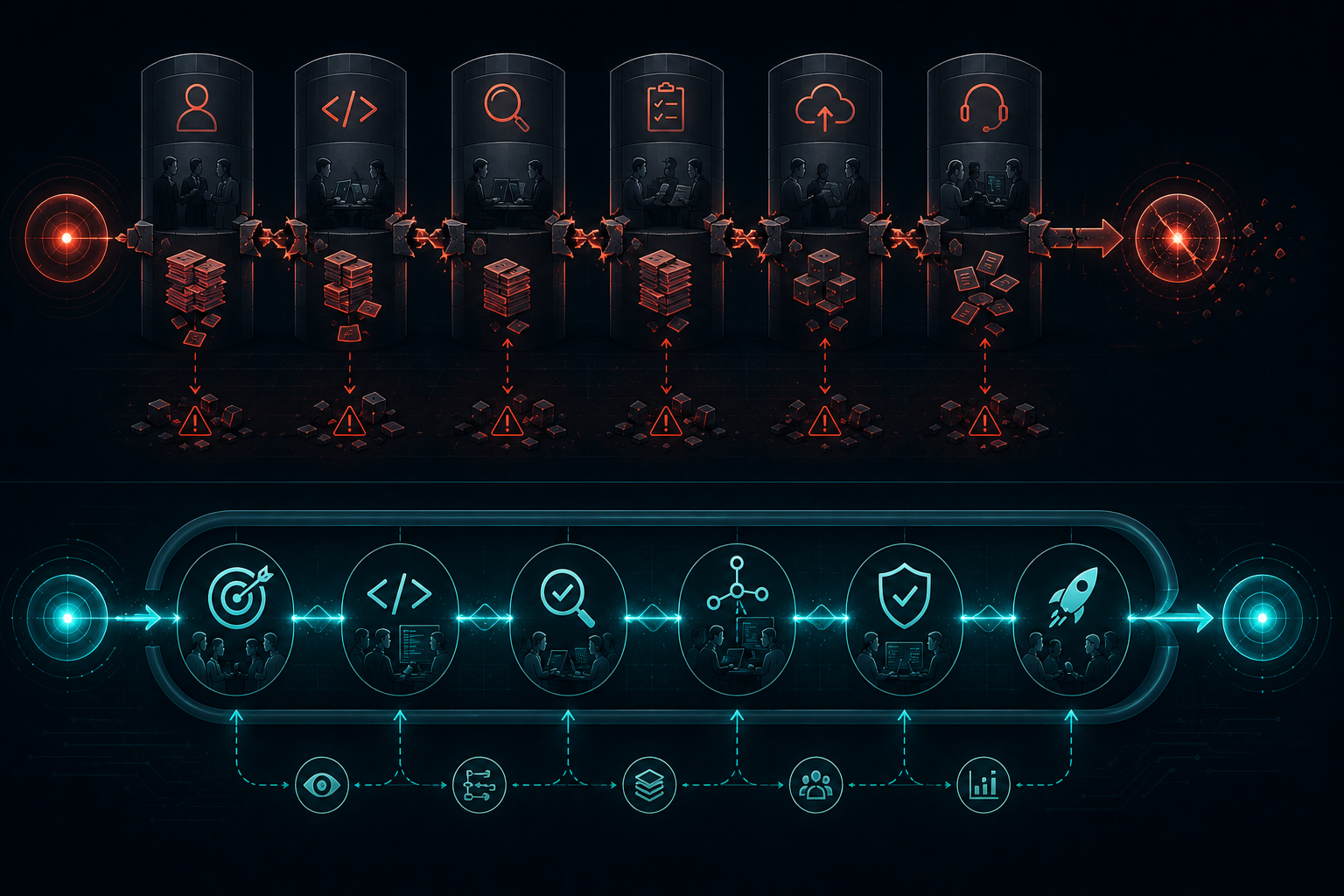
Phase-first models optimize the parts. Flow-first models protect the system.
They are designed around organizational boundaries:
- business analysis
- development
- testing
- release management
- deployment
- production support
Each group has its own tools, meetings, metrics, and definitions of ready/done.
Then the organization tries to stitch those groups together with handoff documents, status meetings, readiness reviews, and escalation paths.
That is not system design.
That is duct tape and bailing wire with governance branding.
A flow-first system would ask different questions:
- How does change intent stay visible across the lifecycle?
- How does downstream testability influence upstream design?
- How does release risk become visible before release week?
- How do dependency signals surface before they become blockers?
- How does evidence get collected as work happens instead of recreated later?
- How do teams maintain autonomy without losing integrated readiness?
Those are better questions.
They are also harder questions, which helps explain why so many organizations keep pretending the handoff is the issue.
The Three Ways Handoffs Usually Fail
1. Intent gets translated instead of preserved
The original reason for the change rarely travels cleanly through the delivery lifecycle.
By the time work reaches testing, the test team may know what the story says, but not necessarily what the business was really trying to accomplish.
By the time work reaches release governance, the release team may know what changed, but not always how the change connects to customer impact, operational risk, dependency exposure, or regulatory concern.
That is how teams end up validating artifacts instead of validating intent.
Once intent is lost, every downstream team has to infer meaning from partial evidence.
That is a rough way to run a serious delivery system.
2. Ownership becomes fragmented
In a badly designed hybrid delivery model, ownership gets divided by phase.
Development owns build.
Testing owns validation.
Release owns readiness.
DevOps owns deployment.
Production owns support.
That sounds clean on paper.
In reality, it creates a dangerous gap.
Nobody owns the end-to-end change outcome.
Everyone owns a slice.
Nobody owns the thread.
That is how you get status meetings where every individual team is green, but the release is somehow flaming at the edges.
Classic enterprise talent show: magic tricks, tap dancing, and a release train quietly smoking in the background.
Everything is fine until someone asks whether the system is ready.
3. Evidence is reconstructed instead of captured
This one matters a lot in regulated environments.
A mature delivery system should capture evidence as work moves.
What changed?
Why?
What requirement or intent did it satisfy?
What tests covered it?
What defects were found?
What dependencies were affected?
What approvals were required?
What risks still remain, and what is being done about them?
Instead, many organizations recreate this evidence near release time. That is the worst possible moment to discover that the thread is incomplete.
Audit-ready traceability requires connected relationships between requirements, tests, execution results, defects, and change history. Without that connected view, release decisions depend on fragmented reports, manual updates, and after-the-fact reconstruction. source
That is the handoff problem in its most expensive form:
The evidence exists somewhere.
Nobody can assemble it cleanly without a scavenger hunt under timeline duress.
Nothing says operational maturity like panic-searching for proof while the release clock is making everyone sweat.
Why “Better Communication” Is Not Enough
Every time handoffs break down, somebody eventually says:
We need better communication.
Sure.
Water is wet. Production defects are unpopular. Status meetings multiply when frightened.
Better communication helps. It just cannot rescue a poorly designed system by itself.
If the system depends on people manually carrying context across disconnected tools, disconnected teams, disconnected metrics, and disconnected definitions of readiness, then “better communication” becomes a polite way of saying:
Please try harder to compensate for the operating model.
That is not transformation.
That is asking constrained teams to become human middleware.

When the system cannot connect itself, people become the integration layer.
If you have watched a program rely on a handful of heroic coordinators to keep delivery stitched together, you know exactly what this looks like.
It works.
Right up until it doesn’t.
Then everyone discovers that the process was never mature. It was dependent on a few people who knew where all the bodies were buried.
Why “Shift Left” Often Misses the Point
“Shift left” started as a useful idea and then got slowly beaten into meaninglessness through overuse.
In theory, it means moving quality, security, testing, risk thinking, and the benefits they bring earlier in the lifecycle.
Good. Better than good. That is actually a great thing to do.
In practice, organizations often translate “shift left” into one or more of these moves:
- ask developers to do more testing
- involve QA earlier in ceremonies
- add more checklist items to sprint completion
- move a few reviews upstream
- declare victory

Moving a gate earlier is not the same thing as redesigning the flow.
Those moves can help a little.
They do not fix the handoff problem when the underlying delivery system remains fragmented.
Shifting left falls short when:
- the system still loses intent as work moves.
- readiness definitions remain inconsistent.
- release evidence is still reconstructed late.
- dependency signals are still hidden in meeting notes.
The point is larger than moving a gate earlier in the lifecycle.
The better goal is a system where quality, risk, compliance, and release confidence are built into the flow.
The Metrics Problem
This is where things get especially ridiculous.
A typical enterprise program may measure:
- story completion
- sprint velocity
- test execution progress
- defect counts
- release readiness
- environment availability
- dependency status
- deployment change windows
- production incidents
Those measures can be useful.
They are also usually incomplete.
Why? Because they live in separate places and tell separate stories.
DORA’s software delivery metrics focus on throughput and stability, including change lead time, deployment frequency, failed deployment recovery time, and change fail rate. Those are useful because they describe delivery as a system, not merely as a collection of local team activities. source
That concept matters.
If metrics do not connect across the flow, the operating model probably does not either.
And when the operating model does not connect, handoffs keep increasing risk.
Local truths are how every team can be green while the release is red.

Every team can be green while the release is still on fire.
What Would Actually Help
So what helps?
Not another ceremony, dashboard, or framework layer that requires a legend, a glossary, and a holy man.
The fix starts by redesigning the delivery system around continuity.
Based on what I have seen over the past 30 years in technology consulting, these principles matter.
1. Design for continuity, not transition
The goal is not prettier handoffs.
The goal is to reduce artificial handoffs and preserve continuity where handoffs genuinely must exist.
The delivery system should maintain a connected thread from:
- change intent
- to design decisions
- to development
- to test coverage
- to defect discovery
- to dependency impact
- to release readiness
- to production deployment
This is not lip-service documentation.
This is the central nervous system of the delivery model.

If the thread breaks anywhere, the system loses feeling.
When systems lose feeling, they hurt themselves without noticing until later.
Usually in release week.
Because of course.
2. Create shared definitions of readiness
Every phase having its own definition of “ready” is one of the oldest and dumbest enterprise delivery traps.
Development says ready means code complete.
Testing says ready means stable enough to validate.
Release governance says ready means controls satisfied.
DevOps says ready means deployable.
Business says ready means usable.
Nobody is technically wrong.
The system is broken when those definitions do not connect.
A mature hybrid delivery model needs shared definitions for:
- ready for development
- ready for integrated testing
- ready for release governance
- ready for deployment
- ready for production support
Not because checklists are fun.
Because unclear readiness definitions create fake progress.
And fake progress can get very expensive.
3. Move evidence capture into the flow
Evidence should not be a late-stage archaeological dig.
If the system needs traceability, capture traceability as work moves.
If the system needs approval history, capture approvals as decisions happen.
If the system needs test evidence, connect testing evidence to the change while testing occurs.
If the system needs release readiness, accumulate readiness signals continuously instead of conducting a frantic retroactive status roundup at the end.
This is where tooling matters.
Tools do not fix operating models by themselves.
A well-designed toolchain can still prevent people from spending their lives copying data between systems like extremely expensive carrier pigeons.
4. Treat dependencies as first-class citizens
Dependencies are often where hybrid delivery goes to die.
They sit between teams, systems, environments, releases, business priorities, and people who all technically agree while misunderstanding each other completely.
If dependencies are not visible early, they become blockers late.
If dependency impact is not connected to release readiness, governance becomes theater.
If dependency decisions live in meeting notes, the organization is one vacation away from amnesia.
Dependency visibility cannot be a side quest.
It has to be part of the system.
5. Use automation to reduce coordination drag
This is where I start getting very interested.
Hybrid delivery is full of signals.
Most organizations simply do not capture them well.
Signals live in:
- Jira tickets
- release notes
- meeting minutes
- dependency logs
- test execution data
- defect triage calls
- environment calendars
- deployment plans
- approval workflows
- change records
The truth usually exists.
It is scattered all over the place.
A better hybrid delivery system should use deterministic automation, analytical tooling, and eventually agentic reasoning to surface signals earlier without dumping more work onto already-constrained delivery teams.
Read that last sentence one more time, please. Surfacing signals earlier with little to no work impact on delivery teams is the secret sauce.
If your solution to delivery friction is “make teams fill out more fields,” congratulations, you have courted some well-deserved resentment.
The best operating-model improvements reduce coordination burden. They do not add another layer of unpaid administrative labor.
I cannot tell you how many times I have been the one asking for more work from teams on a fixed-price contract and then been surprised that they did not want to do it.
“It is a no-brainer. Sixty extra seconds after every feature branch merge to prevent hours of extra work later.”
That logic is often correct.
It also ignores incentives. Local truths force delivery leads to preserve anti-patterns they know are bad because the short-term contract, schedule, or staffing model punishes the better behavior.
That is how organizations accidentally subsidize the mess.

The truth usually exists. The problem is that it is scattered.
The Higher-Level Opportunity
This is where the conversation widens.
The handoff problem is more than a delivery annoyance. It is evidence of a failing operating model.
Financial Services organizations do not need another monolithic framework from on high.
They need a lightweight, purpose-built delivery model that:
- preserves change intent
- strengthens readiness visibility
- connects delivery signals
- reduces evidence reconstruction
- improves dependency awareness
- supports governance without suffocating flow
- works with existing teams instead of creating a giant new burden
That last point is non-negotiable.
Delivery teams are already constrained.
Development teams are already under pressure.
Testing teams are already overloaded.
DevOps teams are already asked to make everyone else’s chaos deployable.
If the proposed improvement requires every team to do a mountain of new unplanned work, it will fail quickly and loudly.
Even worse, it might succeed just enough to become everyone’s least favorite process.
The better answer is an operating model that extracts more value from signals teams already create.
That is where this series is heading.
I promise not to bring you more ceremonies or more framework theater.
The aim is a more intentional hybrid delivery system that protects flow, increases confidence, and reduces the heroics needed to release safely.
What This Means for Leaders
If you lead delivery in a regulated environment, the useful question is not:
How do we make teams hand things off better?
Start here instead:
Where does our delivery system lose context?
Look for the places where teams have to reconstruct:
- what changed
- why it changed
- how it was tested
- what it depends on
- what risk remains
- who approved it
- what evidence supports the release decision
Those are the fracture points.
Figure out:
- Which evidence do we recreate manually every release?
- Which readiness signals exist, but are trapped in meetings or spreadsheets?
Those questions matter.
Once you know where the system loses context, you can design better transitions.
Eventually, you can design fewer of them.
This Is Where Things Start to Come Into Focus
There is a reason this topic keeps pulling me toward change intent, release readiness, dependency visibility, evidence capture, and signal extraction.
The hidden drama in hybrid delivery is rarely the work everyone can see.
It is the work hiding between the artifacts.
The meeting where someone mentions a dependency but nobody records it cleanly.
The test environment conflict that gets resolved informally but changes the release risk profile.
The change intent that gets diluted across tickets.
The approval that happens, but not in a way that can be tied cleanly back to readiness evidence.
The “small” scope adjustment that quietly alters downstream validation needs.
Welcome to the messy middle.
We’ve been expecting you.
This is where hybrid delivery either becomes a designed system or a very expensive group project held together by calendar invites, tribal knowledge, and optimism.
This is also where the next generation of hybrid delivery improvement needs to focus.
No one needs another ceremony, another giant methodology dropped from the sky, or another burden on already-constrained delivery teams.
“Here, fill out fifteen more fields so leadership can pretend the model is mature.”
Hard pass.
We need something lighter.
More modular and signal-driven.
More respectful of the weight development, testing, release, governance, and DevOps teams are already carrying.
The working idea I keep coming back to is a lightweight operating model I’m calling BRIDGE:
Balanced Release & Integrated Delivery Governance Engine.

BRIDGE is not another wall of process. It is a way to connect the system without crushing the teams inside it.
BRIDGE is not meant to replace agile or waterfall or anything else.
It is definitely not meant to become another framework poster that looks impressive in a conference room and collapses on contact with a shared test environment.
The goal is simpler:
Design the flow.
Preserve the context.
Capture the evidence.
Surface the signals.
Reduce the coordination drag.
Increase release confidence.
Do all of that with as little additional burden on teams as possible.
That last sentence matters.
If the answer to a broken delivery model is “make teams do more unpaid administrative labor,” congratulations, you have failed to solve the problem and secured a spot on the fecal roster of delivery teams everywhere.
This is where methodology components like CLEAR and RADAR could eventually be brought to bear.
CLEAR focuses on preserving change intent, launch readiness, and evidence continuity.
RADAR focuses on surfacing hidden risks, dependencies, and delivery signals before they become release-week emergencies.

CLEAR helps the system remember. RADAR helps the system see.
Those are modules.
The bigger idea is the operating model above them.
A design problem needs a design response. Better handoff etiquette will not do the job.
The answer has to help the system see things in real time, then capture and memorialize those signals so the system can remember.
We have just two more articles before formally introducing the BRIDGE methodology, and then the CLEAR and RADAR modules.
First, we need a mid-depth dive into governance and metrics. Those topics set the foundation for improving what delivery teams are using on the ground right now.
Final Thoughts About the Handoff
The handoff is not the villain.
The handoff is the warning light.
It tells you the delivery system is losing continuity somewhere between intent, execution, validation, governance, and release.
So stop blaming the handoff. Stop blaming the teams. And please, for the love of Pete, stop pretending one more ceremony will fix a system that was never designed as a system.
We all know better.
The work is harder.
It is also much more useful.
Design the flow.
Preserve the context.
Capture the evidence.
Surface the signals.
Then maybe the handoff stops being a ritual sacrifice and starts becoming what it should have been all along:
A controlled transition inside a well-designed delivery system.
As I mentioned in the first article: this feels both fixable and worth fixing.
Join the Conversation
Where does context get lost in your delivery model?
Between development and testing?
Between testing and release?
Between release governance and deployment?
Somewhere else entirely?
I would love to hear the real-world version.
Not the theory.
The thing that actually bites teams in the wild.
About the Author
Joe Mack is a Technology Consulting Senior Principal specializing in technology leadership, enterprise SDLC transformation, release management, deployment governance, and delivery optimization for household name Financial Services companies. Joe is also a lifelong self-learner and builder of systems, and Free Tier Life is one of the ways he is trying to turn those experiences and instincts into something other people can actually use.
Bibliography
- Premnath Raja. "The Impact of Hybrid (Agile–Waterfall) Delivery Models on Project Performance in High-Regulation Financial Sectors." Global Business & Economics Journal, October 10, 2025.
- Martin Hinshelwood. "Why Handoffs Are Killing Your Agility." Scrum.org, May 19, 2025.
- Mary Iqbal. "Handoffs Hurt." Scrum.org, July 28, 2025.
- Chris Faraglia. "Software Testing in Financial Services: Building an Audit-Ready Testing Practice." TestRail, June 25, 2026.
- Louis Tadman. "Audit-ready traceability in software testing: Reducing release risk and strengthening compliance." Merito, May 22, 2026.
- DORA. "DORA’s Software Delivery Performance Metrics."