
Stop Throwing Agents at Problems a Script Could Solve
Published on Jul 23, 2026
Stop Throwing Agents at Problems a Script Could Solve
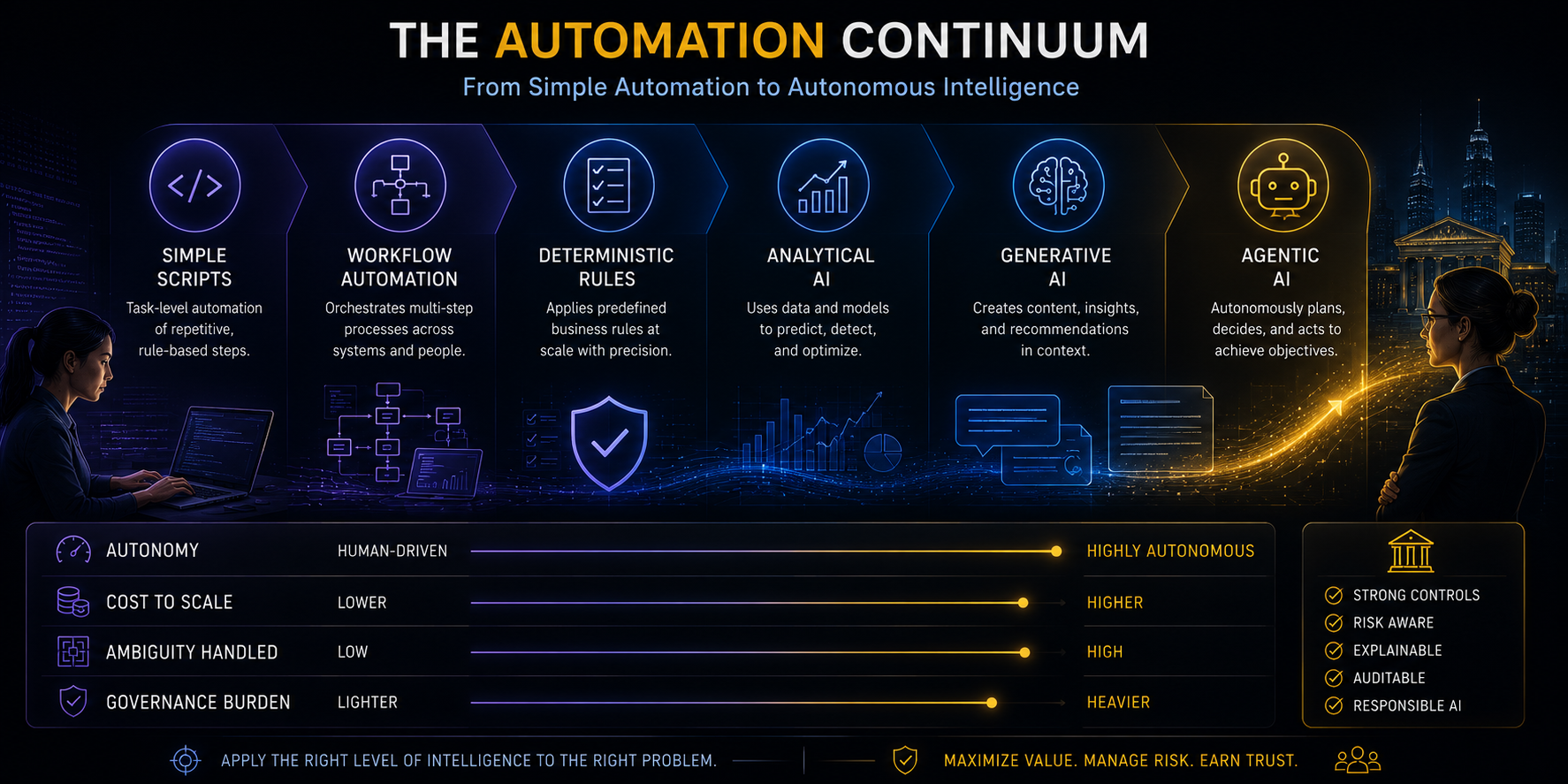
The Automation Continuum — and why the smartest teams are not running straight to agentic AI
The best automation strategy is not “agentic everything.” It is using the least expensive pattern that can safely, reliably, and transparently do the job.
Enterprises are sprinting toward agentic AI.
Of course they are.
The board has asked about it. The CEO has read about it. The technology budget already swallowed the platform costs. The vendors have shown the demos. The internal innovation team has a backlog of agent ideas with suspiciously optimistic ROI estimates. Somewhere, someone has already created a slide titled “Agentic Transformation Roadmap,” and that slide probably has a hexagon on it.
Who can blame them?
Agentic AI is exciting. It can reason, plan, coordinate, call tools, work across systems, and take action with degrees of autonomy that traditional automation could never touch. In Financial Services, the potential is enormous: fraud investigation, compliance monitoring, customer operations, claims triage, credit analysis, software engineering, knowledge work, operational resilience, and every process currently held together by email, spreadsheets, tribal knowledge, and the grinding patience of middle management.
But here is the part that is going to hurt a little:
Not every workload deserves an agent.
In fact, many workloads do not.
If the rules are knowable, stable, auditable, and cheap to execute, then dragging an AI agent into the room may be the enterprise equivalent of hiring a Michelin-starred chef to microwave a burrito.
Could the chef do it?
Sure.
Should the chef be your operating model?
Probably not.
Deloitte’s 2026 Tech Trends work says enterprises are moving quickly toward agentic AI, but many are hitting a wall because they are trying to automate existing human-designed processes without reimagining how the work should actually be done. Deloitte also notes that many so-called agentic initiatives are “automation use cases in disguise,” where simpler tools would suffice and “agent washing” makes the problem worse. source
That is the whole ballgame.
The future of enterprise automation is not a stampede to the top of the hype ladder.
The future is an automation continuum.
Scripts. Scheduled jobs. Rules engines. Workflow automation. RPA. Deterministic orchestration. Predictive analytics. Generative AI. Agentic AI.
All of them matter.
The leadership skill is knowing which one belongs where.
The Short Version
If you only remember six things from this article, make them these:
- Agentic AI is powerful, but power is not the same as fit.
- The right automation strategy pushes each workload down to the cheapest, safest, most auditable pattern that can do the job.
- If you can define the rules, you probably do not need reasoning. You need execution discipline.
- Financial Services needs the full automation continuum because cost, resilience, explainability, auditability, human oversight, and operational risk still matter.
- Agentic AI should be reserved for work that genuinely requires reasoning, ambiguity handling, tool use, context, adaptation, or multi-step judgment.
- The question is not “Can we build an agent?” The question is “What is the lowest-complexity automation pattern that can safely deliver the outcome?”
The Bill Is Coming Due
The first wave of enterprise AI energy was easy to understand.
Everyone wanted to experiment.
Everyone wanted to show momentum.
Everyone wanted a use case portfolio.
Everyone wanted to avoid being the executive who slow-walked the future and accidentally became the cautionary anecdote in someone else’s keynote.
Fine.
Experimentation had a job to do.
But enterprise technology eventually has a way of asking impolite questions:
- What did this cost to build?
- What does this cost to run?
- Who owns it?
- What risk does it create?
- Can we audit it?
- Can we explain it?
- Can we turn it off?
- Is the expensive thing doing work a cheaper thing could have done?
That last question is going to become very popular.
McKinsey’s 2026 AI Trust Maturity Survey found that AI adoption is accelerating toward scaled generative and agentic AI, but strategy, governance, and agentic AI controls still lag. McKinsey also found that security and risk concerns are the top barrier to scaling agentic AI and that active mitigation lags risk awareness across nearly every AI risk category. source
Translation: the machine is getting faster, but the brakes, mirrors, road signs, insurance policy, and driver training are still under construction.
That does not mean stop.
It means stop pretending every problem needs the maximum-autonomy answer.
Agents are not magic. They are software systems with autonomy, cost profiles, governance needs, logging requirements, access-control implications, and failure modes.
That does not make them bad.
It makes them enterprise technology.
Welcome back to gravity.

The best tool is not the most advanced tool. It is the simplest tool that safely solves the problem.
The Automation Continuum
The automation continuum is simple in concept and brutal in practice.
At the bottom, you have automation patterns that are cheap, predictable, transparent, and easy to govern.
At the top, you have automation patterns that are adaptive, contextual, autonomous, expensive, and harder to govern.
Neither end is morally superior.
This is not a maturity ladder where every organization should climb until it reaches agentic enlightenment and starts wearing linen.
It is a menu.
More accurately, it is a set of engineering tradeoffs.
A reasonable continuum looks like this:
- Manual work supported by templates and checklists
- Scripts and scheduled jobs
- RPA and workflow automation
- Deterministic rules and orchestration
- Predictive and analytical AI
- Generative AI
- Agentic AI
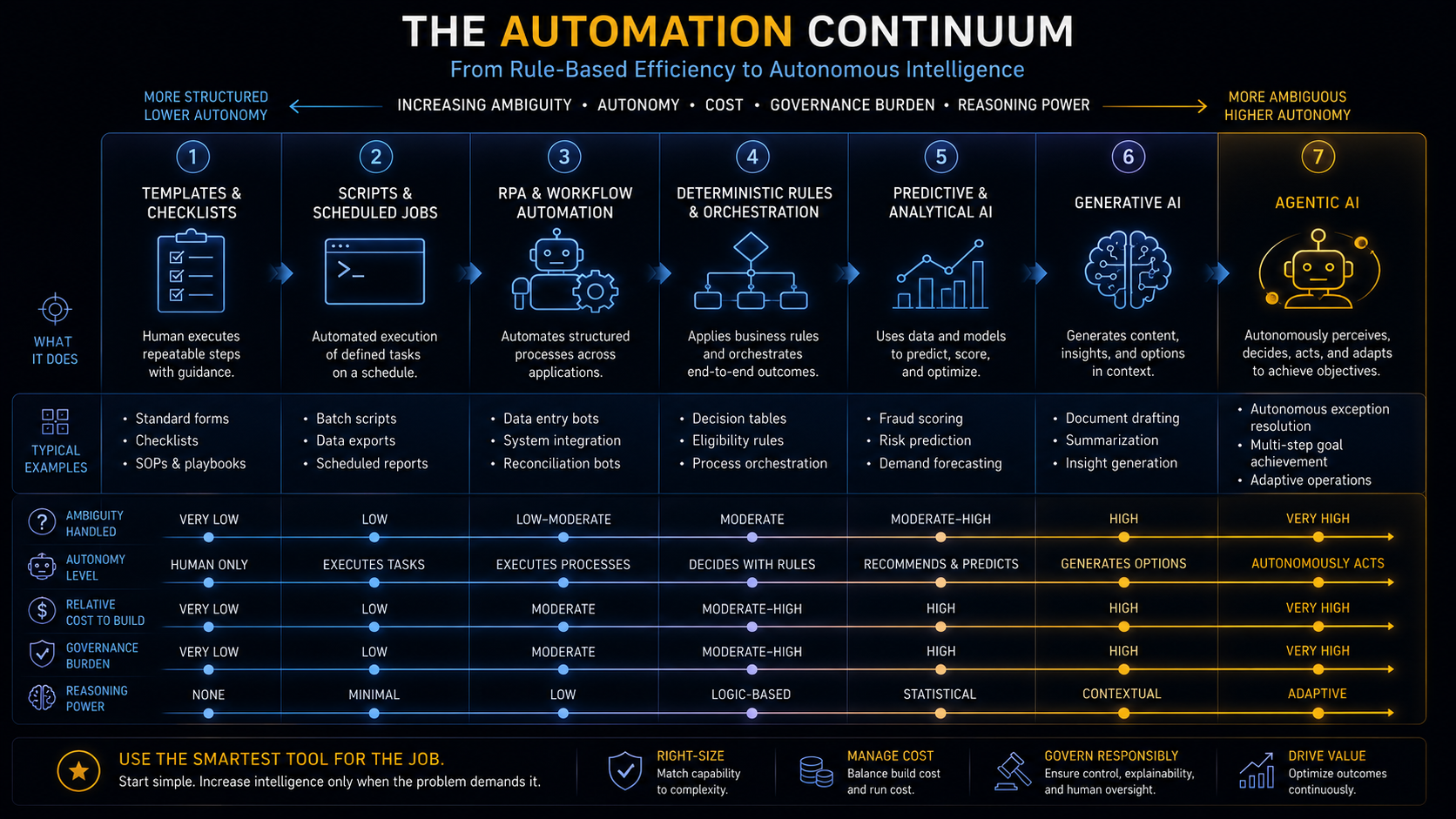
The continuum is not a ladder to climb. It is a set of tradeoffs to choose from.
The closer a workload is to the bottom, the more it depends on known rules, repeatable inputs, and predictable execution.
The closer a workload is to the top, the more it depends on ambiguity, judgment, natural language, dynamic context, and adaptive action.
The mistake is assuming “higher” means “better.”
Sometimes higher just means more expensive, harder to explain, and more likely to summon a governance committee out of the walls.
Layer 1: Templates, Checklists, and Human Discipline
Before automation, there is process discipline.
Yes, that sounds boring.
Boring is underrated.
Some work does not need code, bots, models, or agents. Some work needs a better checklist, a clearer intake form, a sharper decision log, or a standard operating procedure that does not read like it was assembled from twelve SharePoint migrations and a hostage note.
This matters because automating a bad process often gives you a faster bad process.
Deloitte’s agentic AI strategy work makes this point directly: leading organizations do not simply layer agents onto old workflows; they step back and redesign processes around how work should actually happen. source
If the process is unclear, slow, political, duplicated, or irrational, automation may not save it.
Automation may simply preserve the dysfunction at machine speed.
And nothing says enterprise maturity like scaling confusion.
Layer 2: Scripts and Scheduled Jobs
Scripts are the first real automation workhorse.
They move files. Validate data. Trigger jobs. Pull reports. Rename artifacts. Check conditions. Send alerts. Transform records. Reconcile simple datasets. Run scheduled tasks. Clean up the digital crumbs everyone pretends are not there.

A script is not glamorous. A script also does not invoice you by the token.
In many enterprises, the humble script is still the cheapest and most honest answer.
If the task is:
- repeatable
- low ambiguity
- low exception rate
- structurally simple
- easy to test
- easy to log
- easy to roll back
then congratulations, you may not need an AI strategy.
You may need a cron job.
That is not anti innovation.
That is financial stewardship.
This is where some organizations are going to have a reckoning. After the first rush of agentic investment, many leaders will realize they have been using premium reasoning infrastructure for work that could have been handled by a deterministic job and a decent audit log.
The invoice will be clarifying.
Layer 3: RPA and Workflow Automation
RPA and workflow tools exist because enterprises are full of systems that were not designed to cooperate.
Sometimes the API does not exist.
Sometimes the integration roadmap is scheduled for the twelfth of never.
Sometimes the process is trapped inside a legacy application that only speaks in screens, clicks, exports, and prayers.
That is where RPA can still make sense.
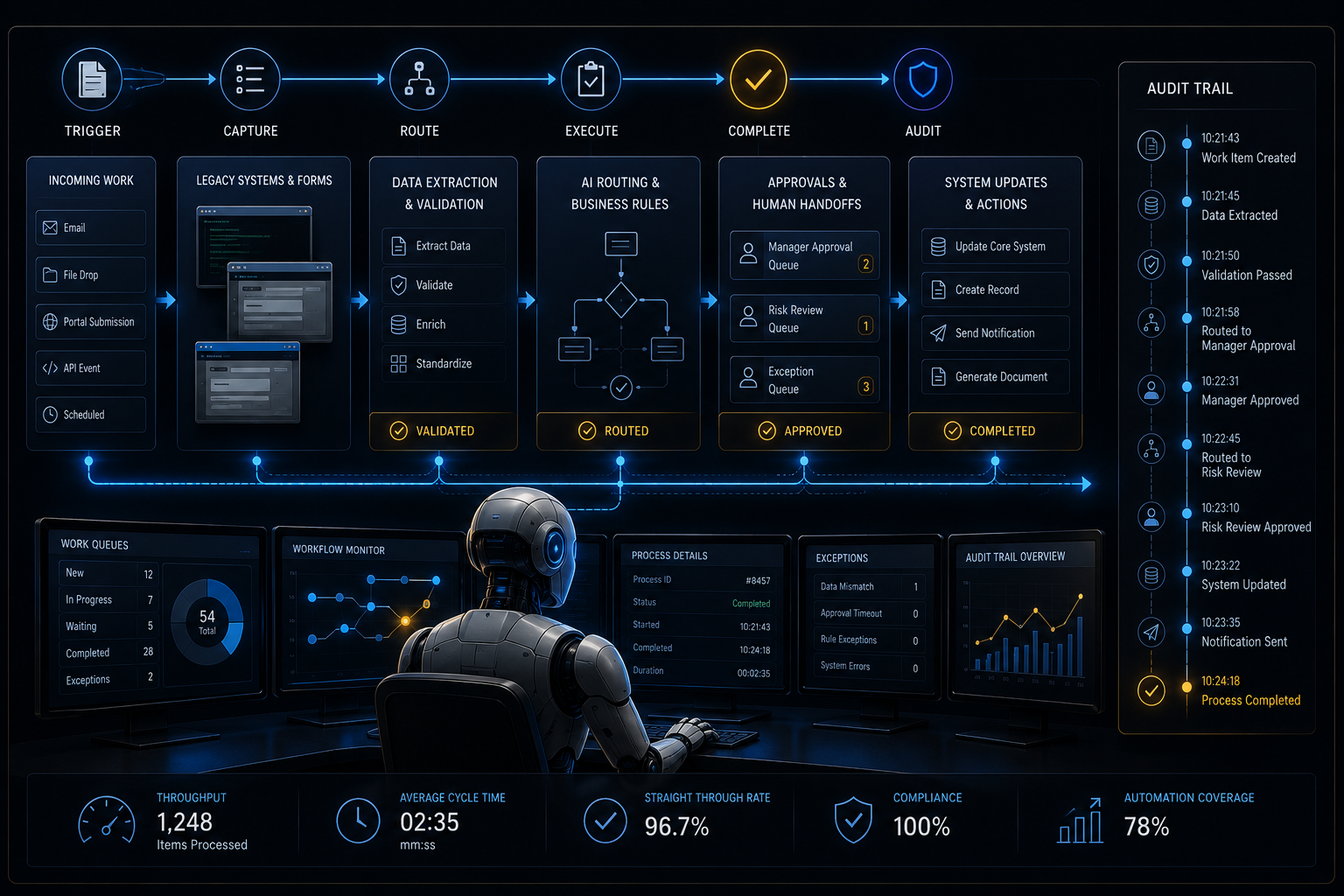
RPA is not dead. It just should not be rebranded as agentic AI because that’s what the board of directors wants to hear about.
RPA is useful when the work is rule-based but trapped in awkward systems.
Workflow automation is useful when steps, handoffs, approvals, routing, and status transitions need to be managed consistently.
These tools are not fashionable right now because everyone wants the agentic headline.
Too bad.
Fashion is a terrible architecture principle.
If a workflow engine can route approvals, enforce rules, capture evidence, and give leaders a clean audit trail, it may be the right answer.
No tiny digital genius required.
Deloitte’s agentic AI work explicitly warns that “agent washing” is compounding enterprise problems, with vendors rebranding existing automation capabilities as agents and organizations applying agents where simpler tools would suffice. source
That line should be printed on a mug and handed out at procurement reviews.
Layer 4: Deterministic Rules and Orchestration
This is the layer I wish more enterprises respected.
Deterministic automation is what you use when the rules are knowable.
Not easy.
Knowable.
If you can define the policy, the routing, the validation, the threshold, the exception path, and the output, then a deterministic rules engine or orchestration workflow can give you exactly what Financial Services often needs most:
- predictable execution
- testability
- auditability
- explainability
- repeatability
- clear exception handling
- lower run cost
- easier controls
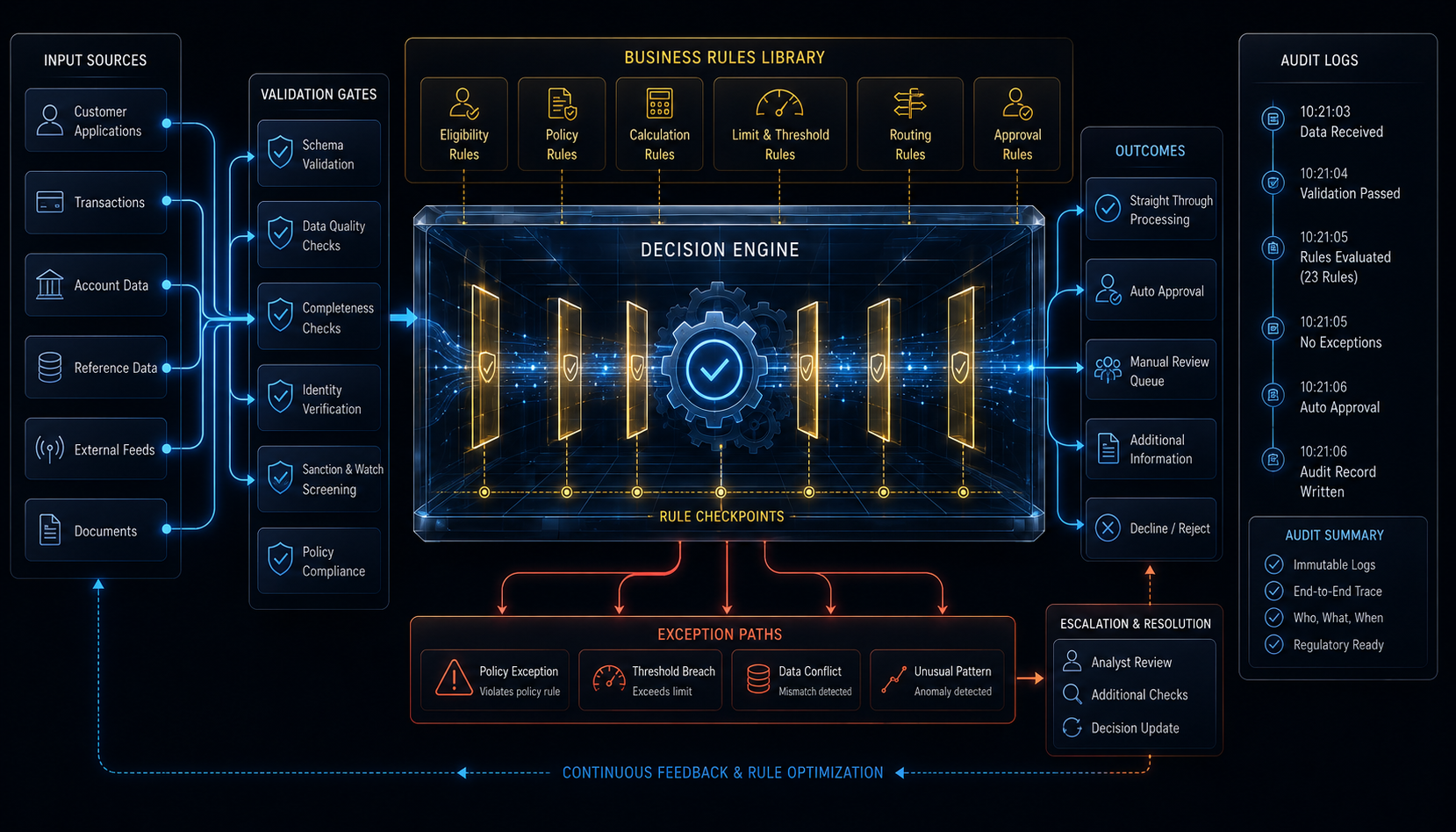
If the rules are knowable, do not buy reasoning. Build execution discipline instead.
This is where the mantra matters:
If you can figure out all the rules, you do not need the reasoning power of an agent.
That does not mean deterministic systems are simplistic.
Some rules engines are complex. Some orchestration layers are sophisticated. Some deterministic workflows handle high volume, high value, high audit scrutiny, and ugly edge cases with great discipline.
But they do not pretend to reason.
They execute.
And sometimes execution is what the enterprise actually needs.
Financial Services should care deeply about this layer because it keeps controls visible. If a payment exception routes a certain way, a credit policy applies a certain threshold, or a compliance check requires a specific evidence package, deterministic automation can make the behavior explicit.
That explicitness is not a limitation.
It is the point.
Layer 5: Predictive and Analytical AI
Predictive and analytical AI belongs where patterns matter.
Fraud scoring. Credit risk signals. Customer churn. Claims leakage. Capacity forecasting. Incident prediction. Anomaly detection. Portfolio analytics. Operational risk indicators. Next-best action recommendations.

Analytical AI helps the enterprise see. It does not automatically mean the enterprise should let the model act autonomously.
This layer is about insight, classification, prediction, and prioritization.
It can be incredibly valuable.
It can also be misused when leaders treat predictions like decisions.
A risk score is not a risk decision.
A churn model is not a customer strategy.
A fraud signal is not a complete investigation.
A model output is not accountability.
The 2026 Cambridge Centre for Alternative Finance Global AI in Financial Services Report found that AI adoption is widespread across financial services, with classical machine learning and generative AI widely used and agentic AI already in active adoption among 52% of industry respondents. The report also found that productivity effects are being felt but enterprise value is harder to evidence, with 55% of industry respondents and 63% of regulators finding it difficult to measure the value of AI deployment. source
That should make leaders slow down in exactly the right way.
Not stop.
Not panic.
Just ask the next grown-up question:
Is this model creating insight, changing decisions, or actually improving outcomes?
Those are three different things.
Corporate life gets expensive when everyone pretends they are the same.
Layer 6: Generative AI
Generative AI belongs where language, synthesis, summarization, drafting, explanation, translation, and knowledge work matter.
It can write first drafts. Summarize complex documents. Turn policy language into plain English. Explain code. Draft release notes. Generate test cases. Create executive briefs. Compare contracts. Extract themes from unstructured text.
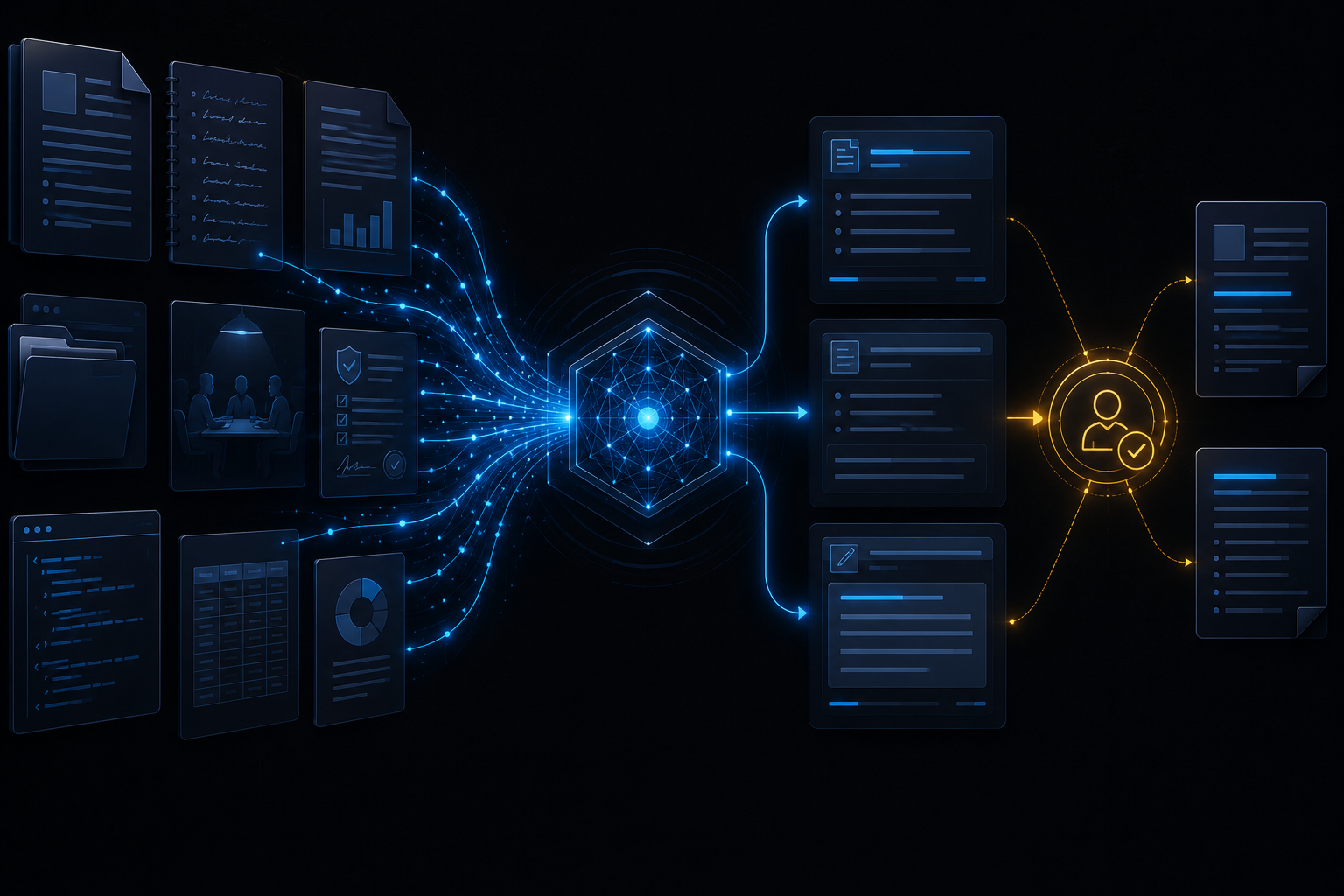
Generative AI is excellent at synthesis. That does not make it an execution engine.
Generative AI is powerful because enterprises are full of language work.
Financial Services might be the world champion of language work: policies, controls, disclosures, risk reports, product docs, meeting notes, audit findings, customer communications, regulatory interpretations, requirements, runbooks, change records, and documents that have somehow survived since 2009.
Generative AI can help.
A lot.
But generating useful content is not the same as owning the process.
A summary can be wrong.
A draft can omit context.
A generated explanation can sound credible while quietly being nonsense with excellent posture.
This is where human review, source grounding, and evidence matter.
Microsoft’s 2026 Financial Services AI perspective argues that the bar for AI in financial services is rising quickly and that competitive advantage will come less from access to models and more from continuously learning from proprietary data, orchestrating human-agent collaboration, and operating a secure, governed AI platform. source
That is the right framing.
Models are not the moat.
The operating system around the models is the moat.
Data. Controls. Context. Workflow. Trust. Adoption. Measurement. Governance.
The stuff that does not look sexy in a demo.
The stuff that determines whether the demo survives production.
Layer 7: Agentic AI
Now we get to the shiny object.
Agentic AI is not just a better chatbot.
An agent can reason over goals, plan steps, call tools, interact with systems, coordinate with other agents, adapt to context, and take action.
That is a major shift.
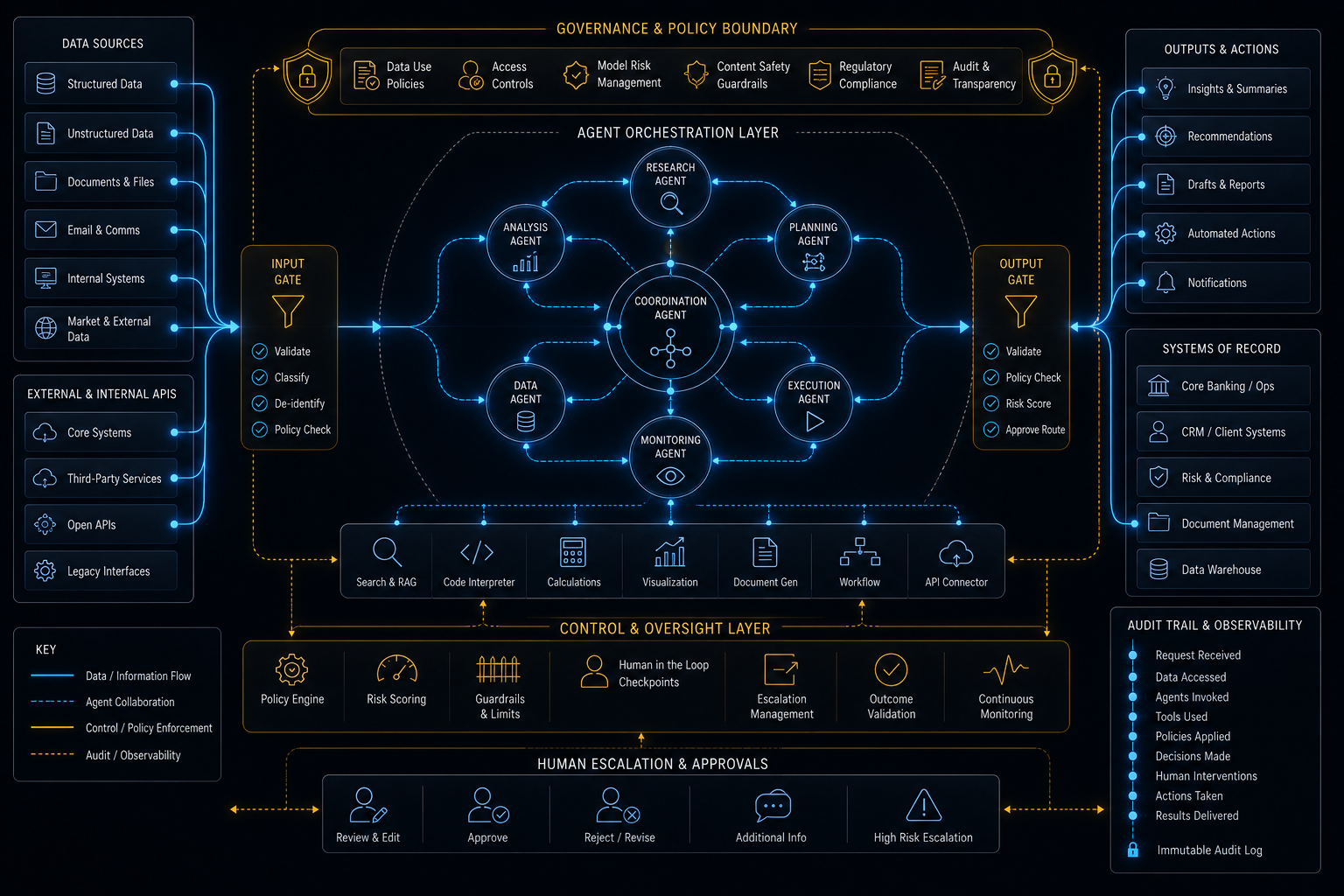
Agents are powerful because they can act. That is also why they need boundaries.
McKinsey describes agentic AI as a shift from model accuracy questions to accountability questions, because agency is a transfer of decision rights. In McKinsey’s words, the question becomes “Who’s accountable when the system acts?” source
That question should be taped to the door of every agentic AI steering committee.
Agentic AI is appropriate when work genuinely requires:
- multi-step planning
- dynamic context
- ambiguous inputs
- tool use across systems
- adapting to new information
- coordinating specialist capabilities
- natural language interaction
- reasoning over incomplete evidence
- human escalation at meaningful decision points
That is real value.
A financial crime investigation agent that assembles signals across transactions, customer records, sanctions data, adverse media, prior cases, and analyst notes may be justified.
A claims triage agent that reads documents, extracts facts, checks policy constraints, routes exceptions, and prepares a human review package may be justified.
A program intelligence agent that reads meeting notes, identifies weak risk signals, connects dependencies, and flags emerging release risk may be justified.
But an agent that checks whether a file arrived by 6:00 PM and sends an email if it did not?
My brothers and sisters in architecture, that is a scheduled job.
Why Financial Services Needs the Full Continuum
Financial Services institutions cannot afford automation monoculture.
They need options.
They need scripts for simple tasks.
They need workflows for routing and approval.
They need deterministic automation for rules and controls.
They need analytical AI for signals and predictions.
They need generative AI for synthesis and language work.
They need agentic AI for ambiguous, multi-step, tool-using, context-heavy workflows.
And they need the judgment to know the difference.
The World Economic Forum’s 2026 AI Playbook for Financial Services argues that AI represents a structural disruption in financial services and that firms need strong foundations across platform architecture, skills, culture, governance, risk, compliance, security, model risk, and human-AI partnership. It also emphasizes that people must remain firmly in the lead and that risk management and responsible AI need to be embedded at every layer. source
That is not a call for agentic everything.
That is a call for disciplined composition.
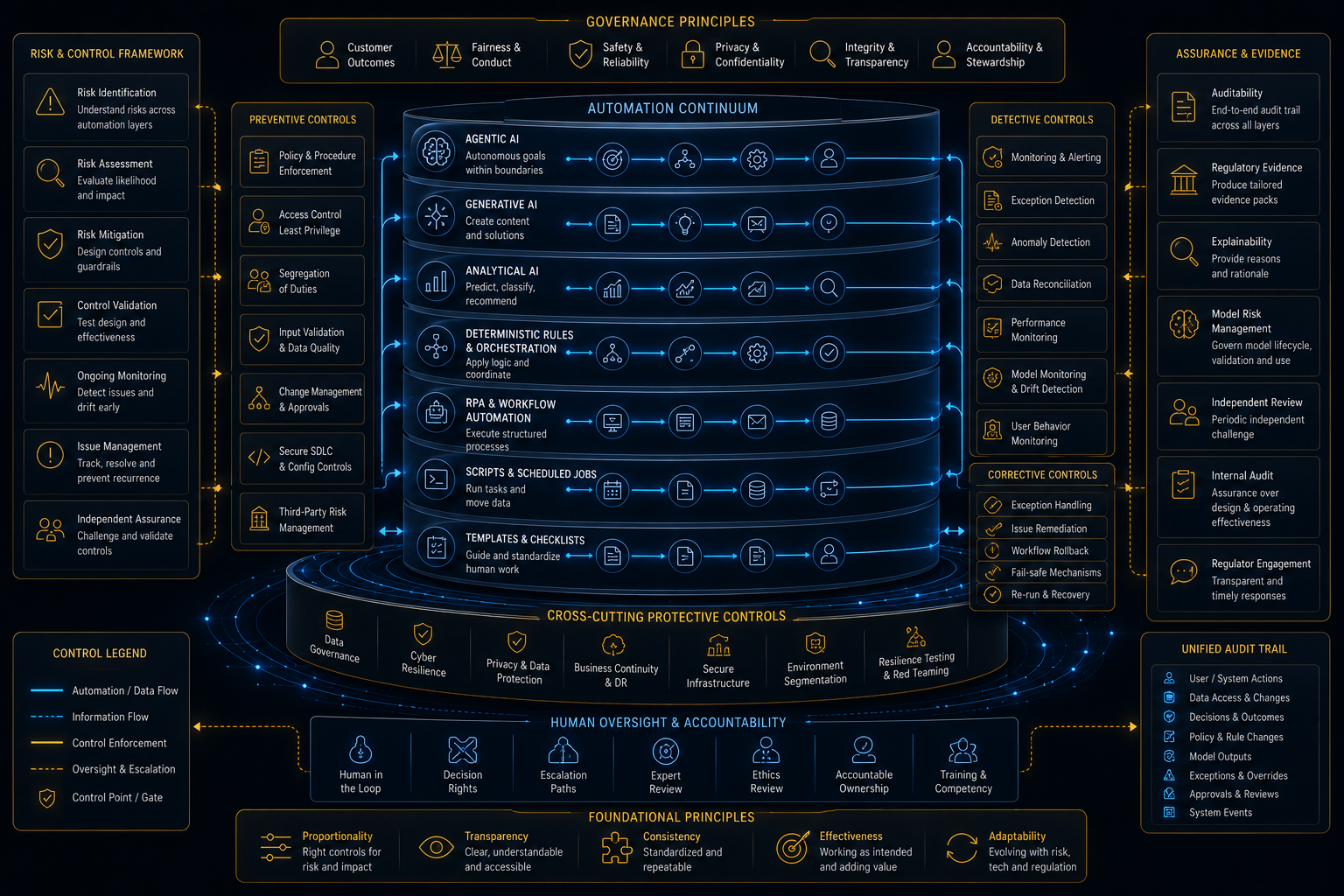
Financial Services automation is not just about capability. It is about capability inside controls.
The more autonomy you grant, the more control design matters.
At the lower layers, the control problem is usually simpler: did the job run, did it follow rules, did it log the result, did it handle exceptions?
At the upper layers, the control problem gets harder: what did the agent infer, which tools did it call, what data did it access, which decision rights did it exercise, what did it change, can the organization reconstruct the action, and who owns the outcome?
That is a different risk profile.
Treating all automation as if it were the same is how enterprises get surprised.
And surprise is generally frowned upon in regulated banking.
The Wrong-Tool Problem
The wrong-tool problem has two flavors.
The first is old and familiar:
Using brittle legacy automation for work that has too much ambiguity.
That is how teams end up with massive exception queues, manual workarounds, fragile bots, and the kind of operational “automation” that mostly automates disappointment.
The second is newer and more fashionable:
Using expensive AI agents for work that has too little ambiguity.
That is how teams end up with runaway costs, governance headaches, inconsistent behavior, and an uncomfortable realization that the agent is doing what a rule engine could have done with less drama and better logs.
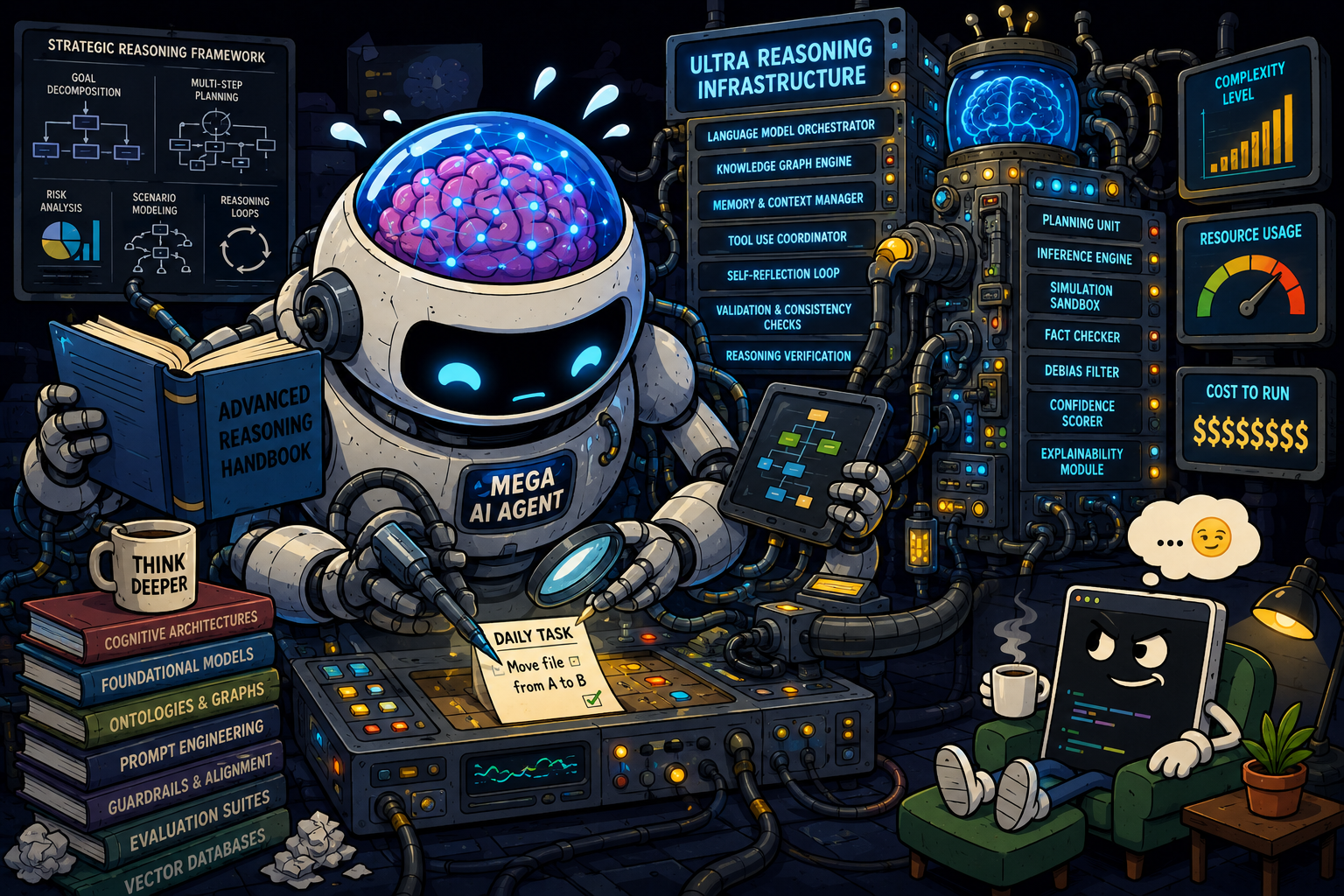
If the work is deterministic, do not summon a digital wizard.
This is not a theoretical concern.
Deloitte’s 2026 agentic AI work says many implementations are failing because organizations layer agents onto old workflows and because many apparent agentic use cases are really simpler automation use cases in disguise. source
McKinsey’s agentic AI governance work makes the risk side just as clear: agents can plan, call tools, and execute workflows, so organizations need auditable scope, ownership, inventory, control, monitoring, and rollback. McKinsey warns that if organizations cannot inventory and identity-bind agents, they are not scaling agents; they are scaling unknown risk. source
That is the pincer movement.
Use agents where they are not needed, and you waste money.
Use agents where you cannot govern them, and you create risk.
Use them where they truly fit, inside the right controls, and now we are talking.
A Practical Decision Framework
Here is the simple version.
Start low on the continuum.
Then move up only when the problem demands it.
Ask these questions:
1. Can we define the rules?
If yes, start with deterministic automation.
If no, move toward analytical, generative, or agentic patterns.
2. How much ambiguity exists?
Low ambiguity belongs lower on the continuum.
High ambiguity may justify AI.
3. Does the system need to act, or only inform?
If the system only needs to summarize, classify, predict, or recommend, do not automatically grant it action rights.
Action changes the risk profile.
4. What is the cost of being wrong?
A wrong internal summary is one thing.
A wrong payment, credit decision, trade, customer communication, or compliance action is another.
5. Can we explain and audit the outcome?
If the answer is no, stop pretending the use case is production-ready.
6. Can a human meaningfully supervise the workflow?
Human-in-the-loop should not mean “a person glances at the smoking crater after the agent is done.”
Oversight has to be designed.
7. What is the cheapest safe pattern?
This is the question that needs to come back into fashion.
Not cheapest in a reckless way.
Cheapest safe.
Cheapest auditable.
Cheapest resilient.
Cheapest that actually works.
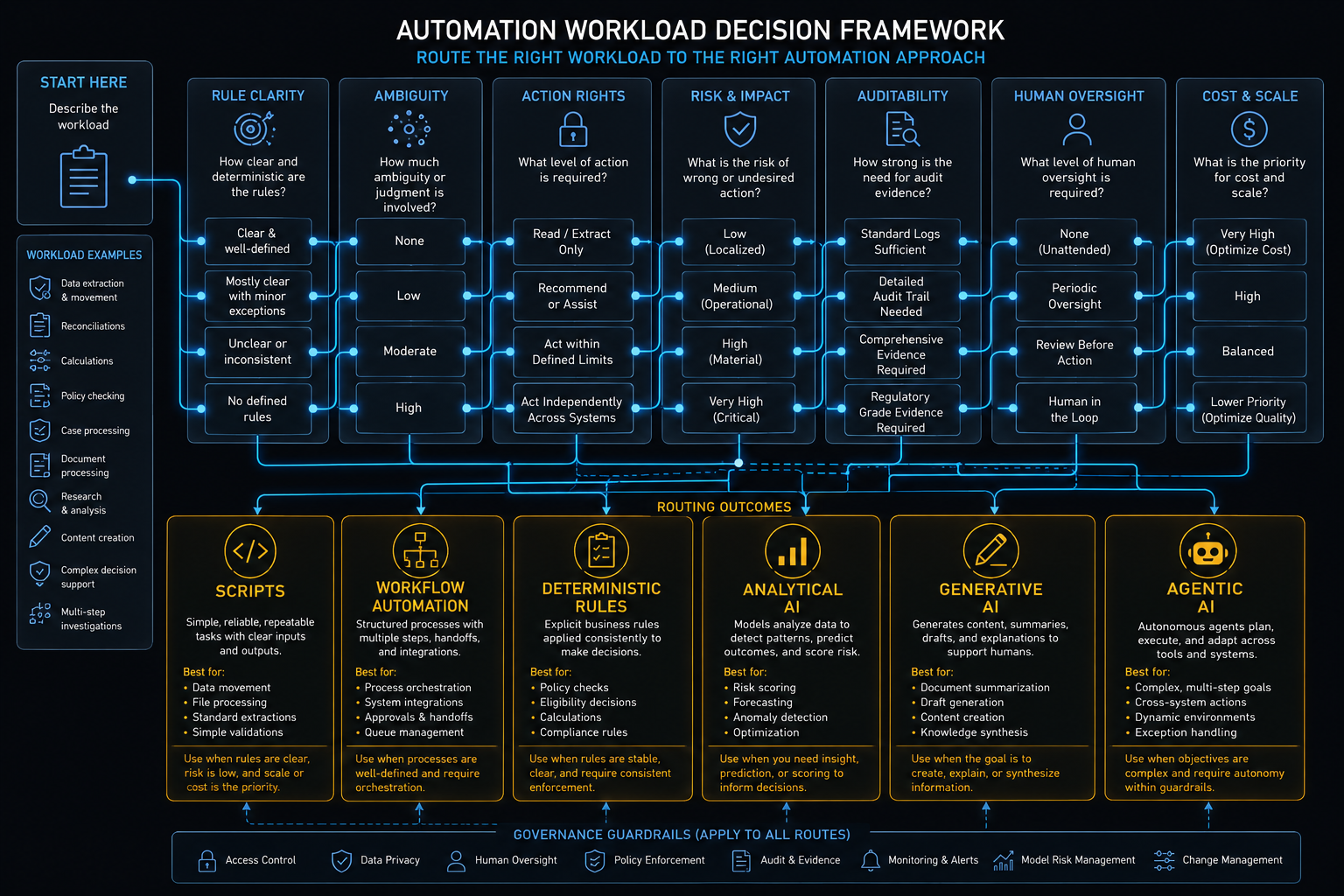
Start low. Move up only when the workload earns the complexity.
The Rule of Cheapest Safe Automation
Here is the rule I would use:
Push every workload as far down the automation continuum as it can safely go.
That one sentence can save a lot of money.
It can also save a lot of governance pain.
If a script works, use the script.
If a workflow engine works, use the workflow engine.
If a rules engine works, use the rules engine.
If predictive AI adds insight, use predictive AI.
If generative AI helps synthesize messy language, use generative AI.
If agentic AI is truly needed because the work requires reasoning, tool use, adaptation, and multi-step decision support, then use the agent.
But make it earn the job.
This is not anti-agent.
It is pro-fit-for-purpose.
And in the next few years, fit-for-purpose is going to matter more than AI enthusiasm.
The Cambridge 2026 Global AI in Financial Services Report found that 81% of surveyed financial services firms are adopting AI at some level, but only 14% currently see AI as transformational to organizational strategy and competitive advantage. The report also found that data quality, talent, and legacy architecture remain core constraints to adoption and scaling. source
That is the gap.
Adoption is easy to declare.
Transformation is harder to prove.
What Good Looks Like
A mature enterprise automation strategy does not worship any one technology.
It composes.
It uses deterministic workflows for known controls.
It uses analytics for signals.
It uses generative AI for language and synthesis.
It uses agents for dynamic reasoning and cross-system execution.
It wraps everything in identity, logging, policy, evidence, monitoring, cost controls, rollback, and human accountability.
It treats automation as an operating model capability, not a collection of vendor demos.
Good automation strategy looks like this:
- Workloads are classified by ambiguity, risk, auditability, cost, and autonomy.
- Deterministic automation is used wherever rules are knowable.
- AI is used where it changes insight, quality, speed, or decision effectiveness.
- Agentic AI is reserved for workflows that genuinely require agency.
- Human oversight is designed into high-impact decisions.
- Every automated action has an owner, log, policy boundary, and rollback plan.
- Leaders measure business outcomes, not tool adoption.
- The automation portfolio is continuously reviewed for cost, risk, and fit.
That last point matters.
Some of today’s agentic workloads will be tomorrow’s deterministic workflows.
Once the organization learns the process, stabilizes the rules, and understands the exception patterns, the workload can move down the continuum.
That is not failure.
That is maturity.
The expensive reasoning layer helped discover the shape of the work.
The cheaper automation layer should eventually take over the stable parts.
That is how enterprises will get durable value instead of permanent AI theater.
Final Thoughts
Agentic AI is real.
It matters.
It will reshape enterprise work.
It will absolutely belong in Financial Services.
But agentic AI is not the answer to every automation problem.
Sometimes the answer is a workflow.
Sometimes the answer is a rules engine.
Sometimes the answer is a better data feed.
Sometimes the answer is a script with clean logs and one adult owner.
Sometimes the answer is to fix the process before automating anything at all.
The smartest enterprises will not be the ones that put agents everywhere first.
They will be the ones that learn how to compose automation intelligently across the full continuum.
Use the cheapest safe pattern.
Preserve auditability.
Control autonomy.
Measure outcomes.
Keep humans accountable where judgment matters.
And for the love of everything operationally sane, stop throwing agents at problems a script could solve.
The future is not agentic everything.
The future is fit-for-purpose automation.
And that future is going to be a lot cheaper to run.
Join the Conversation
Where is your organization overusing advanced automation?
Are teams reaching for agents when deterministic automation would work?
Are legacy automation tools being dismissed too quickly because they are not shiny enough?
Where does AI genuinely add reasoning value?
Where does it mostly add cost, risk, and another dashboard?
I would love to hear the real-world version.
Not the vendor-demo version.
The practical version from the messy middle, where budgets, governance, architecture, delivery teams, and executive expectations all collide.
What work should move up the continuum?
What work should move down?
And what work should probably not be automated until someone fixes the process underneath it?
About the Author
Joe Mack is a Technology Consulting Senior Principal specializing in technology leadership, enterprise SDLC transformation, release management, deployment governance, and delivery optimization for household name Financial Services companies. Joe is also a lifelong self-learner and builder of systems, and Free Tier Life is one of the ways he is trying to turn those experiences and instincts into something other people can actually use.
Bibliography
- Deloitte. “The Agentic Reality Check: Preparing for a Silicon-Based Workforce.” Tech Trends 2026, December 10, 2025.
- McKinsey & Company. “State of AI Trust in 2026: Shifting to the Agentic Era.” March 25, 2026.
- McKinsey & Company. “Trust in the Age of Agents.” March 5, 2026.
- World Economic Forum, in collaboration with Accenture. “The AI Playbook for Financial Services.” June 2026.
- Cambridge Centre for Alternative Finance. “The 2026 Global AI in Financial Services Report: Adoption, Impact and Risks.” April 2026.
- Microsoft Cloud Blog. “AI in Financial Services: Bringing Trusted Data into the Flow of Work.” June 25, 2026.