
Stop Treating Agentic AI Like Gravity: Optimize for Future-Proofing, Not Speed-to-Agent
Published on Aug 17, 2026
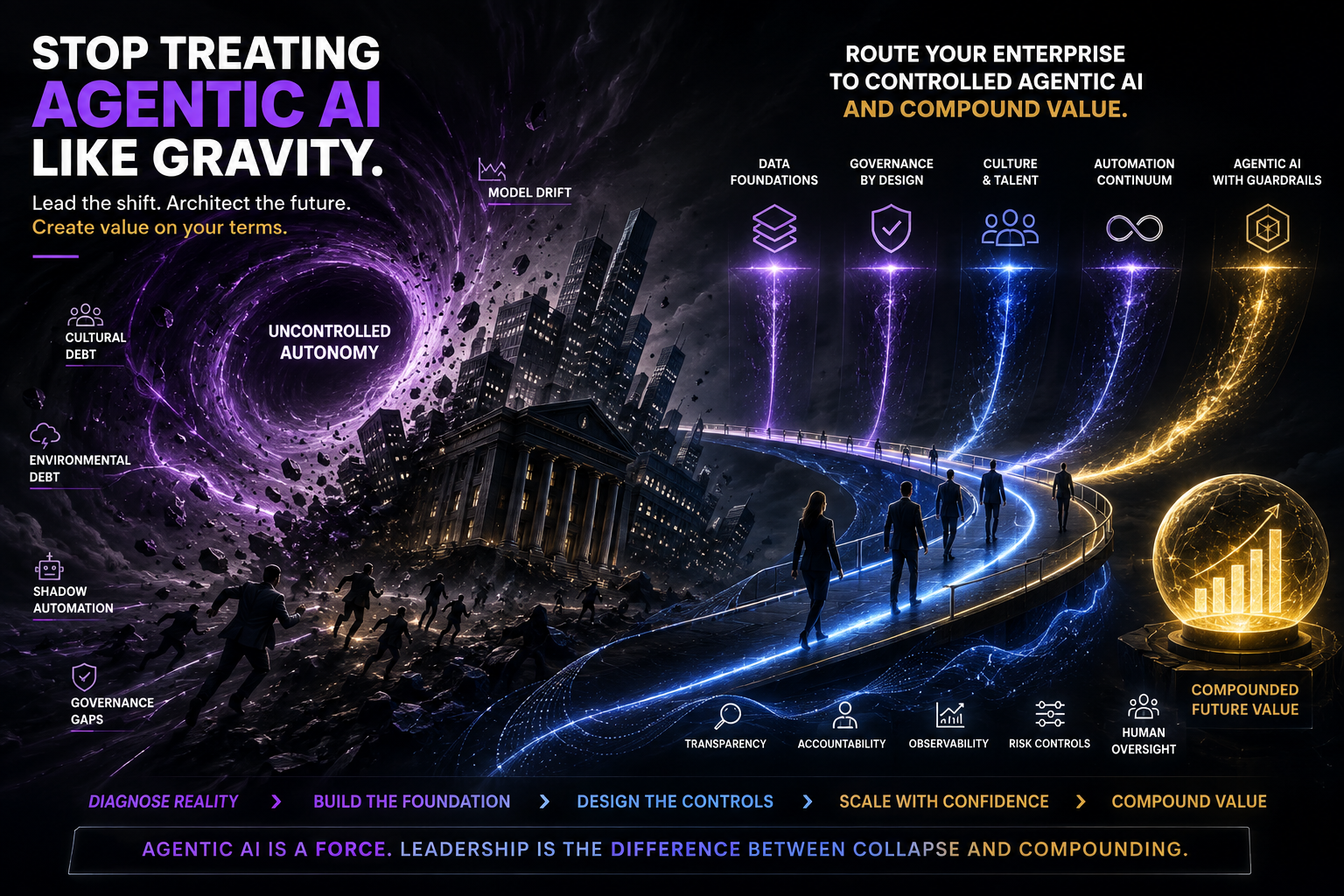
Stop Treating Agentic AI Like Gravity
Optimize for Future-Proofing, Not Speed-to-Agent
The responsible transformation goal is not maximum agentic adoption. It is maximum future-proofing.
There is a dangerous assumption hardening inside modern transformation work.
The assumption goes something like this:
Agentic AI is coming. Every serious enterprise has to get there. Financial Services firms need to move fast or get left behind. The only real question is how quickly leadership can scale the technology, train the workforce, update governance, and start harvesting value.
That sounds crisp and clean.
It also sounds like it came directly from the marketing department, and has never had to be explained to a regulator, a customer, a burned-out operations team, or the person whose job was just “augmented” into a vague professional fog bank.
I am not anti-agentic AI, I promise.
I am, however, VERY MUCH anti-hype and anti-silliness.
Agentic AI is being treated like a force of nature. Something inevitable. Something every institution must accelerate toward. Something that belongs at the center of every modern operating model because the market said so, vendor demos made everyone ‘ooh’ and ‘aah,’ and every executive forum suddenly adopted the same new vernacular over a three-week period.
That is not strategy.
That is herd behavior with better lighting.
Financial Services should be especially careful here. This industry was never supposed to be the drunk guy sprinting into the fireworks tent with a book of matches.
For very good reasons.
Customers are not beta testers. Production systems have consequences. Trust is not decorative. Regulators do not grade on innovation enthusiasm. Culture does not heal itself because an AI roadmap says “human-centered” in a tasteful font.
Agentic AI may, and likely will, absolutely become part of the future for every enterprise.
But rushing firms toward agentic AI as quickly as possible may be the incorrect mandate - and hardly anyone is even considering that possibility.
A better mandate might be…helping institutions become FUTURE-READY:
- data-ready
- governance-ready
- automation-ready
- culture-ready, and…
- agentic-capable only where the work actually earns it
That is a very different job.
Less shiny.
Much more useful.
The Short Version
If you only remember six things from this article, make them these:
- Financial Services should not optimize for speed-to-agent. It should optimize for maximum future-proofing.
- No-regrets work matters most: data quality, metadata, lineage, identity, controls, observability, evidence, decision records, ownership, and process transparency.
- Agentic AI should have to earn autonomy through value, scope, evidence, controls, cultural readiness, and explicit risk acceptance.
- Cultural debt is real. If agents bypass the hard human learning leaders were supposed to create, the enterprise may gain efficiency and lose capability.
- Environmental debt belongs in the ledger. AI infrastructure consumes real energy, water, land, and capital. Those costs should not vanish behind a productivity slogan.
- The responsible path is not “go agentic faster.” The responsible path is a future-proofing portfolio that separates no-regrets foundations from reversible bets, strategic wagers, and high-consequence slow-down zones.
The Dangerous Assumption
The current agentic AI conversation has a weird inevitability problem.
It sounds like this:
“We need to become agentic.”
Do we?
Everywhere?
At what autonomy level?
Inside which workflows?
With what permissions?
Against which risks?
At what cultural cost?
With what evidence trail?
With what environmental footprint?
With what rollback mechanism?
Those questions, if ever asked, tend to arrive late, usually after a proof of concept and a talent show, best-case demo for the steering committee.
That is backward, if you ask me.
Gartner warned in May 2026 that applying one-size-fits-all governance to AI agents can lead to enterprise failure, and it predicted that by 2027, 40% of enterprises would demote or decommission autonomous AI agents because governance gaps surface after production incidents. source
That should make people sober up and try to get ahead of that shift, no?
The problem is not that agents are useless. The problem is that autonomy changes the risk surface. A chatbot can say something wrong. An agent can do something wrong. That difference is not academic when the workflow touches customer records, payments, claims, credit, compliance, fraud, production change, or operational resilience.
The moment AI starts acting, leadership cannot keep pretending this is just another productivity tool.
An autonomous actor inside a regulated enterprise is not a toy.
It is an operating-model decision with a corporate credit card, a cloud bill, and a blast radius.
Financial Services Was Not Built to Sprint Into the Fireworks Tent

Financial Services caution is not cowardice. Sometimes caution is the control that keeps the fireworks out of the customer ledger.
Financial Services has never been famous for reckless early adoption.
This is usually said like an insult.
It is not.
Financial Services is conservative because the stakes are real. Money moves. Customer trust matters. Fraud adapts. Regulators ask questions. Systems are integrated in ways that can make one “small change” feel like pulling a thread on a very expensive sweater.
The industry absolutely needs modernization. No argument there.
But “modernization” and “maximum autonomy” are not synonyms.
KPMG’s 2026 Banking Technology Survey reported that 80% of banking executives expect AI to significantly disrupt business and operating models over the next three to five years. The same survey found that 92% are increasing cybersecurity budgets, 84% are increasing cybersecurity investment for AI-related risks, and top emerging threats include AI-introduced code vulnerabilities, deepfakes, AI bots, and securing agentic technologies. source
So, what does this mean?
Disciplined sequencing is the path forward, not panic-fueled adoption at scale, racing to use the most expensive cloud resources and least-governed tooling in the whole company.
Bank Director’s 2026 Risk Survey found that a third of surveyed bank leaders said they do not understand agentic AI at all, while AI-related fraud and scams targeting customers and employees ranked as major concerns. source
So yes, clients are asking for agentic AI.
Of course they are. It would probably be irresponsible if they were not asking for it.
However, they are also asking how to compete, reduce cost, improve experiences for both customers & employees, address risk, and avoid being the institution that shows up five years late to the future with a laminated org chart and a suspiciously fresh innovation strategy.
But when a client is screaming for speed, the advisor’s job is not to nod faster.
The advisor’s job is to help the client decide what deserves speed, what deserves foundation work, what deserves experimentation, what deserves board-level risk acceptance, and what deserves a very polite “absolutely not yet.”
That is leadership.
That is consulting.
That is the job.
Maximum Future-Proofing Beats Maximum Agentic Adoption
Here is the better north star:
Maximum future-proofing, not maximum agentic adoption.
Future-proofing means doing the work that makes the enterprise stronger regardless of which AI platform wins, which vendor gets acquired, which regulation lands next, which model gets cheaper, which architecture pattern becomes fashionable, or which executive suddenly discovers the word “orchestrator.”
No-regrets modernization is powerful because it pays off across multiple futures.
Better data helps deterministic automation.
Better metadata helps analytics.
Better lineage helps auditability.
Better identity helps security.
Better decision records help governance.
Better process transparency helps human teams.
Better event capture helps program intelligence.
Better ownership helps everything.
None of that depends on a single agent.
Of course, if agents eventually belong in the workflow, all of that will make for safer agents.
NIST’s AI Risk Management Framework is built around Govern, Map, Measure, and Manage, with governance designed as a cross-cutting function across the AI lifecycle rather than a decorative committee at the end of the hallway. source
That is the spirit of future-proofing.
Build and train your muscles before trying to lift a car.
The Future-Proofing Portfolio
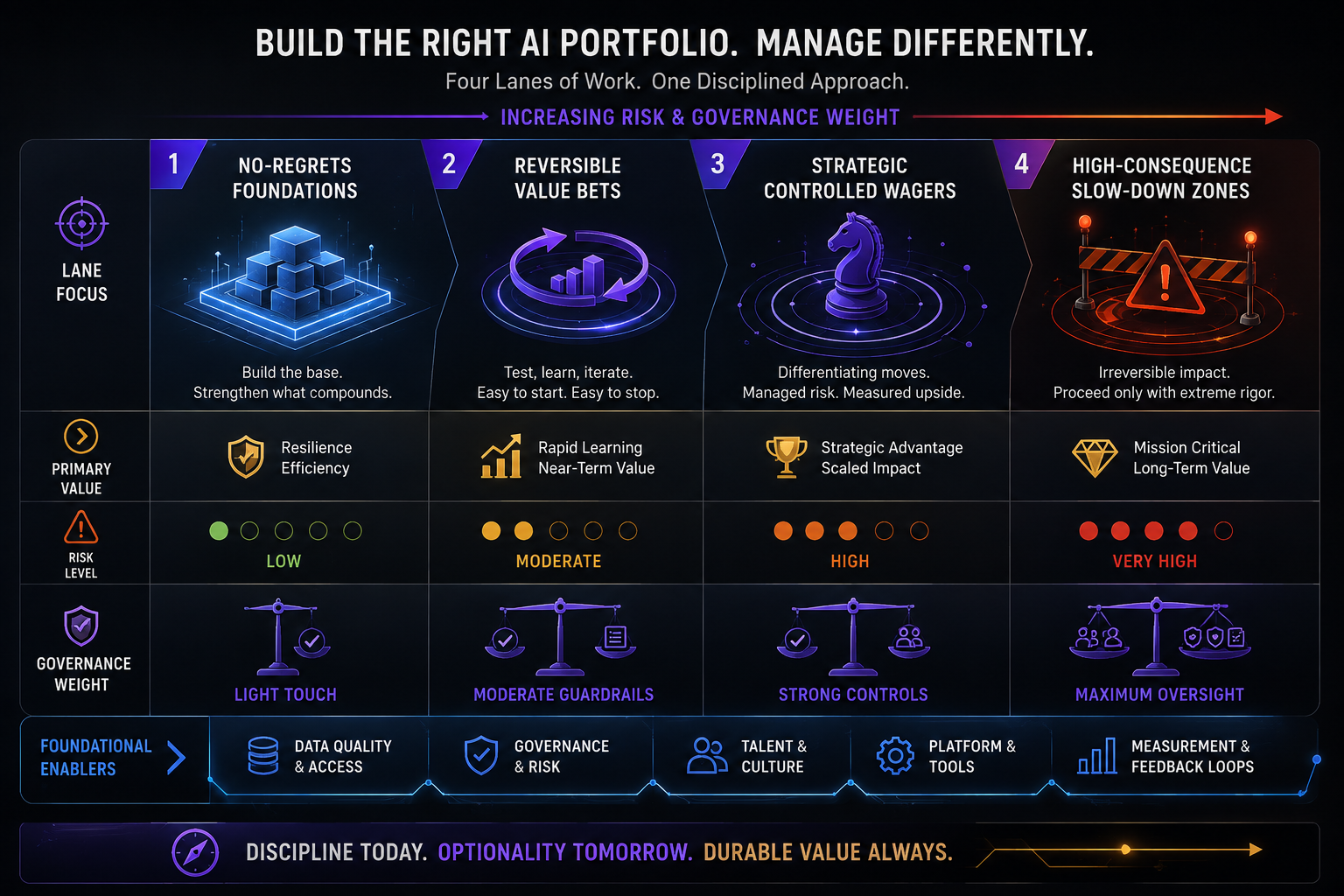
A responsible AI transformation portfolio separates foundational work from bounded experiments, controlled wagers, and places where speed becomes governance malpractice.
I would group modern AI and automation transformation work into four categories.
Not because the world needs another framework.
The world is already at capacity for frameworks.
This matters because different work deserves different urgency, governance, funding, risk appetite, and leadership attention.
1. No-Regrets Foundations
This is work the enterprise should do even if the current agentic AI wave underdelivers.
Examples:
- data quality
- metadata discipline
- data lineage
- identity and access hygiene
- API modernization
- event logging
- decision records
- control inventories
- ownership clarity
- automation inventories
- process transparency
- evidence capture
- risk taxonomy cleanup
- knowledge hygiene
- workflow observability
No-regrets work is not glamorous.
That is fine.
Neither is plumbing, and civilization seems fairly fond of it.
This is the work that makes every future easier: deterministic automation, analytics, generative AI, agentic AI, audit readiness, operational resilience, and human decision-making.
If a consulting team wants to help a Financial Services client move faster, this is where speed belongs.
Move fast on the foundations.
2. Reversible Value Bets
This is where AI and automation can create value quickly, with bounded downside.
Examples:
- AI-assisted summarization with human review
- knowledge search over approved content
- internal copilots
- deterministic workflow automation
- read-only agents
- analytics that surface signals without acting autonomously
- low-risk drafting support
- internal advisory tools
- controlled experimentation in non-customer-impacting workflows
These are not zero-risk.
But the blast radius is smaller, the learning is reusable, and the work can usually be stopped without calling twelve committees and three holy men.
This is the right zone for fast learning.
3. Strategic Controlled Wagers
This is where agentic AI may belong.
Examples:
- release readiness investigation
- fraud investigation support
- operational risk triage
- evidence gathering across systems
- dependency analysis
- exception routing with human approval
- internal workflow orchestration inside narrow guardrails
- root cause investigation across approved tools
These are wagers because they require autonomy, tool use, reasoning, and trust boundaries.
They can be worth it.
Some will be very worth it.
But they need a control plane: identity, permissions, monitoring, evidence, human review, escalation, rollback, audit trail, cost controls, and clear ownership.
An agent should have to earn autonomy.
That sentence should probably be nailed to the door of every AI transformation room.
4. High-Consequence Slow-Down Zones
This is where speed can become malpractice.
Examples:
- agents executing customer-impacting financial decisions
- autonomous credit, underwriting, claims, or suitability workflows
- agents with write access across production systems
- agents interacting directly with customers in high-stakes scenarios
- agents replacing human decision forums for unresolved organizational problems
- workforce-displacement-first use cases
- opaque vendor-controlled agents in regulated workflows
- agentic workflows with broad permissions and thin evidence
This does not mean never.
It means, simply, let’s slow down because the blast radius of these type of workflows is quite large. Let’s make sure we get it completely correct.
Make the risk explicit. Make the governance real. Make the evidence traceable. Make the human accountability undeniable.
If the blast radius includes customers, capital, compliance, employment, resilience, trust, or culture, urgency is not the right strategy.
It is just speed for the sake of speed, completely ignoring the increased risk profile.
No-Regrets Work Is Where the Real Leverage Lives
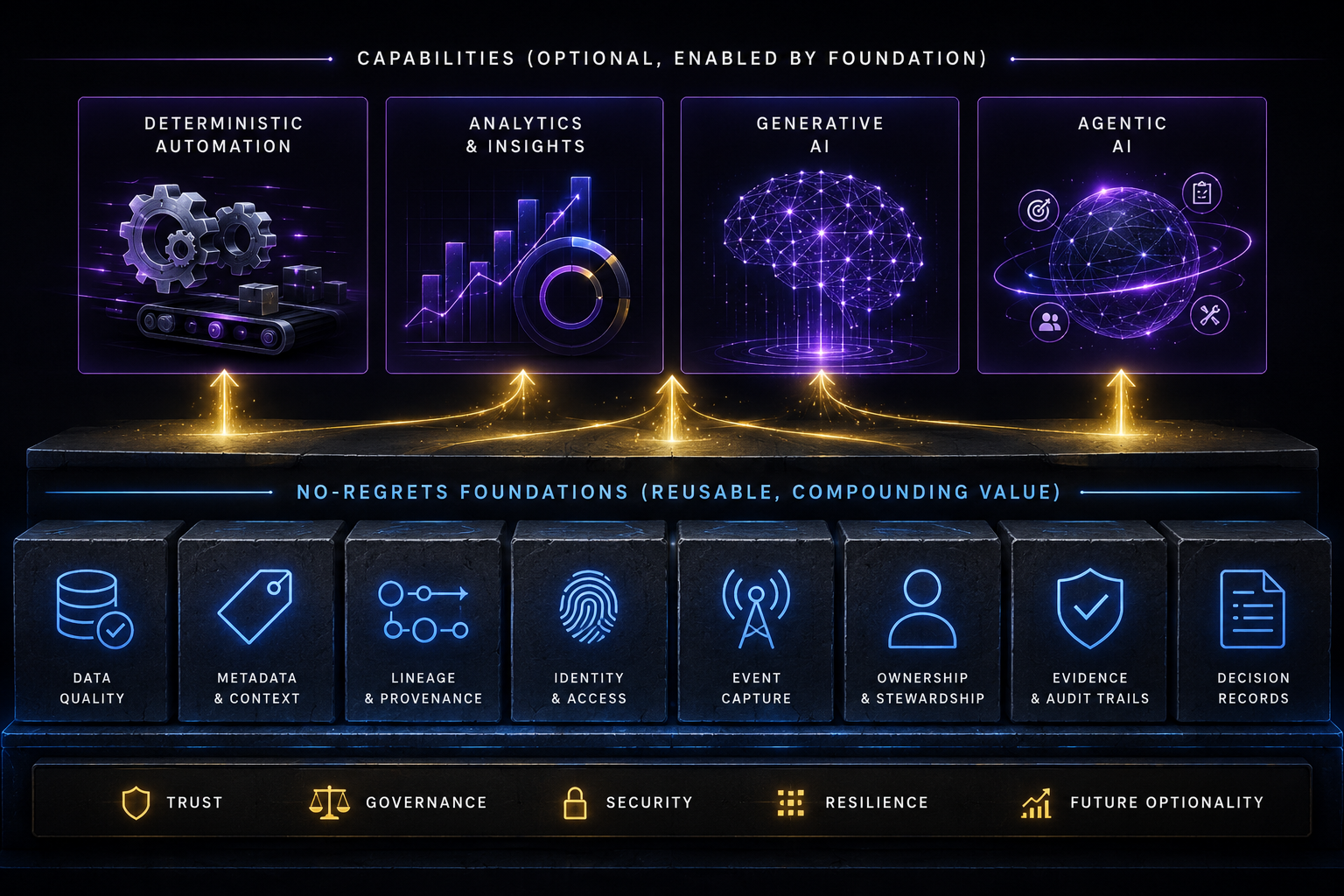
No-regrets work makes the enterprise stronger before the agent ever shows up.
The frustrating truth is that most enterprises already know what the foundations are.
They know the data is messy.
They know ownership is unclear.
They know decision records are scattered.
They know controls are inconsistently evidenced.
They know too many processes depend on institutional memory trapped inside exhausted humans.
They know the system is not as observable as the dashboard pretends.
Then an AI program arrives and somehow everyone acts surprised that the same old mess did not become a clean operating model because someone added a model endpoint.
No-regrets work is usually obvious, and therefore not very exciting.
That is also why it is unforgivable to skip.
And here is the key point: no-regrets work is not just preparation for AI.
It is better management.
It is better governance.
It is better operations.
It is better decision-making.
It is better leadership.
The AI may come later.
The enterprise gets better immediately.
That is the kind of investment Financial Services leaders should love.
It creates value in multiple futures.
Cultural Debt Is Real
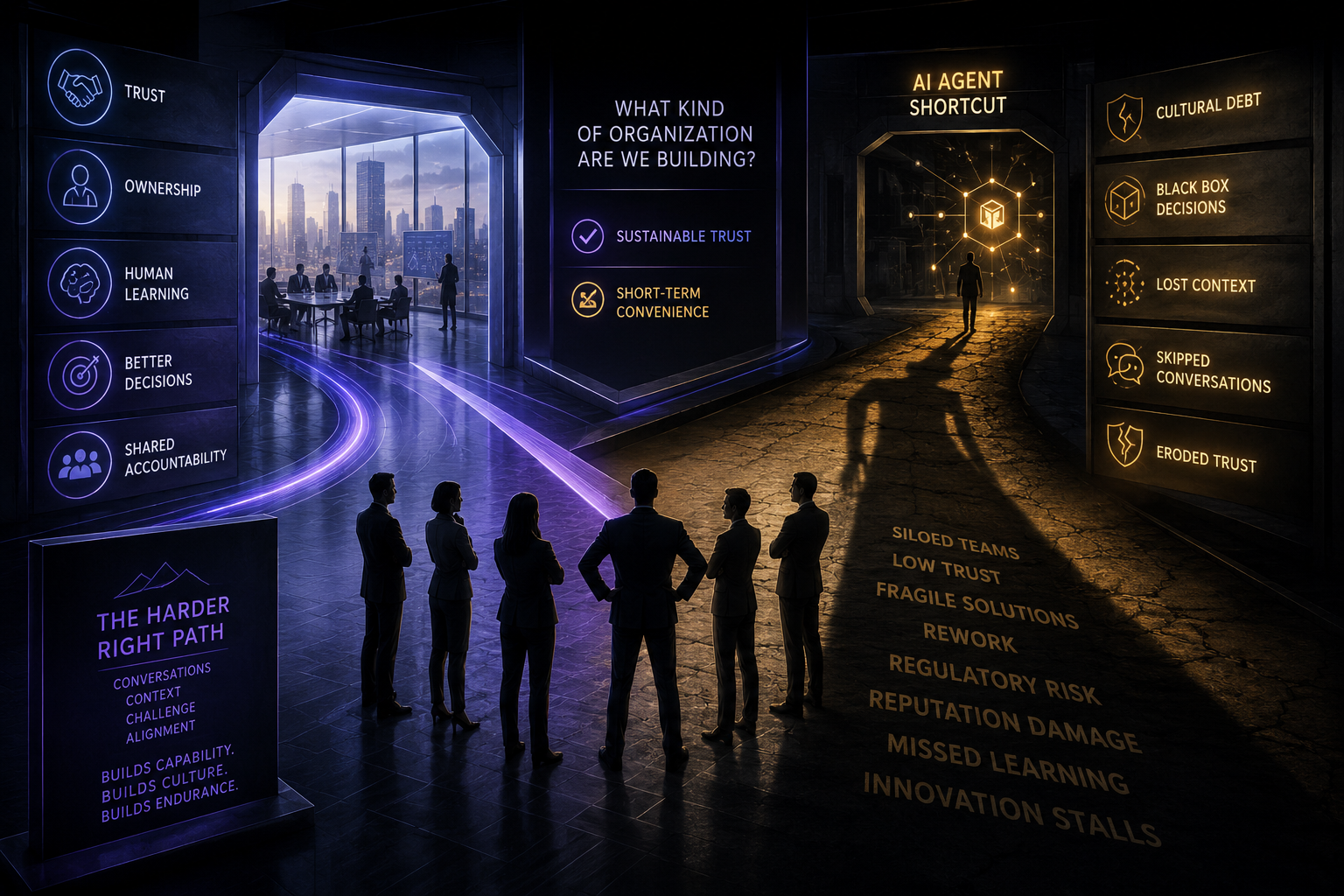
Cultural debt accumulates when technology lets the organization avoid the hard human work it needed to do.
Here is one part of the Agentic AI push that does not get enough oxygen.
Agentic AI can create a lot of cultural debt, if you are not careful.
Cultural debt is the loss of trust, capability, agency, shared ownership, and human problem-solving muscle created when organizations use technology to bypass hard human work.
That sounds touchy-feely until the bill shows up.
If teams have not learned to make decisions, assigning an agent to coordinate the workflow does not fix leadership issues.
If workstreams do not trust each other, automated routing of messages does not build or repair trust.
If ownership is unclear, an agent may only make the ambiguity move faster.
If leaders avoid conflict, agentic AI can become the most expensive conflict-avoidance mechanism in the entire building.
If employees already feel replaceable, invisible, or uncertain, dropping agents into long-standing pain points can easily feel less like empowerment and more like management saying, “Good news, we found a way around you.”
APA’s 2026 workplace uncertainty analysis says workers are navigating economic instability, policy changes, and AI disruption, with many reporting feeling disengaged, replaceable, and invisible. APA also emphasizes that job insecurity affects mental health, physical health, and job satisfaction, and that organizations can help by communicating transparently and demonstrating that employees matter. source
Wait. Employees still matter?
You’re damn right they do!!!
The future of work does not run only on models and APIs.
It runs on trust.
Here is the line I keep coming back to:
If an agent solves the problem leaders were supposed to learn from, the enterprise may gain efficiency and lose capability.
That is not a reason to stop using agents.
It is a reason to be honest about what the agent is replacing.
Is the agent removing toil?
Great.
Is the agent improving signal visibility?
Excellent.
Is the agent helping humans make better decisions?
Good.
Is the agent quietly bypassing conversations the organization needed to have?
Uh-oh! Now we have a problem.
The cultural debt will not show up in the first productivity dashboard.
It will show up later, when the organization has fewer people who understand the work, fewer teams willing to surface ugly truths early, and more leaders mistaking automation throughput for institutional capability.
That is how efficiency becomes fragility.
Throw in some dashboard theater, which either doesn’t know how to quantify cultural debt, or even intentionally skips it entirely, and you may end up with a ticking time bomb.
Environmental Debt Is Not a Footnote
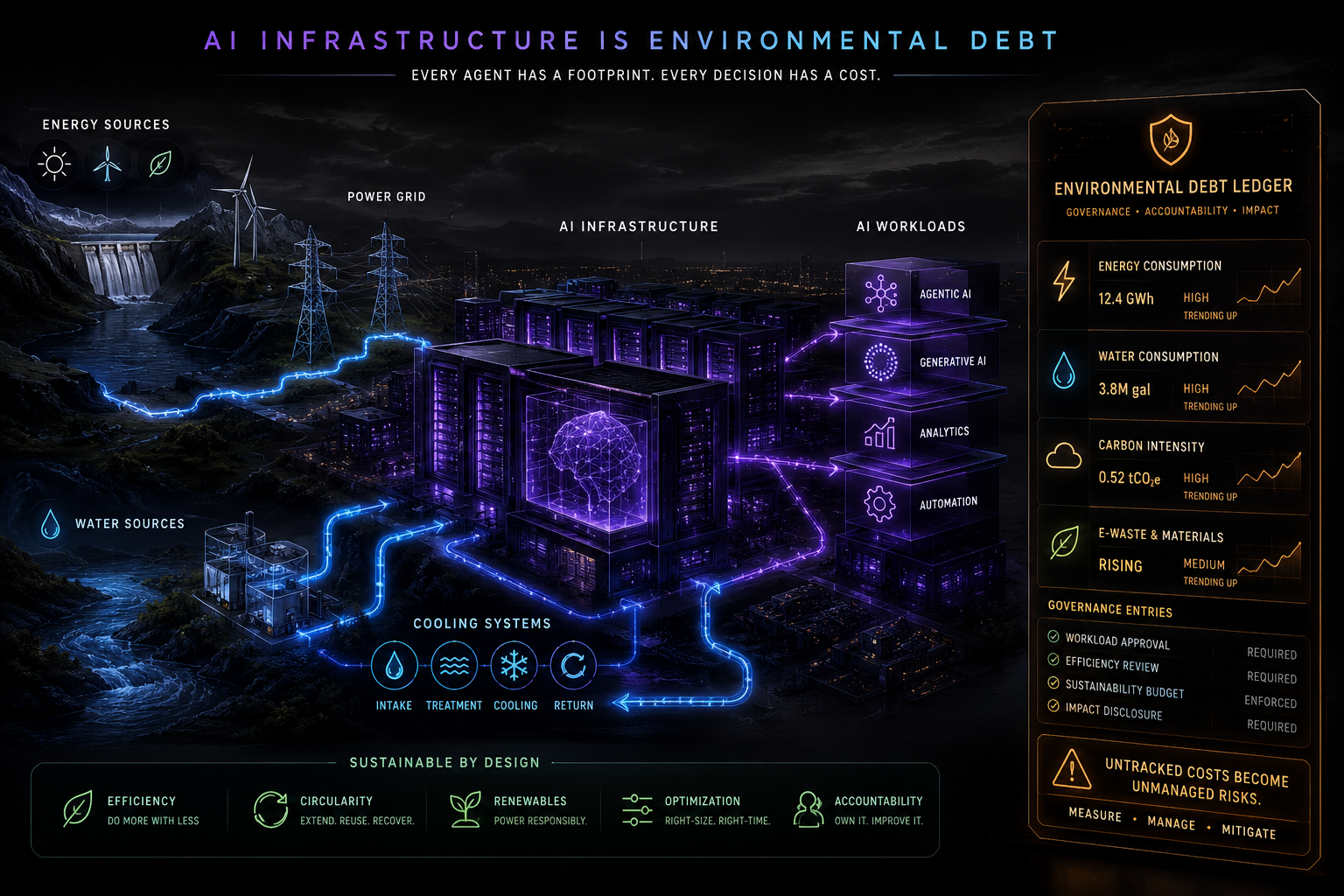
Do not spend environmental capital on performative automation.
The environmental cost of AI infrastructure is not a rounding error.
It belongs in the transformation ledger.
The International Energy Agency projects that global electricity generation needed to supply data centers will grow from 460 TWh in 2024 to more than 1,000 TWh in 2030 in its base case. The IEA also says natural gas and coal together are expected to meet more than 40% of additional data center electricity demand through 2030. source
The IEA also reported that data center electricity demand is set to more than double by 2030, with AI as the major driver, and that data centers are projected to drive a significant share of electricity demand growth in advanced economies. source
That does not mean AI is bad.
That does not mean agents should never be used.
It means environmental cost should not disappear behind the heading “innovation.”
If an agent enables meaningful fraud reduction, operational resilience, customer protection, risk management, or material productivity gains, fine. Make the case.
If an agent is doing work a deterministic rule could do with less cost, less complexity, less governance burden, and less compute consumption, then maybe the enterprise should stop pretending that that is progress.
Do not spend environmental capital on performative automation.
That line deserves a place in every governance deck.
Maybe in bold.
Possibly with a small picture of a server rack looking ashamed of itself.
Governance Has to Become a Ledger
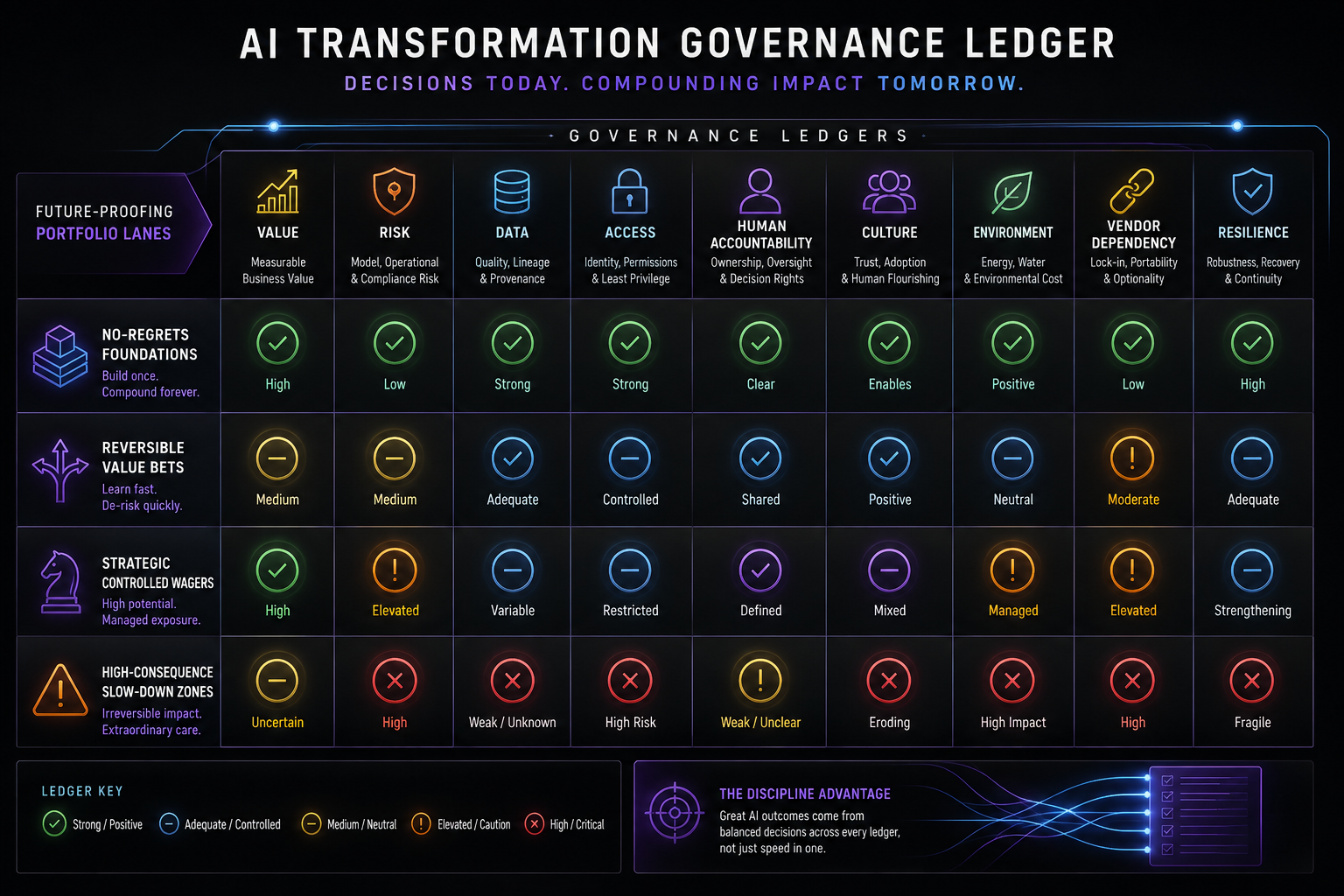
Governance should not be a ceremony that blesses the roadmap. It should be the ledger that shows what the transformation is really creating and consuming.
Governance cannot remain a single blob on the operating model diagram.
That is where good concepts go to become corporate soup.
Governance needs to be broken into ledgers:
- value governance
- risk and regulatory governance
- data and evidence governance
- access and tool governance
- human accountability governance
- cultural governance
- environmental governance
- vendor and dependency governance
- resilience governance
Each transformation move should be judged across those ledgers.
A no-regrets metadata effort may score well across most of them.
A read-only summarization assistant may require light governance.
A controlled agent that gathers evidence across systems may require more.
An autonomous agent making customer-impacting decisions requires a very different conversation.
This is the point Gartner is making with proportional governance for agents: different autonomy levels and trust boundaries need different controls. Over-restricting simple agents slows delivery and drives shadow development, while under-restricting higher-autonomy agents increases operational, security, and compliance risk. source
That is the real work.
Not one gigantic governance gate.
A risk-weighted portfolio.
Not one AI policy.
A transformation ledger.
Not one maturity curve toward agentic everything.
A future-proofing discipline.
What Leaders Should Ask Before They Say “Agentic”
Before approving a speed-to-agent strategy, leaders should ask better questions.
Start here:
- What problem are we solving?
- Is the work deterministic?
- Can rules, workflow, analytics, or generative AI solve enough of the problem?
- Does this require autonomy, or are we buying autonomy because the demo looked fancy?
- What no-regrets foundation work would make this safer and more valuable?
- What data, metadata, lineage, identity, evidence, and ownership gaps exist?
- What permissions would the agent need?
- What can the agent read, write, trigger, modify, approve, escalate, or delete?
- Who owns the business outcome?
- Who owns the risk?
- Who owns the override?
- What evidence is retained?
- What human learning might we bypass?
- What cultural debt could this create?
- What environmental cost are we accepting?
- How do we stop it?
- What happens when it is wrong?
- What value changes if it works?
- What value survives if the agentic technology changes or goes away?
- Is this future-proofing the enterprise or just dragging the enterprise toward the most fashionable edge of the hype cycle?
Those questions are not anti-innovation.
Those questions are the cost of being serious about innovation in the real world.
And Financial Services should be serious about innovation.
The industry has earned its cautious reputation the hard way.
The Better Mandate
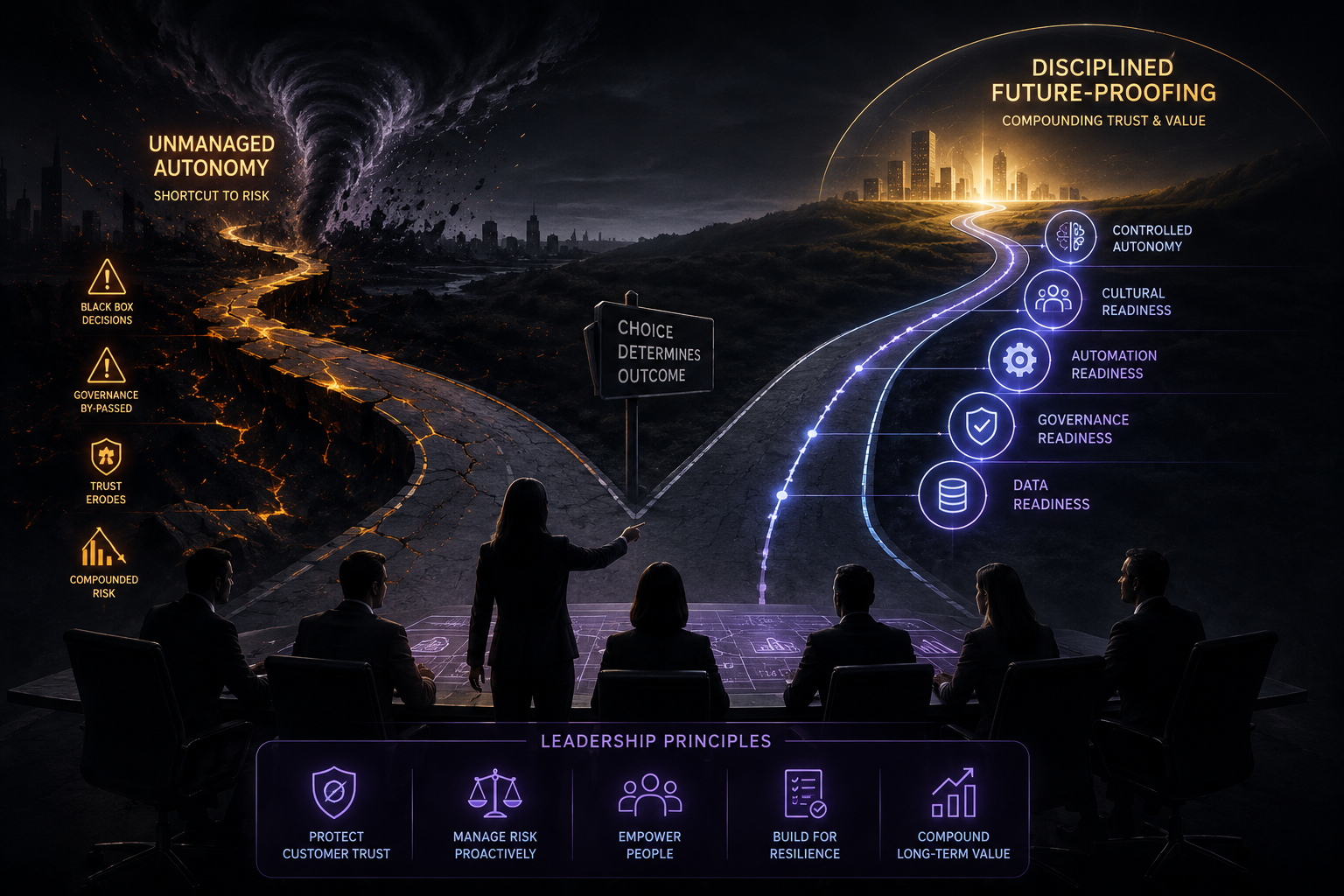
The better mandate is not “go agentic faster.” The better mandate is “become future-ready faster.”
Here is the consulting posture I would rather see:
Do not help clients become agentic faster.
Help clients become future-ready faster.
That means helping them become:
- data-ready
- metadata-ready
- governance-ready
- evidence-ready
- automation-ready
- culture-ready
- control-ready
- value-ready
- agentic-capable where agentic AI actually belongs
The distinction matters.
Agentic-ready is not the same as agentic-first.
Agentic-ready means the enterprise has enough foundation, ownership, observability, control, and trust to introduce autonomy responsibly where the value case earns it.
Agentic-first means every workload gets dragged toward the most dramatic answer before the enterprise has done the boring work required to make dramatic answers safe.
One of these approaches demonstrates leadership.
The other is simply a drunk guy sprinting toward the fireworks tent.
Choose carefully.
Where This Points Next
This idea belongs in the broader automation continuum conversation.
It also belongs in the leadership conversation.
And it absolutely belongs to “the messy middle.”
Because the messy middle is where strategic ambition meets operating reality.
It is where foundational work gets skipped because the future sounds urgent.
It is where culture gets treated like a communications plan.
It is where governance gets reduced to a control gate.
It is where teams are told to “move fast” inside systems that were never designed to move with transparency or reliability.
Agentic AI will not fix that mess, bur rather, will expose it.
The leaders who get this right will not be the ones with the most agents.
They will be the ones with the clearest judgment about where autonomy belongs, where it does not, what must be fixed first, and what debt they are willing to create in exchange for speed.
That is the leadership work.
Not worshipping, or even accepting as a fait accompli, the agentic future that everyone is talking about.
The right approach is building an enterprise that can shift and maintain transformation momentum in any future state.
Final Thoughts
Agentic AI may matter a lot.
In some places, it will be transformative.
In other places, it will be overbuilt automation with a cloud bill, a governance problem, and a cultural smell nobody wants to acknowledge in the meeting.
Financial Services should not treat agentic AI like gravity.
It does not have to happen everywhere.
It does not have to happen first.
It does not get to skip the foundation work because the market is excited.
The responsible goal is not maximum agentic adoption.
The responsible goal is maximum future-proofing.
Do the no-regrets work.
Make reversible bets.
Control the strategic wagers.
Slow down in high-consequence zones.
Measure value.
Protect trust.
Respect culture.
Count the environmental cost.
Make autonomy earn its place.
And please, for the love of every customer, regulator, employee, and exhausted transformation leader in Financial Services, stop pretending the drunk guy sprinting into the fireworks tent is showing courage.
Sometimes the bravest thing a leader can say is:
Not yet.
Join the Conversation
Where is your organization treating agentic AI like gravity?
Where does autonomy genuinely belong?
What no-regrets foundation work is getting skipped because the shiny thing has everyone distracted?
Where could agentic AI create real value?
Where could it create cultural debt?
Where should Financial Services move faster?
And where should it slow the hell down before someone hands an agent a tool, a credential, and a vague mandate to “optimize the workflow”?
I would love to hear the real-world version.
Not the keynote version.
The version from the room where the demo looked great and then Risk asked a question everyone should have asked six weeks earlier.
About the Author
Joe Mack is a Technology Consulting Senior Principal specializing in technology leadership, enterprise SDLC transformation, release management, deployment governance, and delivery optimization for household name Financial Services companies. Joe is also a lifelong self-learner and builder of systems, and Free Tier Life is one of the ways he is trying to turn those experiences and instincts into something other people can actually use.
Bibliography
- Gartner. “Gartner Says Applying Uniform Governance Across AI Agents Will Lead to Enterprise AI Agent Failure.” May 26, 2026.
- KPMG. “The 2026 Banking Technology Survey.” June 17, 2026.
- Bank Director. “Bank Director’s 2026 Risk Survey: AI Exposes Threats, Knowledge Gaps.” March 31, 2026.
- NIST AI Risk Management Framework Core. “Govern, Map, Measure, and Manage.”
- American Psychological Association. “Workers are facing an age of uncertainty.” January 1, 2026.
- International Energy Agency. “Energy supply for AI.” Energy and AI.
- International Energy Agency. “AI is set to drive surging electricity demand from data centres while offering the potential to transform how the energy sector works.” April 10, 2025.