
The $10 Script vs. the $10,000 Agent: A Decision Framework for Enterprise Automation
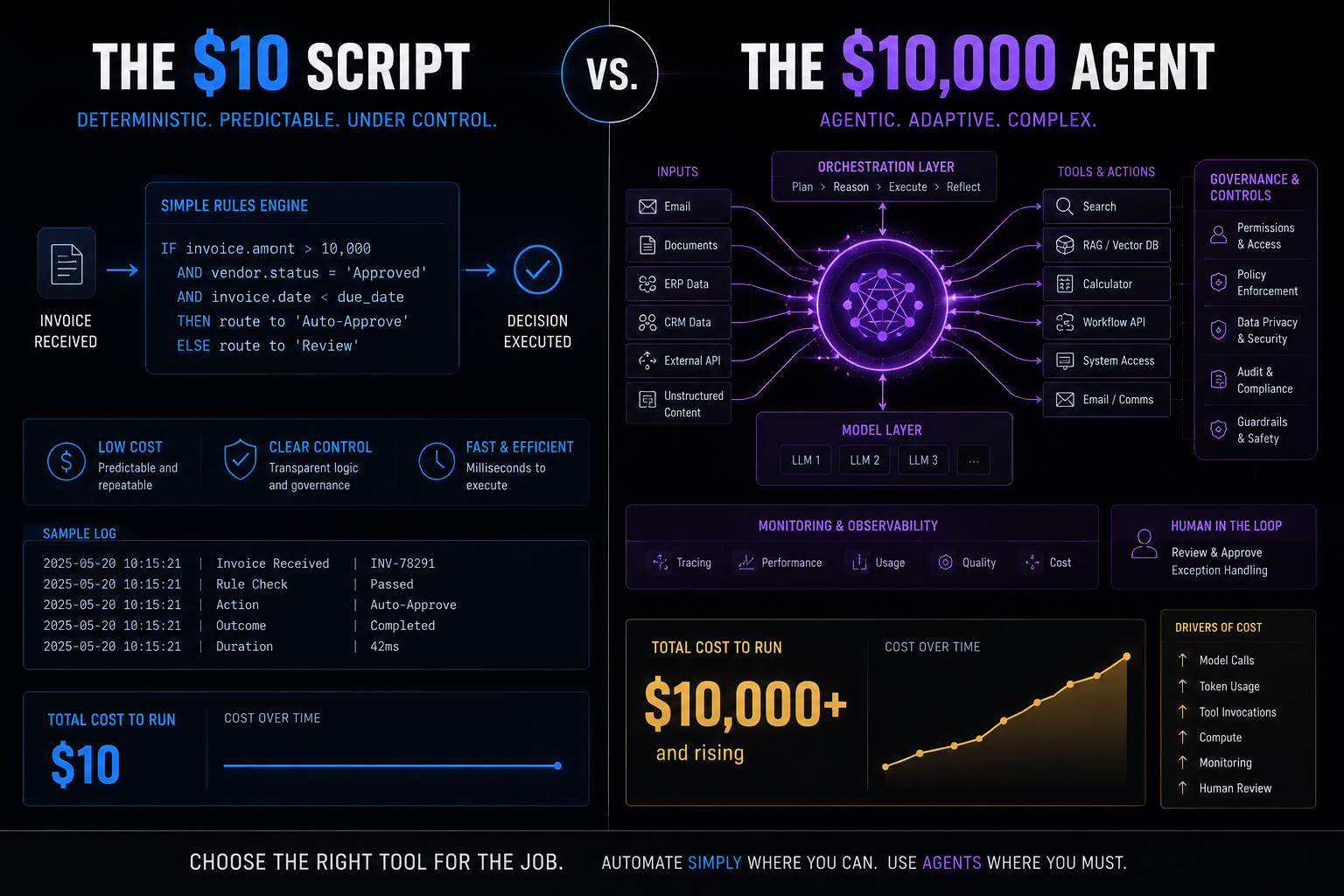
Published on Aug 10, 2026
The $10 Script vs. the $10,000 Agent
A Decision Framework for Enterprise Automation
The mature automation question is not “Can we use AI?” The mature question is “What is the cheapest, safest, most controllable pattern that can reliably solve this?”
There is a strange little sickness spreading through enterprise technology right now.
Every problem is being invited to audition for an agent.
Need to rename files?
Agent.
Need to route an approval?
Agent.
Need to check whether a field is missing?
Agent.
Need to summarize a two-paragraph status update?
Believe it or not, also agent.
Apparently, basic automation was discovered dead in a conference room, surrounded by innovation stickers and an infrastructure bill, rubber-stamped “Too Cheap to Be Any Good.”
Tool escalation is not transformation.
And in Financial Services, tool escalation gets expensive fast. Not just in cloud spend. In governance burden. In operating complexity. In model risk. In support obligations. In audit questions. In the joyful little moment when someone asks, “Why did the agent do that?” and the room suddenly discovers nobody knows.
Agentic AI is powerful. It will matter. In some areas, it will matter a lot.
But an agentic-first automation strategy can be fiscally irresponsible.
Sometimes a $10 script is the adult in the room.
The Short Version
If you only remember six things from this article, make them these:
- Not every automation problem deserves AI.
- Not every AI problem deserves an agent.
- Deterministic automation still matters because many enterprise problems are rule-based, repeatable, and boring in exactly the right way.
- Generative AI earns its place when language, summarization, translation, synthesis, or pattern explanation creates value.
- Agentic AI earns its place when ambiguity, multi-step reasoning, planning, tool use, and adaptive investigation justify the cost and risk.
- The best automation strategy routes work across the full automation continuum instead of dragging every task to the most expensive end of the bar.
The Automation Continuum Exists for a Reason
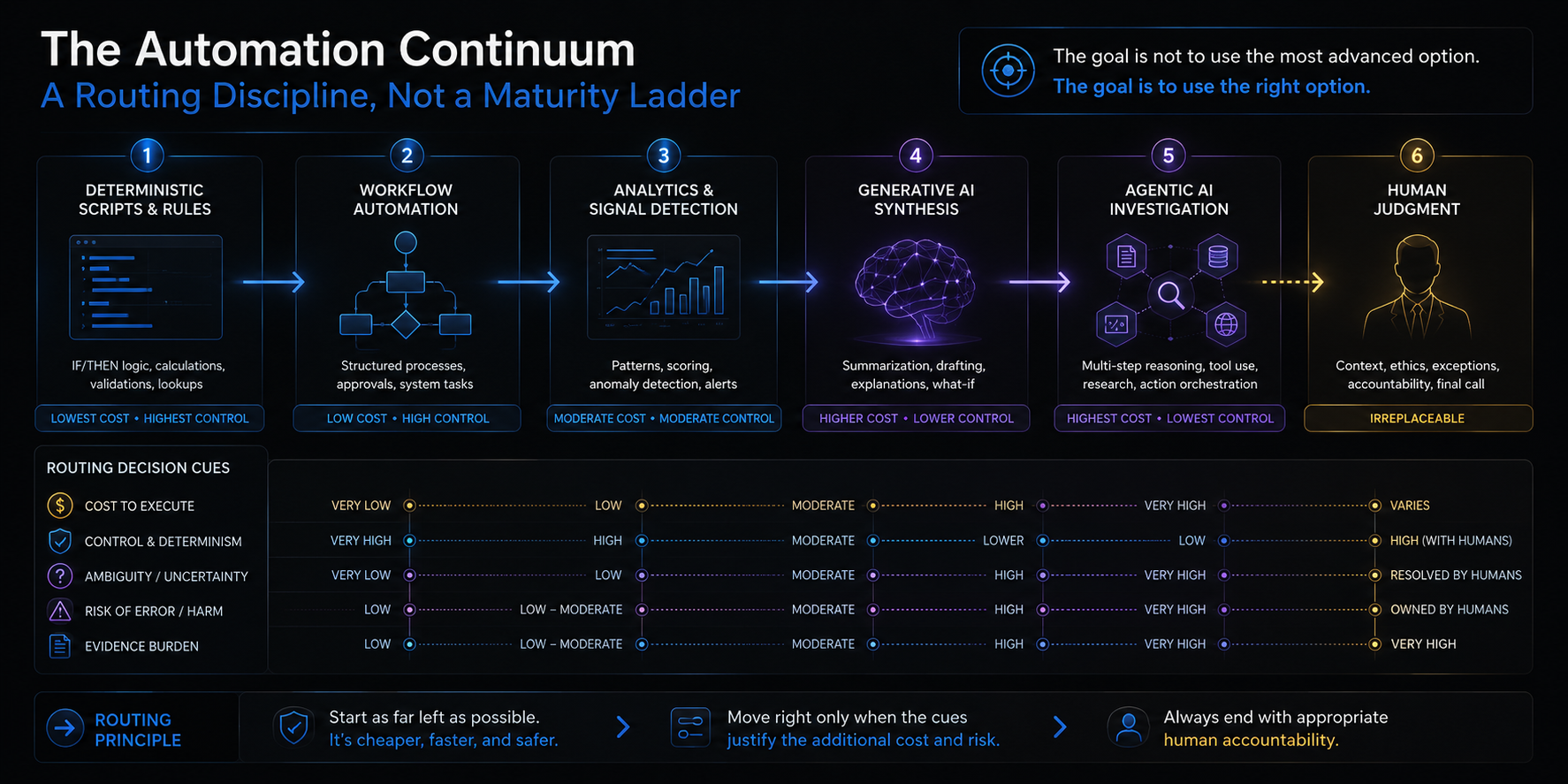
The automation continuum is not a maturity ladder toward agents. It is a routing discipline.
Enterprise automation is not a ladder where every workload climbs toward agentic AI like it is seeking professional enlightenment.
It is a continuum.
Different work deserves different machinery.
At one end, you have simple deterministic automation:
- scripts
- rules
- scheduled jobs
- data validations
- file movement
- API calls
- basic workflow triggers
- RPA where the system refuses to expose a decent interface because apparently suffering builds character
In the middle, you have more intelligent automation:
- analytics
- pattern detection
- classification
- anomaly detection
- rules plus signals
- workflow orchestration
- decision support
Then generative AI becomes useful when the work involves language:
- summarizing
- drafting
- translating
- comparing
- explaining
- extracting meaning from messy text
- turning signal clusters into executive-readable narratives
Finally, agentic AI enters when the problem requires autonomy across steps:
- investigate this issue
- decide what information is missing
- call multiple tools
- compare options
- reason through ambiguity
- recommend the next action
- operate under guardrails with human review
That last part matters.
An agent is not just a more impressive script.
An agent is an operating actor.
It can reason, plan, call tools, move across systems, and make choices inside a bounded goal. That can be enormously valuable. But without the correct guardrails, an agent can also turn an unassuming workflow problem into a series of war rooms that will still be discussed five years from now.
Financial Services does not need every automation use case to become a tiny digital employee with access rights, binary logic, and draconian execution.
Sometimes the right answer is a rule.
Sometimes the right answer is a cron job.
Sometimes the right answer is a dashboard.
Sometimes the right answer is a person.
Why Agentic-First Thinking Gets Dangerous
The current agentic AI hype cycle is not subtle.
Gartner’s 2026 Hype Cycle for Agentic AI places agentic AI at the Peak of Inflated Expectations, while also noting a gap between ambition and actual deployment: only 17% of organizations had deployed AI agents at the time of the survey, while more than 60% expected to do so within two years. source
That gap is where bad decisions multiply.
Because when executive appetite moves faster than operational discipline, the enterprise starts funding experiments that sound strategic but behave like expensive improvisation.
The business says:
We need to apply agentic AI.
A vendor says:
Great news. Everything is agentic now.
A team says:
We can build a prototype in two weeks.
Finance says:
What does this cost?
Technology says:
That depends.
Risk says:
What can it do?
Security says:
With what credentials?
Audit says:
Please explain the evidence path.
Then everyone looks at the demo again because watching the demo is way more fun, and safer, than dealing with the questions.
This is how organizations end up overbuilding automation.
A simple rule becomes a model call.
A model call becomes a workflow.
A workflow becomes an agent.
The agent gets a tool.
The tool gets permissions.
Permissions create risk.
Risk creates governance.
Governance creates delay.
Delay creates a steering committee.
The steering committee requests a dashboard.
And somewhere underneath the whole circus, a $10 script is quietly wondering why nobody asked it to check whether the field was blank.
The Real Cost of an Agent Is Not the Token Bill
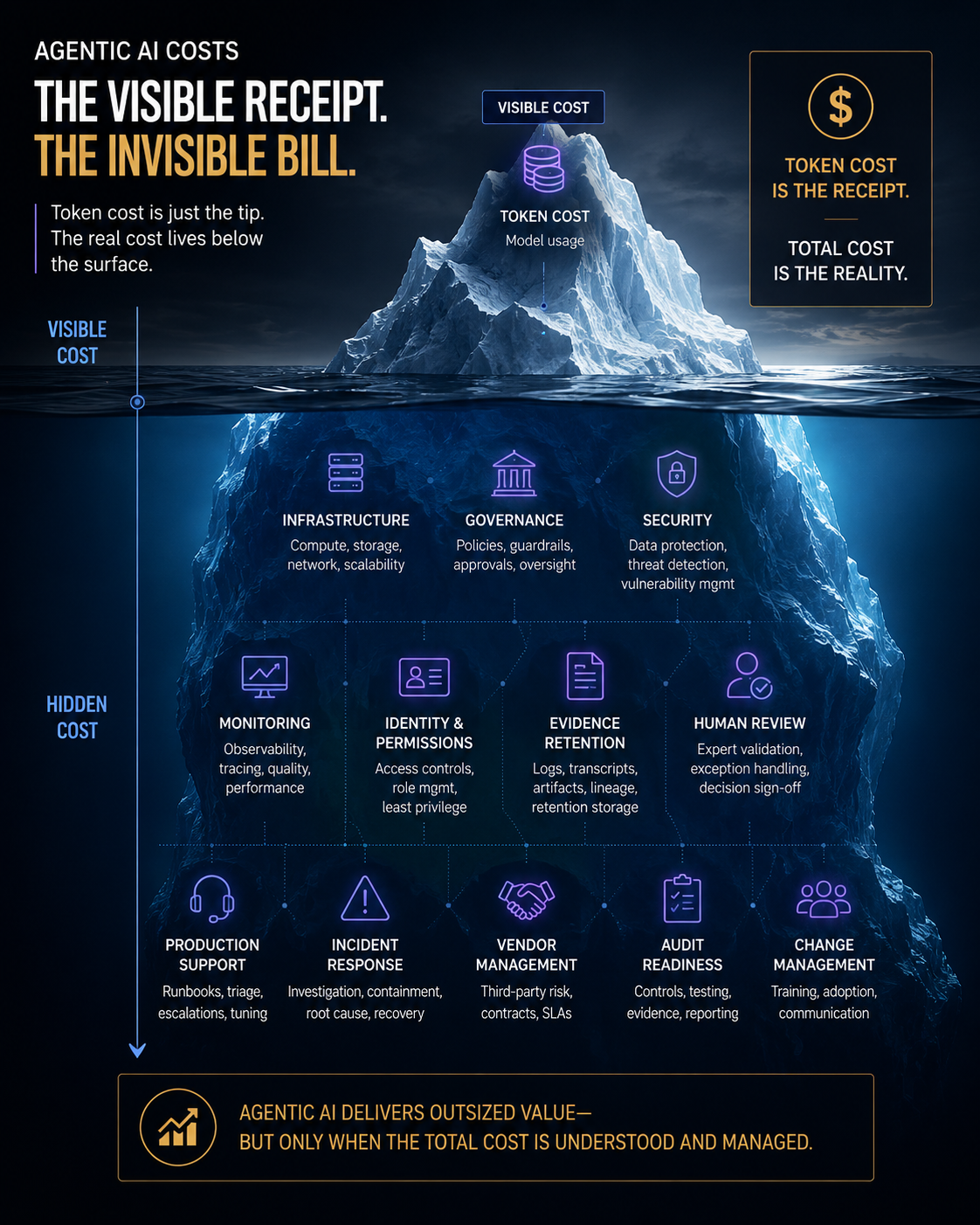
The token bill is only the receipt you can see first. The real cost lives underneath.
The easiest cost to see is the token bill.
That is also why it gets too much attention.
EY’s agentic AI cost analysis makes a useful point: token costs are often the visible line item, but the real economics of agentic workflows include infrastructure, governance, change management, operational support, failure recovery, regulatory risk, and broader run-rate exposure. EY also argues that organizations need an investment discipline for agentic AI, including ownership, cost controls, and value metrics. source
That is exactly the conversation enterprise leaders should be having.
Because the cost of an agent includes:
- model usage
- orchestration infrastructure
- tool integrations
- identity and access management
- logging
- monitoring
- prompt/version management
- test harnesses
- human review
- exception handling
- evidence retention
- security controls
- production support
- governance reviews
- incident response
- business change
- training
- vendor management
- audit readiness
That is a lot of baggage for “send a reminder when this approval is overdue.”
Some workloads earn that burden.
Many do not.
Before we give some guidance for leaders, I want to acknowledge that each agentic solution can be allocated a portion of the up front expenditure of all the non-token agentic costs mentioned above. It kind of has to work that way to determine the overall cost of a solution.
However, the more agents and agentic solutions that join the mix, less and less of the overall enabling costs should be attributed to a single agent or agentic solution. I would think that, eventually, most organizations implementing AI Strategy the correct way (certainly any and all of them that I am personally advising right now), would be able to account for those costs, and show them diminishing per agent over time.
But for now, let’s just reiterate that there are a lot of up-front costs before any serious Financial Services enterprise should be willing to let agentic solutions graduate from the POC train.
So, what is a Financial Services leader supposed to do? Hold up the POC train until he can play catch up with the digital core? Or maybe she should just go “full send” with the hope that the governance will catch up, hopefully kinda quick-like? We all can easily determine the Pros and Cons on each side.
I would generally advise leaders to stick with the approach that best fits their long-standing corporate culture. That usually means that, if they are being honest, they will want to be especially careful. A bank, insurer, payments company, wealth platform, or capital markets environment does not generally get, or want, to treat automation as a toy box.
However, everyone is caught up on the very real competitive advantage of being “first.”
Here is a Financial Services reality check that no one really wants to hear right now.
If any proposed solution touches:
- customer outcomes
- regulated processes
- operational resilience
- financial exposure
- access control
- risk decisions or
- changes to production
here are the questions that you should be asking.
Can we…
- explain it?
- govern it?
- monitor it?
- support it?
- stop it immediately?
The more complexity involved, in not just the solution, but the layers and layers of enabling technology for the solution…the higher the chance that you have to answer “No” to any of those questions.
And even one “No” is too many in a regulated environment.
A script can be audited.
A rule can be tested.
A workflow can be traced.
An agent can also be governed — but only if the organization builds the control plane around it.
That control plane is not free.
The Decision Framework
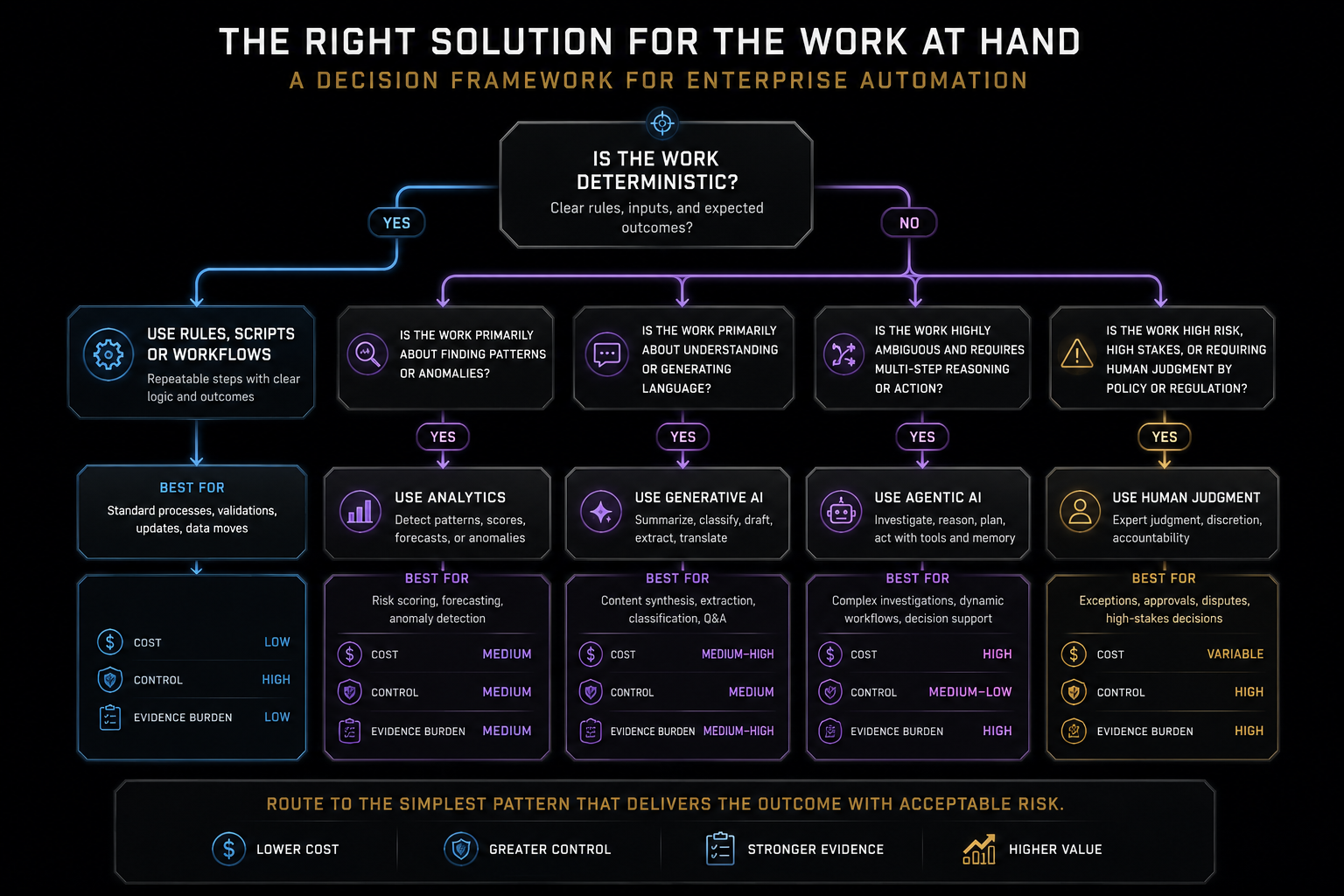
The best automation strategy routes the work before it routes the budget.
Here is the question I would put in front of every automation intake conversation:
What is the simplest automation pattern that can solve the problem reliably, safely, and economically?
Then walk through the decision tree.
1. Is the work deterministic?
If the answer is yes, start there.
Examples:
- required field missing
- SLA threshold breached
- file arrived
- status changed
- approval overdue
- record count mismatch
- branch name matches pattern
- deployment window closed
- risk has no owner
- evidence artifact missing
Use a rule.
Use a script.
Use a workflow.
Use SQL.
Use an API call.
Use basic event processing.
Do not summon an agent to discover that Tuesday comes after Monday.
2. Does the work require pattern detection?
If the work needs trend analysis, recurrence detection, aging, anomaly detection, or signal clustering, use analytics.
Examples:
- repeated blocker mentions
- decision latency increasing
- defects clustering around one component
- workstream status divergence
- dependency aging
- growing exception volume
- unusual release risk pattern
This may need data modeling and analytics.
It may not need generative AI.
The dashboard might be ugly. That does not mean it is wrong.
3. Does the work require language synthesis?
This is where generative AI earns its seat.
Examples:
- summarize a risk cluster
- explain status movement
- draft an executive brief
- compare two decision records
- translate technical risk into business language
- generate a concise narrative from meeting notes and delivery signals
Generative AI is good at language work.
Use it.
Just do not confuse a summary with a control.
A well-written paragraph is a well-written paragraph.
Governance still needs machinery.
4. Does the work require adaptive reasoning across steps?
Now we can talk about agents.
Examples:
- investigate why a risk is recurring across multiple workstreams
- trace related PRs, incidents, decisions, and dependencies
- recommend escalation based on evidence
- assemble missing context across systems
- compare several possible root causes
- plan a next-best-action sequence under guardrails
That is agent-shaped work.
It has ambiguity.
It requires planning.
It may require tool use.
It may need to revise its approach as it learns.
Fine.
Give it an agent — but give the agent boundaries, logs, permissions, monitoring, human review, and a kill switch.
Anything less, and you are just asking for problems.
Financial Services Needs AI-Pragmatic Automation
This is where the AI-pragmatic doctrine comes in.
Use the right intelligence for the work.
That means:
- deterministic where rules are knowable
- analytical where patterns need measurement
- generative where language and synthesis create value
- agentic where ambiguity and adaptive reasoning justify the cost and risk
- human where judgment, accountability, or risk acceptance matters
This is not anti-AI.
It is anti-irresponsibility.
There is a difference, though it occasionally gets lost in the glow of a vendor booth.
IBM’s agentic AI governance playbook argues that agentic systems shift enterprise AI from insight to execution, requiring expanded governance focused on agent actions, accountability, monitoring, and controls. The same IBM piece also highlights the risk that many agentic initiatives may fail because of high costs, unclear value, and weak risk controls. source
That is the danger of not even considering most of the continuum.
If every task becomes agentic, the enterprise loses cost discipline.
If every agent gets broad permissions, the enterprise loses control discipline.
If every demo becomes a roadmap, the enterprise loses prioritization discipline.
If every productivity claim becomes business value, the enterprise loses credibility.
Financial Services has enough complexity already. Financial Services does not need automation architecture built on vibes, novelty, and a procurement hangover.
The $10 Script Has a Brand Problem
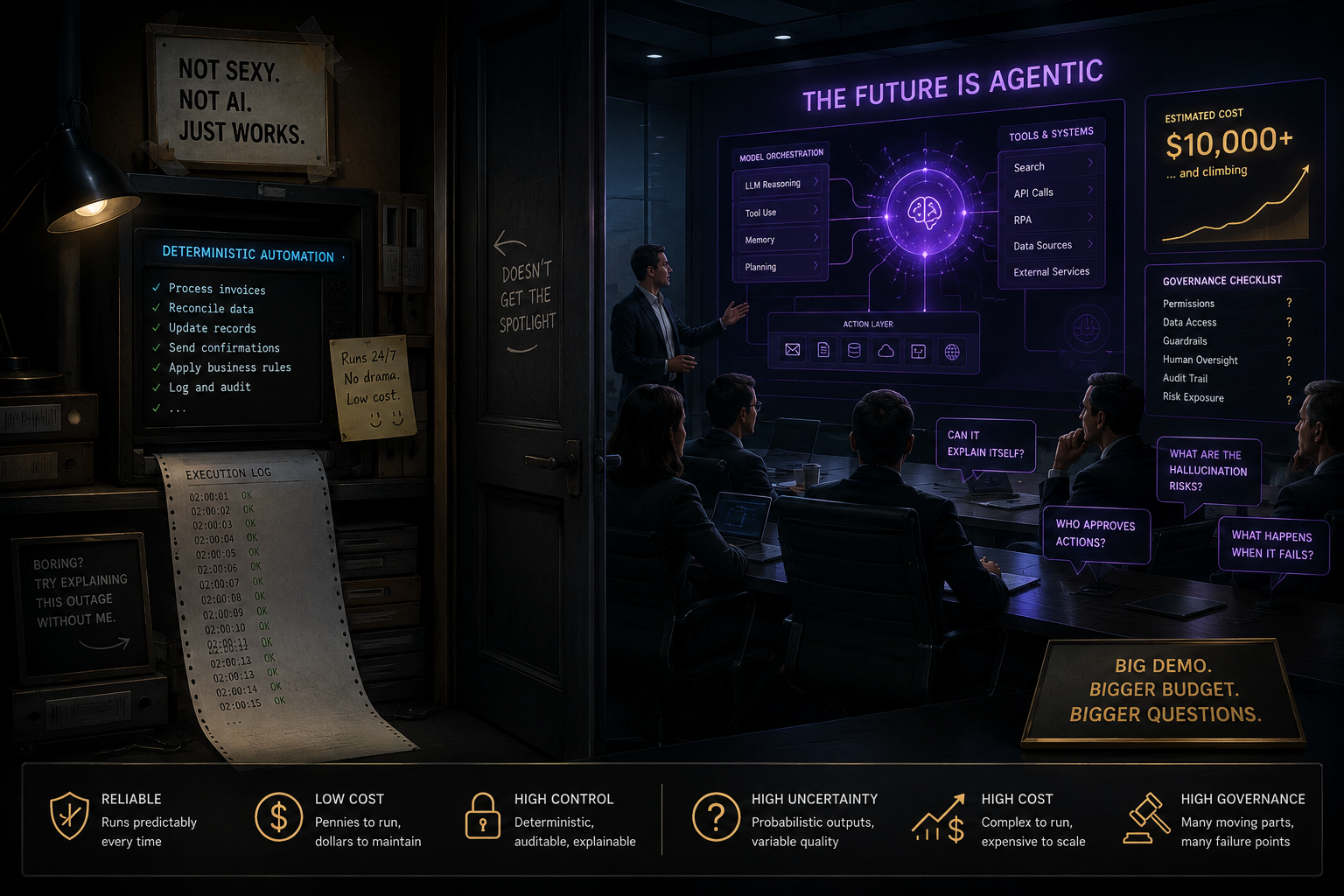
Boring automation carries the enterprise. It just has terrible marketing.
Part of the issue is emotional.
Scripts do not sound strategic.
Rules do not sound transformative.
Batch jobs do not get invited to innovation showcases.
Nobody puts a cron job on a keynote slide unless everyone involved has completely given up on being loved.
But boring automation carries the enterprise.
It moves files.
Checks fields.
Routes exceptions.
Flags thresholds.
Validates controls.
Reconciles records.
Closes gaps.
Signals problems.
Starts workflows.
Stops bad things from moving forward.
Boring automation is the plumbing of digital operations.
And this boring plumbing remains as undefeated as death, taxes, and shower beers.
The mature technology leader does not look down on deterministic automation because it lacks narrative sparkle. The mature technology leader respects deterministic automation because it is cheap, explainable, testable, and usually easier to support at 2:00 a.m. when something breaks and nobody wants to hear about emergent reasoning.
The $10 script does not need a strategy deck.
It needs a clear requirement, a test, a log, and maybe a decent owner.
That is beautiful.
In a deeply unromantic way.
The $10,000 Agent Also Has a Place
Do not misunderstand the argument.
Some problems absolutely deserve agents.
When a system needs to investigate across multiple tools, compare evidence, reason over ambiguity, and recommend a path forward, an agent can create real value.
Think about a complex release readiness scenario.
There are PRs, work items, test results, change records, dependency notes, exception approvals, incident history, deployment windows, and risk signals scattered across systems. A deterministic rule can catch obvious problems. Analytics can surface patterns. Generative AI can summarize narrative.
An agent may help investigate the messy question:
What is the real readiness concern hiding across these signals?
That is useful.
That is not a $10 script problem.
But the agent should stand on top of the cheaper layers, not replace them.
The best agentic workflows will often be built on boring foundations:
- clean event capture
- good identifiers
- deterministic rules
- normalized data
- reliable APIs
- permission boundaries
- observability
- evidence stores
- workflow state
- human review gates
Skip that foundation and the agent becomes a charming liar with tool access.
And yes, that should make people nervous.
Where Leaders Get This Wrong
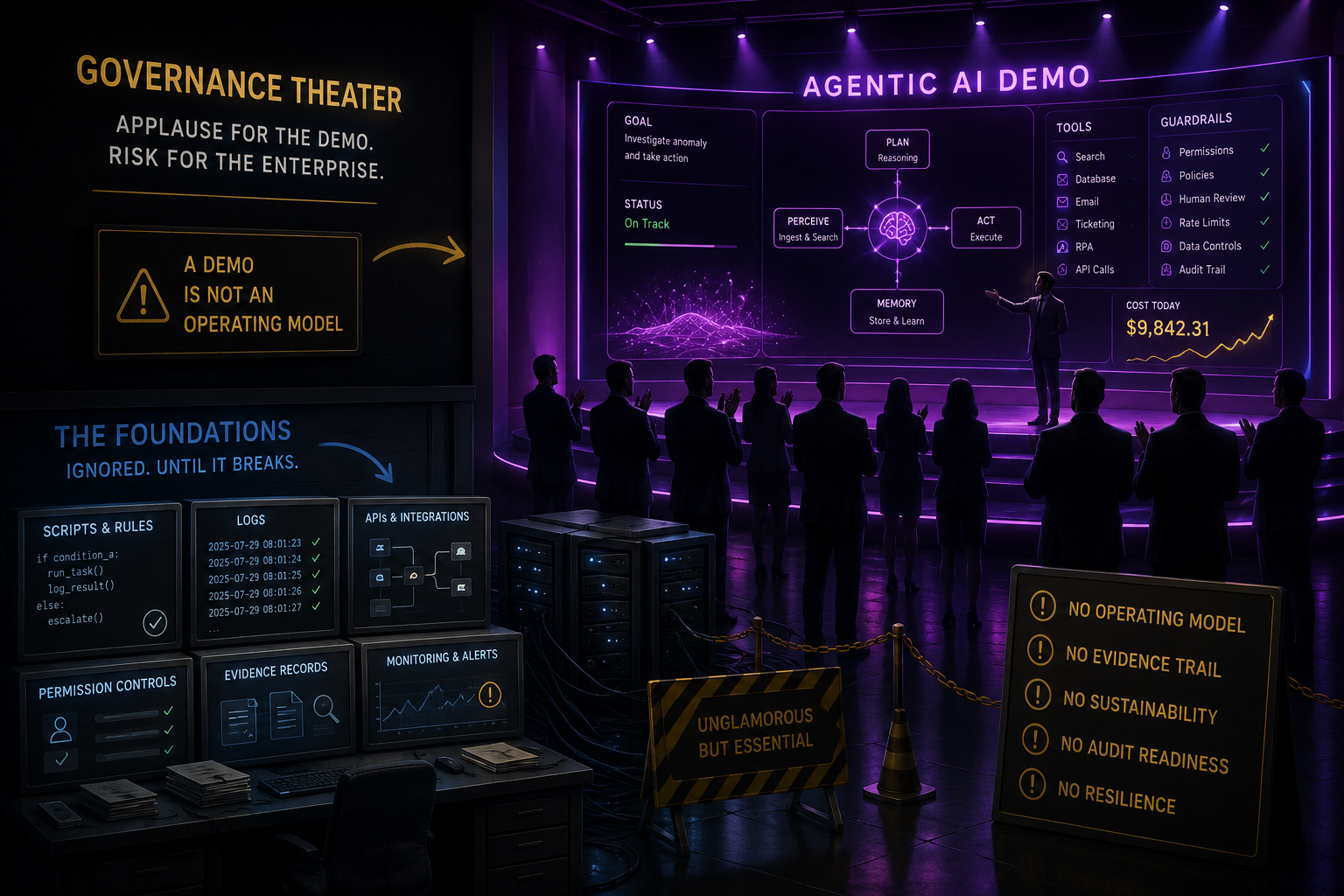
The demo is not the operating model. The demo is bait with lighting.
The failure patterns are predictable.
They start with the technology
The intake question becomes:
Where can we use agents?
Wrong question.
Start with the work.
What is the decision?
What is the action?
What is the risk?
What is the value?
What is the evidence requirement?
What is the cheapest reliable mechanism?
If the answer turns out to be agentic AI, great.
If the answer is a rules engine and a scheduled job, also great.
The goal is not to make the architecture more fashionable.
The goal is to make the work better.
They ignore run-rate economics
A prototype is cheap because nobody has scaled it yet.
Then usage grows.
Then model calls multiply.
Then workflows get chained.
Then logs need retention.
Then governance asks for evidence.
Then production support needs monitoring.
Then security asks who approved the tool access.
Then the agent makes a weird decision and the “pilot” suddenly wants a real operating model.
This is the moment your free puppy grows into her paws and starts unintentionally knocking things over.
They confuse autonomy with value
An autonomous system has no inherent moral superiority over a basic automation job.
Autonomy matters when autonomy improves an outcome enough to justify the cost and risk.
Otherwise, congratulations.
You automated the wrong thing with extra liability.
They underuse deterministic controls
This one is still my favorite.
A team will spend weeks discussing an AI agent when a deterministic rule could catch 80% of the problem.
That is expensive avoidance of basic engineering.
Please do not put it on a roadmap and call it reinvention.
They forget that humans still own judgment
The machine can recommend.
The machine can inspect.
The machine can summarize.
The machine can route.
The machine can act within a boundary.
Someone, a human, still owns:
- the risk.
- the workflow.
- the business outcome.
- the decision to let the machine act in the first place.
If nobody owns it, the enterprise has not created autonomy.
The enterprise has created accountability fog.
What Good Looks Like
A mature automation strategy should feel boring in the right places and intelligent in the right places.
Low-risk, rule-based work should move quickly.
Common controls should be deterministic.
Frequent patterns should become analytics.
Language-heavy work should use generative AI.
Ambiguous investigation should use agents.
High-risk decisions should keep humans in the loop.
The automation portfolio should show:
- what is deterministic
- what is analytical
- what is generative
- what is agentic
- what requires human approval
- what evidence is captured
- what value is measured
- what cost is being incurred
- what risks are accepted
- what controls are in place
That is the adult version.
Less theater.
More routing discipline.
Less “everything is an agent.”
More “this workload earned an agent.”
In Financial Services, that distinction is not academic. That distinction is how organizations scale automation without lighting budget, trust, and operational control on fire.
The Practical Test
Before approving an agentic solution, ask these questions:
- Can a deterministic rule solve this?
- Can a script solve this?
- Can workflow automation solve this?
- Can analytics surface the pattern?
- Can generative AI summarize or explain the signal without taking action?
- Does this require multi-step reasoning?
- Does this require tool use?
- Does this require autonomy?
- What can the agent touch?
- Who owns the risk?
- What evidence will be retained?
- How do we monitor it?
- How do we stop it?
- What value changes if this works?
- What does it cost when it scales?
If the business case falls apart under those questions, the answer is probably not an agent.
It might be a script.
And that is not failure.
That is basic fiscal responsibility and hygiene.
Where This Points Next
The automation continuum is going to become more important, not less.
As AI capabilities improve, the temptation to overuse them will grow. Every new model will make demos easier. Every new platform will make agent creation faster. Every vendor will find new ways to describe automation as intelligence.
Technology leaders will need more discipline, not less.
The winners will not be the organizations with the most agents.
The winners will be the organizations that know which work deserves agents.
They will use cheaper automation aggressively.
They will use generative AI intentionally.
They will use agents carefully.
They will keep humans accountable.
They will measure value before celebrating adoption.
That is the real automation maturity curve…and it doesn’t have a darn thing to do with how shiny the demo looks.
The key is: how well does the enterprise route work to the right execution pattern?
Final Thoughts
The $10 script and the $10,000 agent can both be useful.
The trick is knowing which one belongs in the room.
A simple automation problem does not become strategic because someone added reasoning loops, tool calls, and enough token consumption to mandate its own budgeting line item.
A complex ambiguity problem does not become safe because someone called the agent “governed” in a slide deck.
The work decides.
The risk decides.
The economics decide.
The evidence burden decides.
The operating model decides.
Use AI where it helps.
Use automation where it is enough.
Use humans where judgment matters.
And please, for the love of every exhausted technology budget in Financial Services, stop sending agents to do a script’s job.
Join the Conversation
Where do you see automation getting overbuilt?
Are teams reaching for agents before fixing basic workflow, rules, data, and integration problems?
Where have you seen the opposite — a genuinely agentic use case that earned the cost and complexity?
What should be deterministic?
What should be generative?
What should be agentic?
And what should stay firmly in human hands because the enterprise would like to remain employed by its regulators?
I would love to hear the real-world version.
Not the innovation theater version.
The version from the room where someone finally asks how much the demo costs when it runs every day.
About the Author
Joe Mack is a Technology Consulting Senior Principal specializing in technology leadership, enterprise SDLC transformation, release management, deployment governance, and delivery optimization for household name Financial Services companies. Joe is also a lifelong self-learner and builder of systems, and Free Tier Life is one of the ways he is trying to turn those experiences and instincts into something other people can actually use.