
The Hybrid Reality
Published on Jun 19, 2026
The Hybrid Reality
Why Financial Services Might Never Be Pure Agile — And Why That’s Fine

Most Financial Services technology programs run in a hybrid delivery model.
That is not an accident. It is also not evidence that the organization failed to believe hard enough in agile. And it is definitely not proof that one more framework diagram stapled onto the wall is going to save the day.
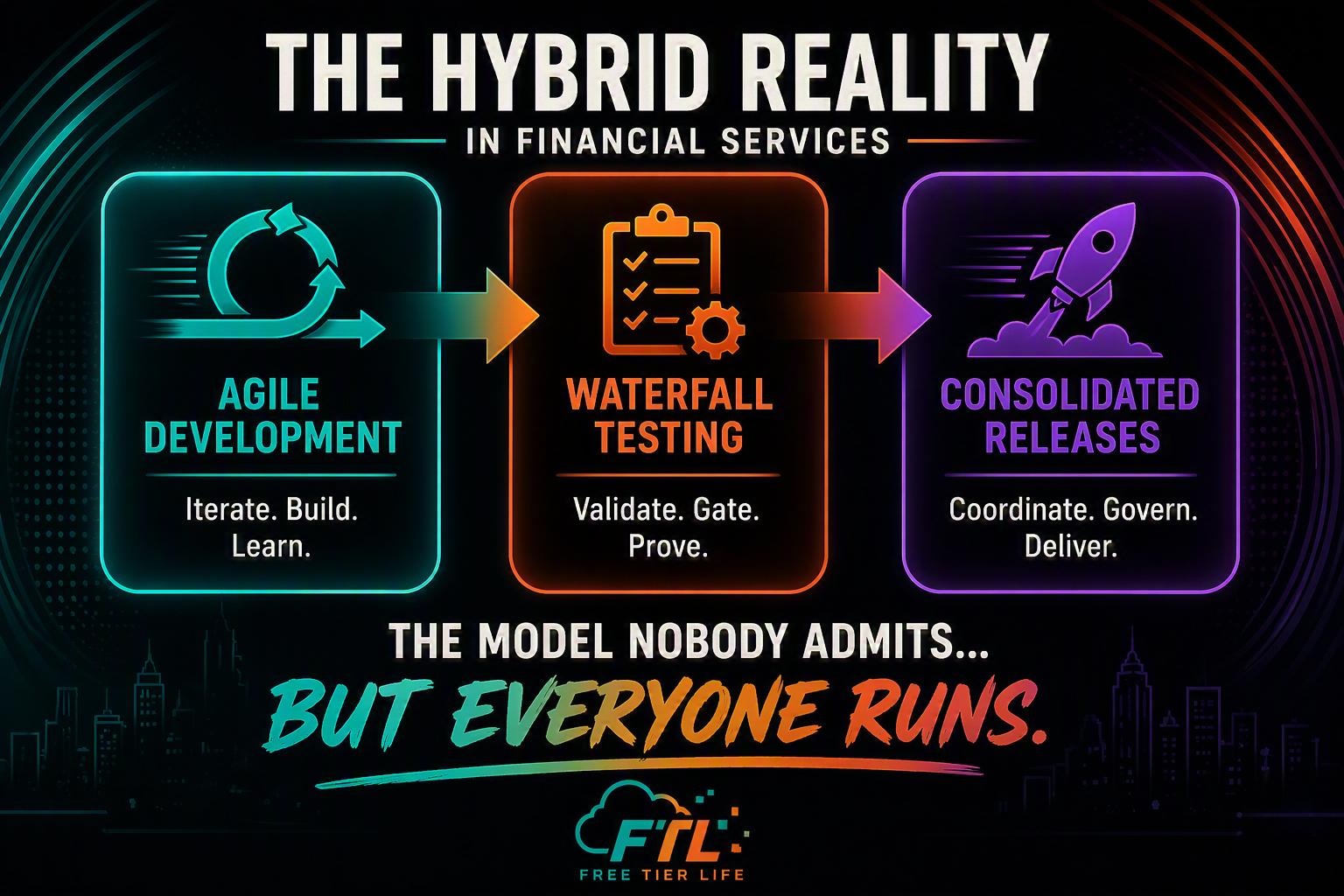
Hybrid delivery exists because the constraints are real. Agile development happens. Structured testing happens. Consolidated releases happen. Governance happens. Audit evidence still matters. Production stability still matters. Regulators still have questions. Customers still expect the thing to work.
The industry keeps talking about hybrid delivery like it is a temporary condition on the road to a cleaner future. I do not buy that.
For large Financial Services programs, hybrid delivery is the operating model. Once we stop apologizing for it, we can start designing it to actually work.
The problem is not the existence of hybrid delivery. The problem is how little intentional design went into it.
The Short Version
If you only remember four things from this article, make them these:
- Financial Services delivery is hybrid because the constraints are real, not because teams are lazy.
- Pure agile plateaued in regulated enterprises because traceability, approvals, integrated testing, production controls, and release governance never left the building.
- The real opportunity is to design one delivery system that borrows smartly from agile, waterfall, testing discipline, governance, and automation across the full lifecycle.
- Framework theater and operational discipline are not the same thing. They occasionally wear similar badges. Do not be fooled.
Why This Conversation Matters
There is a lot of enterprise delivery content that pretends the destination is still “pure agile” if only the teams would commit harder, buy another framework, or sit through one more transformation workshop with inspirational stock photography.
That story gets harder to sell when real work has to pass through integrated test environments, release governance, shared dependency calendars, production controls, audit expectations, and operational readiness checks.
Let’s call it plainly: in regulated environments, pure agile was never the real destination. Some form of hybrid delivery was always the operating reality, whether people admitted it or not.

The Uncomfortable Truth Nobody Wants to Sell You
Here is the open secret of enterprise agile consulting: pure agile was never a realistic end state for most large Financial Services technology programs.
Not in banking.
Not in insurance.
Not in any environment where someone with actual authority can show up and ask you to prove exactly what changed, who approved it, how it was tested, what evidence exists, and why the release was safe.
Hybrid delivery keeps expanding because reality keeps winning. Governance, documentation, evidence, integrated testing, and release control are not side quests. They are part of the ground truth. They need to be part of the operating model.
The market data points in the same direction:
- 76% of organizations expect to increase hybrid delivery adoption source
- 63% of organizations globally already operate in hybrid Agile–Waterfall models source
- Financial Services firms widely use agile, but usually inside a hybrid governance model source
That reality creates a few truths people rarely say out loud.
Regulators do not care about your sprint velocity
Sprint velocity can be useful for a team. It can help with predictability, capacity conversations, and local planning. Fine.
It is not evidence of release readiness. It is not traceability. It is not a control framework. It does not prove that the right test coverage exists or that risk was accepted by the right person.
In regulated industries, the burden of proof still matters. Documentation, approvals, evidence, testing discipline, and control ownership do not disappear because the team had a good retro.
Shared environments change the rules
You cannot deploy continuously into a space that is already locked for regression, performance validation, certification, data refresh, or another coordinated test cycle.
When environments are shared, sequencing matters. When sequencing matters, governance matters. And when governance matters, some delivery behavior will look far less like startup agile mythology and far more like enterprise reality wearing steel-toed shoes.
Multi-stream release coordination is not optional
When multiple value streams feed a single integrated release, somebody has to own scope, readiness, sequencing, dependencies, acceptance, and go/no-go decisions.
That work may not feel glamorous. It may not get a keynote. It may not look good on a transformation poster.
It is still necessary.
No amount of framework jargon changes the fact that release coordination in a regulated enterprise often looks more like structured control than agile mythology wants to admit.

The Bigger Mistake
The industry’s quieter mistake is even worse than pretending hybrid delivery is temporary: we still describe hybrid as if agile lives on one side of the wall and waterfall lives on the other.
That framing is too simple. Frankly, it is a little lazy.
If the reality is hybrid, the design should be hybrid too.
- Development should borrow more discipline where it improves downstream readiness, traceability, and release confidence.
- Testing should borrow more agility where it improves feedback loops, automation, and incremental learning.
- Governance should borrow from both: enough structure to protect the enterprise, enough flexibility to avoid turning into bureaucratic dinner theater.
The real opportunity is not to survive the handoff between two badly connected worlds. The opportunity is to design one delivery system that uses the best parts of multiple methods across the full lifecycle.
That takes more work than renaming ceremonies.
Which is probably why so many organizations keep renaming ceremonies.
A Brief, Necessary Word About SAFe
I’ll keep this in the blunt but useful register that I hope this site becomes known for: SAFe often gives executives a sense of control long before it gives delivery teams a better operating model.
What SAFe gives leaders is a vocabulary, a map, and the emotional comfort of naming things. There is value in that. Shared language can help.
What it does not reliably solve is the real friction of shared environments, integrated testing, consolidated release governance, dependency collisions, and the awkward marriage between iterative development and regulated enterprise controls.
In the real world, throwing more framework at those problems can become process theater wearing a lanyard.
You can’t SAFe your way out of a shared test environment.

Where Hybrid Actually Breaks Down
Saying hybrid delivery is real does not mean today’s hybrid systems are good. Plenty of organizations are not operating a well-designed hybrid model. They are limping through a badly stitched-together one and calling it maturity because the dashboard has colors.
The breakdowns usually happen in four places.
1. The system was never designed as one system
This is the real handoff problem. The handoff itself is usually not the root cause. The design is.
Stories become “test scope.” Intent becomes tickets. Defects lose their connection to the originating change. Developers move on. Testing catches up later. Accountability gets fuzzy.
That is not a communication glitch. That is a design flaw.
Development was not designed with downstream realities in mind. Testing was not designed to participate early enough to shape quality before the big ceremonial validation event. Release governance was not designed to see risk while teams still had time to do something useful about it.
By the time everyone realizes the thread is broken, the program has already started the archaeology phase.
Nobody enjoys the archaeology phase.
2. Environment chess
This is where delivery turns into operational improv.
Agile teams want flexible, on-demand environments. Test teams want stable, controlled environments. Both are right. Both are trapped in the same infrastructure.
So leadership manages environment contention with spreadsheet gymnastics, calendar negotiations, side-channel favors, and expensive heroics.
Some of the most important risk signals do not come from the code itself. They come from the collision of environment availability, test readiness, release timing, and shared dependency constraints.
That collision rarely looks dramatic at first. It looks like one slipped test window, then one delayed defect retest, then one conditional approval, then a release-readiness call where everyone develops a sudden interest in precise wording.
3. Governance mismatch
Classic waterfall governance does not fit iterative delivery well. Pure agile governance often does not give release-intensive regulated programs enough confidence.
So organizations drift into one of two bad outcomes: governance theater or governance gaps.
Governance theater creates friction without useful confidence. Governance gaps create speed without enough control. Both eventually become somebody’s problem during release week.
The fix is not weaker governance. The fix is better governance, designed for the world people are actually working in.
4. Metrics that lie
This one should make more leaders uncomfortable than it does.
- Velocity lives in one dashboard.
- Testing progress lives in another.
- Release readiness is tracked somewhere else.
- Dependencies are documented in some other file.
- Environment truths live in meeting notes or tribal knowledge.
Then everybody asks for “one version of the truth” with a straight face.
If the metrics do not connect across the full delivery flow, neither does the operating model. At that point, transparency is not a capability. It is a wish made during a status meeting.
What Would Actually Help
Pure agile alone does not solve this. Pure waterfall does not solve this. Scaled framework theater does not solve this.
The useful question is simpler and harder:
What would a deliberately designed hybrid delivery model actually need to do?
Based on what I have seen over the past 30 years, four principles matter.
1. Hybrid by design, not by accident
If you are going to call the model hybrid, build it like you mean it.
Development keeps its iterative engine, but adds stronger readiness discipline where it matters. Testing keeps rigor, but becomes more adaptive and earlier. Release control protects confidence without crushing flow.
That is not compromise. That is design.
And design beats accidental process inheritance every day of the week.
2. Shared definitions of readiness
One of the fastest ways to destroy delivery coherence is to let each phase define “done” differently.
Development thinks the work is complete. Testing believes it is not ready. Release governance sees missing approvals. Operations wants support readiness. The business wants usable capability.
Nobody is necessarily wrong.
The system is wrong if those definitions do not connect.
A real hybrid model needs shared readiness definitions across the full chain. Otherwise, the organization is not running one process. It is running several belief systems with a shared calendar invite.
3. Unified flow and governance
The usual tradeoff is framed as speed versus control. That framing is tired, and worse, it usually leads to bad decisions.
The better question is this: how do we design a system where governance increases confidence without crushing flow?
That means risk-based controls, meaningful gates, and reporting that tells one connected story from intent to code, from code to testing, from testing to release, and from release to production outcome.
Governance should create better decisions earlier. If it only creates more meetings later, congratulations, you have built a very expensive rearview mirror.
4. Automation where it belongs
This is one of the strongest concepts in the whole conversation because it rewards discipline over trend-chasing.
Not everything needs an agent. Not everything needs machine learning. And not everything needs a human drowning in spreadsheets with seven browser tabs open and the will to live rapidly declining.
Deterministic automation comes first. Analytical tooling belongs where patterns and signals matter. Agentic reasoning should be reserved for problems that truly require ambiguity, judgment, and next-best-action reasoning.
Humans stay in charge. Everything else should earn its place.

The Opportunity
This is where the horizon should start to open up.
Almost nobody is building for this reality clearly enough. The market is still full of frameworks and narratives designed for cleaner, less regulated, less entangled operating conditions.
Meanwhile, the people actually shipping software in Financial Services are piecing the system together with spreadsheets, release calls, test calendars, tribal knowledge, heroics, and one or two people who somehow know where every dependency is buried.
That gap is enormous.
It does not need another monolithic framework dropped from the sky. It needs a purpose-built operating model for hybrid delivery — one that treats development, testing, governance, release management, and automation as parts of the same machine.
More agile language will not fix that.
More waterfall nostalgia will not fix that.
More framework theater definitely will not fix that.
How about something intentionally designed for the world teams are actually living in?
That feels more useful.
And a lot less insulting.
What’s Next
This article is the opening salvo in a larger conversation.
The next article will tackle the handoff problem directly. Not as a people problem. Not as a communication problem. As a design problem.
When delivery systems are designed properly, handoffs stop being acts of faith and become engineered transitions.
After that comes the more opinionated question: what would a better hybrid operating model actually look like in the wild?
To me, that feels worth building.
And worth documenting.
Final Thought
Hybrid delivery is not the embarrassment everybody keeps pretending it is.
It is the operating reality.
The actual embarrassment is that so few organizations have designed it intentionally.
That feels fixable, so I am going to explore it deeper in the articles ahead.
I hope you come along for the ride.
Join the Conversation
What is the biggest friction point you have seen in hybrid delivery programs?
Not the theory. The real thing.
The ugly thing.
The thing that keeps biting teams in the wild.
If you’ve lived through it, I want to hear about it in the comments.
About the Author
Joe Mack is a Technology Consulting Senior Principal specializing in technology leadership, enterprise SDLC transformation, release management, deployment governance, and delivery optimization for household name Financial Services companies. Joe is also a lifelong self-learner and builder of systems, and Free Tier Life is one of the ways he is trying to turn those experiences and instincts into something other people can actually use.
Bibliography
- Agile Project Management Institute Centre (APMIC). "Project Management Methodology Adoption: Waterfall vs. Agile vs. Hybrid (2026–27 Data)."
- Raja, Premnath. "The Impact of Hybrid (Agile–Waterfall) Delivery Models on Project Performance in High-Regulation Financial Sectors." Global Business & Economics Journal, October 10, 2025.
- Gitnux. "Agile Statistics | 2026 Edition." Gitnux Report, 2026.
- Justus, Jonathan. "Why 76% of Firms Now Pick Hybrid Project Delivery." jonnynow.com, May 13, 2026.
- TransformXperience. "Agile at Scale: Why 84% of Enterprise Transformations Fail (And How to Beat the Odds)." Published August 7, 2025.