
Your AI Strategy Has a Middle-Management Problem

Published on Oct 29, 2026
Your AI Strategy Has a Middle-Management Problem
And It Isn’t the Managers
The strategy lives on the top floor. The tools live on the bottom floor. The messy part is everything required to turn one into the other.
Sadly, we’ve all seen this movie. Too many times.
The CEO takes the stage at the town hall. There’s a slide with the words “AI-first” on it, a slide with a rocket, and a slide with an arrow that points up and to the right. Licenses get provisioned by Friday. Somebody launches a prompt-a-thon. The intranet gets a new banner.
Then Monday comes.
A manager with a dozen direct reports, a delivery target set well before any of this happened, and roughly 40% of her week already spent doing individual-contributor work opens her laptop and tries to figure out what, exactly, she is supposed to do differently.
Nobody told her.
The strategy deck did have a slide for this. Unfortunately, it was the one with the arrow of ambition and accelerated growth.
That’s the middle-management problem I want to talk about.
Now, before anyone gets excited, the managers are NOT the problem. It’s the way most enterprises are treating them: as a channel to broadcast through, a convenient place to put the blame when AI programs under-deliver, and, increasingly, a layer to compress in the name of efficiency.
That is especially dangerous because the middle is where strategic intent has to become delivery reality. And enterprises were not exactly flawless at that translation before AI arrived. Intent gets summarized, interpreted, decomposed, reinterpreted, threaded through governance, squeezed through funding, collided with old processes, and eventually handed to teams as work.
By then, “transform the business with AI” can mean almost anything.
Scary, right?
Now, consider that most companies have people trying to manage that ambiguity while the technology, vendor landscape, risk profile, workforce expectations, and definition of “good AI use” are literally changing in real time underneath their feet.
That isn’t a talent problem. It’s what happens when strategy stops at the org chart.
The Short Version
If you only remember six things from this article, make them these:
- Middle managers are the translation layer between AI ambition and changed work, but the evidence says many enterprises involve them less than senior executives and, incredibly, less than junior employees.
- Manager support is one of the strongest conditions that is directly, and heavily, linked to impacting regular AI use and reported productivity gains.
- Strategic clarity matters more than simply putting more tools in people’s hands. The newer research keeps making that point, and keeps getting ever louder about doing so.
- At the same time, organizations are flattening management layers and widening spans, often before proving that AI has actually removed the work those managers were doing.
- AI handed managers a new job: translating changing intent, validating output, redesigning work, deciding what saved capacity means, and settling questions about trust and fairness. Most organizations never wrote that job down, let alone gave their managers any resources or training to help them.
- A license is not an operating model. Managers need clear intent, decision rights, cover, capacity, feedback loops, and measures that reward changed work over simple usage metrics.
The Layer Everybody Skipped

Most AI programs connect the boardroom to the keyboard and route around the people who have to turn intent into work.
Infosys surveyed 2,603 employees globally in 2026. Only 22% of middle managers said they were actively involved in their company’s AI transformation, compared with 49% of senior executives and 25% of junior employees. source
Read that ranking again. The middle manager is less involved than the junior employee.
Hang on. It gets even more weird. Middle managers were more than twice as likely as senior leaders to downplay their own AI use. More than half of the managers who downplayed it said they did so because using AI made them look less skilled or capable. source
So we have built a situation where the people responsible for translating AI into daily work may hide the fact that they use it because they worry it makes them look like they can’t do their jobs.
That’s not resistance. That’s a pretty rational response to an incoherent signal.
And this is where the problem gets bigger than middle management.
Most strategies are abstractions. They have to be. “Become AI-first” is not a backlog item. Neither is “reinvent operations” or “unlock productivity.” Someone has to translate that intent into decisions about work: which processes change, which controls remain, what gets automated, where human judgment stays, what happens when the tool is wrong, and what outcomes are actually supposed to improve.
That work lives in the middle.
If the intent arrives there fuzzy, the manager doesn’t execute the strategy. The manager reconstructs it.
Do that across hundreds or thousands of teams and you don’t have a cohesive AI strategy anymore. You have a portfolio of local interpretations that happen to share little more than a corporate logo.
The Multiplier Hiding in Plain Sight
Here’s the part that should make every executive sponsor sit up.
The data says that the manager is one of the strongest levers for activation and adoption at scale. Not the model. Not the license count. Not the prompt library somebody built in a weekend.
Gallup’s February 2026 study of 23,717 U.S. employees found that, in organizations where AI is available, 78% of employees who strongly agreed their manager actively supports AI used it frequently, versus 44% among those who did not strongly agree. The same research found workflow fit mattered just as much: frequent use was 88% among employees who strongly agreed AI integrated well with their systems and processes, versus 55% among those who did not. source
That’s useful because it gets us past the lazy “people need more training” diagnosis. People need tools that fit the work and managers who can explain what those tools are for.
Gallup’s productivity research, updated September 30, reinforces the point. In May 2026, 65% of employees at organizations that had implemented AI said it positively affected their productivity or efficiency. Gallup also identifies manager support and workflow integration as two of the conditions most strongly associated with frequent AI use. source
BCG’s 2026 AI at Work research is even more direct about the organizational problem. Forty-two percent of frontline employees who regularly use AI say they save at least a full workday per week, yet 66% receive limited or no guidance on what to do with the time they save. Only 33% of frontline employees said leadership communicates clearly about AI, and only 28% saw strong alignment between what leaders say and what the organization actually does. source
There it is again: intent without translation.
The tool can create capacity. It cannot decide what the enterprise meant to do with that capacity.
Guess who gets that question on a random Tuesday afternoon?
The Intent Decay Problem
AI didn’t create the enterprise’s intent problem. It put it on fast-forward.
Most large organizations already know the pattern.
- A strategy starts crisp at the top.
- Then, it moves through portfolios, programs, functions, governance forums, funding decisions, product teams, projects, vendors, operating units, and local priorities.
- Every handoff adds interpretation.
- Every delay adds the possibility that the original assumption has changed.
- Every metric becomes, at best, a proxy for what somebody actually wanted.
Eventually, a team can be executing beautifully against work that no longer cleanly connects to the intent that created it.
AI makes that old delivery problem more precarious for one simple reason: the time between “we decided” and “the world changed” is getting shorter.
BCG’s September research on more than 50 AI front-runners describes organizations changing not just tools but the work itself, decision architecture, coordination, and rewards. Decisions move closer to the people nearest the problem, while humans increasingly direct and evaluate AI-produced work. source Its broader 2026 Applied AI research lands on the same principle from another direction: strategic clarity plus applied AI produces materially more value than either one without the other. source
That is not an argument for another cascade of PowerPoint decks. It is an argument for a living connection between intent and execution.
Managers need to know not only what the AI strategy says, but why a particular outcome matters, what constraints are real, which assumptions may have changed, where they have authority to adapt the work, and when new evidence should travel back up and change the plan.
Without that loop, strategy, and the intent behind it, gets weaker with every handoff, leading directly to misunderstanding.
And AI lets that misunderstanding move much faster.
We’re Cutting the Layer We Need Most

The org chart got flatter. The manager’s week did not get longer. Something had to give, and it usually isn’t the delivery date.
While research keeps pointing toward managers as a critical part of AI adoption and translation, a lot of organizations are busy making the layer thinner.
Gartner predicted that through 2026, 20% of organizations would use AI to flatten their organizational structures and eliminate more than half of current middle-management positions. Importantly, Gartner’s prediction also named the risks: managers overwhelmed with additional direct reports, employee reluctance to change, job-security concerns, and broken mentoring and learning pathways. source
Most people read the first sentence and mentally booked the savings.
The flattening itself isn’t imaginary. Korn Ferry’s Workforce 2025 survey of more than 15,000 professionals found 41% said their organization had slashed management layers. Thirty-seven percent said the lack of managers had left them feeling directionless. source
That second number should get more attention than it does.
Because direction is the thing we’re simultaneously asking AI strategy to supply at unprecedented speed.
And there is an important 2026 reality check for executives who think the technology has already earned the headcount reduction. Gartner reported in January that only 1% of layoffs in the first half of 2025 were attributed to AI increasing employee productivity, warning that some organizations may have to rehire roles cut on the assumption of AI returns that have not materialized. source
I want to be fair here. Some layers deserve to go. Every one of us has worked in an organization where a decision needed four signatures and three of them belonged to people whose main job appeared to be forwarding email. If AI kills the status-report relay race, I will personally bring the cake.
But there’s a difference between removing coordination overhead and removing the people who translate intent, make judgment calls, coach humans, and adapt work when reality refuses to follow the slideware.
The first can make you faster.
The second can make you WRONG faster.
If you fire the translators, don’t act shocked when nobody speaks the language.
The New Job Nobody Wrote Down

AI didn’t take work off the manager’s plate. It added a second plate and forgot to mention it.
Here’s what actually happened to the manager’s job when AI showed up.
It got bigger, and nobody updated the job description.
BCG found that nearly half of respondents say their roles have shifted toward managing and directing AI instead of simply doing the work themselves. Among frontline employees who regularly use AI, 42% report saving at least a full workday a week. But 66% say they get limited or no guidance on what to do with the time they save. source
Think about that from the manager’s chair.
Your team suddenly has capacity appearing in patches. Nobody upstairs has said whether it should become more output, better quality, faster cycle time, innovation, development, new work, or a quiet headcount reduction next quarter. Your people want to know. You want to know. Six months from now, somebody will want the value case.
That ambiguity is not a footnote. Resolving it is PRIMARY SUCCESS FACTOR in executing the AI strategy.
Then there are the questions nobody wants to touch.
Deloitte’s 2026 Global Human Capital Trends found that 80% of leaders, managers, and workers are concerned their co-workers or teams are using AI to appear more productive than they are. Forty-two percent of workers said their organization rarely evaluates AI’s impact on people. Deloitte points to the questions employees are being left to navigate: Is AI use cheating? What counts as hard work now? Who is responsible when AI is wrong? source
Those questions don’t stay neatly inside an AI Center of Excellence. They show up in one-on-ones, performance conversations, team meetings, quality reviews, and the awkward pause after somebody admits that the deliverable took twenty minutes instead of two days.
Gallup added another useful signal in September: frequent AI users were more than twice as likely to fear that technology could eliminate their jobs within five years as less-frequent users, while supportive management practices were associated with lower anxiety. source
So, to recap the role: the manager translates changing intent, validates AI output, coaches people on tools that may be changing monthly, redesigns workflows, decides what saved capacity means, settles fairness and trust questions, carries a wider span, and still has a day job.
Honestly? I’m impressed they’re handling it at all.
A License Is Not an Operating Model
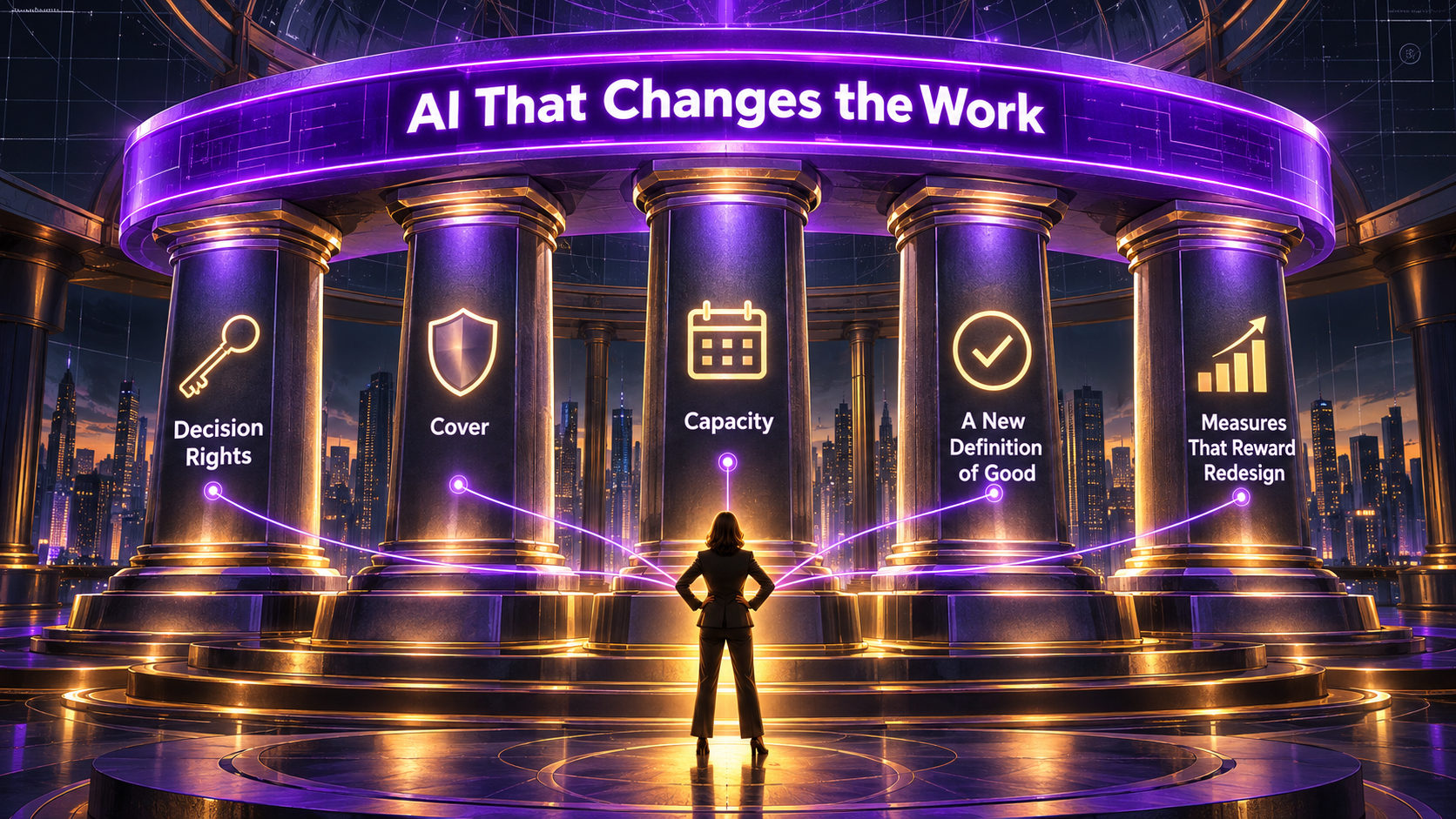
Training is one input. Managers need intent, authority, protection, time, feedback, and incentives that all point in the same direction as the strategy.
Training matters. Keep doing it.
But training by itself is the corporate equivalent of handing someone a cookbook and calling it dinner. It teaches a skill. It does not tell a manager which meal the business needs, who is allowed in the kitchen, what happens when something burns, or why Finance suddenly wants half the ingredients back.
Here’s what managers actually need. None of it is exotic. All of it is routinely skipped, just about everywhere that I’ve seen lately.
1. Intent They Can Actually Execute
“Use AI.” “Become AI-first.” “Drive productivity.” These are slogans until somebody connects them to an outcome.
Managers need the why, the desired business result, the non-negotiable constraints, and the assumptions underneath the ask. Just as important, they need a way to send evidence back upstream when any of those assumptions stop being true.
Intent that only travels downward eventually becomes doctrine. Good strategy supports a feedback loop that allows it to evolve when evidence from execution says it should.
2. Decision Rights
Managers need explicit authority to redesign how their team works with AI: which tasks move to the tool, which steps disappear, where human review remains, and when a change requires escalation.
Without decision rights, every change becomes an escalation, and every escalation becomes a series of ever larger meetings about who needs to be in the next meeting.
When decisions rights are clear, and arrive before the decision itself, governance becomes a change engine. Same principle, one layer down.
3. Cover
The Infosys findings suggest many middle managers believe AI use can make them look less capable or expose them to blame when AI-assisted work fails.
You won’t get useful experimentation from people who believe the first mistake becomes a career-limiting event.
Leaders need to say, specifically, which kinds of AI-assisted failure are acceptable learning, what must never happen, and where accountability sits. Then, they need to behave consistently the first time, and every other time, something goes sideways.
Your managers will learn more from that than from twelve town halls put together.
4. Capacity
You cannot add a transformation job to a manager with a widening span and a pile of individual-contributor work and expect the calendar to politely make room.
Something has to come off the plate: reporting that AI can generate, approvals that can be delegated, meetings whose only purpose is moving status from one slide to another.
If the flattening plan assumes AI will absorb administrative work, prove that the work disappeared before you remove the people who were doing it.
The sequence matters.
5. A New Definition of Good
Somebody has to answer the uncomfortable questions out loud. What does good work look like when AI drafts the first version? When is AI use expected, optional, or prohibited? Who owns AI-assisted output? What deserves human attention now that routine production is cheaper?
If the organization doesn’t answer, every manager will.
Congratulations. You now have twelve AI cultures inside one company.
6. Measures That Reward Redesign
Most AI scorecards love adoption: licenses activated, prompts sent, active users, agents deployed.
That’s measuring gym memberships and calling it fitness.
Reward managers for what actually matters: workflows redesigned, cycle time reduced, quality improved, controls strengthened, capacity redeployed, customer outcomes improved, and people developing new capability.
The newest research is getting increasingly explicit here. Gartner warned in May that leaders can mistake access and adoption metrics for transformation. source BCG’s September research on AI front-runners found that leaders distinguish themselves by redesigning how work, decisions, coordination, and rewards actually operate. source
If the incentives point at usage, you’ll get usage.
But usage isn’t the outcome. The strategy presumably wanted something to change: the economics, the customer experience, the control environment, the speed of delivery, the quality of the work, maybe all of the above.
Managers need measures that preserve that connection. Not “Did your team use AI?” but “What changed because your team used AI, and was it the change we actually intended?”
Otherwise, the metric becomes the target, the target becomes the behavior, and the original intent disappears somewhere along the way.
Enjoy your dashboard theater production.
Financial Services Can’t Afford to Get This Wrong
In a lot of industries, a broken translation layer means slower adoption and an ugly ROI slide.
In Financial Services, it can also weaken the control environment.
The manager inside a bank, insurer, or payments company is often close enough to the work to notice when a process is being bypassed, when a review becomes ceremonial, when a control no longer matches the workflow, or when a team starts using a tool in ways the policy never contemplated.
Now picture that layer stretched thin, only loosely connected to strategic intent, unsure what “good” means, and nervous about admitting which tools the team actually uses.
That’s not merely an engagement problem. It is an information problem sitting directly in the path between policy and behavior.
The organizations that get this right will treat managers as part of the AI control system, not just the AI communication plan. They will give them enough context to understand intent, enough authority to act inside defined boundaries, and a clean escalation path when the facts on the ground no longer match the assumptions upstairs.
In a fast-changing AI landscape, that last part matters enormously.
Strategy, policy, and intent all age quickly these days. A functioning management system notices.
The Monday Morning Test

Every AI strategy eventually meets a manager’s Monday morning. Most strategies lose.
Want to know whether your AI strategy has a middle-management problem? Pick any manager in your organization, at random, and ask:
- What business outcome is your team supposed to change because of AI? Not “use it more.” Change.
- Why does that outcome matter to the strategy?
- Which assumptions or constraints behind that direction are non-negotiable, and which can you challenge when the work tells you they’re wrong?
- Which decisions about AI-enabled work can you make without asking anyone?
- What happens if an AI-assisted piece of work goes wrong?
- What are you supposed to do with the time AI saves your team?
- What came off your plate to make room for leading this change?
- How is success measured, and does that measure reward redesigned work or just usage?
- Do you know where to send new evidence when reality no longer matches the strategy?
- Do you feel comfortable telling your boss exactly how you use AI yourself?
If the answers are vague, nervous, contradictory, or just a long pause followed by “I’d have to check,” your strategy isn’t really stuck at the manager.
Your intent never made it through the middle intact.
Don’t blame the manager. That’s somewhere between laziness and a complete abdication of responsibility.
The questions were always yours to answer first.
Besides, every good leader knows that you should always push credit down and pull blame up, right?
Where This Connects
This is the leadership side of a theme I keep coming back to: enterprises do not usually fail because they lack ambition and intent. They have that. In spades. Enterprises fail because the connection between intent and execution gets progressively weaker with every handoff, as work moves through the messy middle.
In The Leadership Debt Always Comes Due, I argued that leaders accumulate debt in clarity, trust, accountability, and decision discipline, and the delivery system eventually collects the debt. An AI strategy that skips the middle layer is a very efficient way to take on that debt at scale.
In Governance Is an Engine, Not a Brake, the first component was decision rights before decisions. Managers need the same thing for AI, or every change becomes an escalation.
In Your AI Agent Needs a Job Description, I argued that every agent needs a defined purpose, authority, and owner. It’s a little embarrassing that many enterprises are now putting more thought into the agent’s job description than into the manager’s role in making the strategy real.
And it all sets up a critical thought piece, AI Without Messing Up the Culture, which is still under review. The main premise: AI is an amplifier. If you have cultural issues, even minor ones, it will make them worse. Culture doesn’t change from the town hall. It changes in thousands of local decisions about what gets rewarded, tolerated, questioned, automated, escalated, and learned from.
Guess where most of those decisions live.
What Good Looks Like

When the middle layer is properly prepared and equipped, AI stops being an announcement and starts changing the work.
The mature version doesn’t look like a bigger change-management office. It looks like an organization where intent can survive contact with reality.
Managers are involved in shaping AI use cases for their areas, not merely informed after the fact.
Strategic intent arrives with outcomes, constraints, assumptions, and enough context to make local decisions without reverse-engineering the slide deck.
Decision rights for AI-enabled workflow changes are explicit and pushed toward the work wherever the risk allows.
Expected AI use, acceptable AI use, and off-limits AI use are defined in plain language, along with who owns AI-assisted output.
Managers have a feedback path for new evidence, changed assumptions, emerging risks, and delivery signals. Strategy does not merely cascade. It learns.
Administrative work comes off the manager’s plate before new transformation responsibilities or direct reports go onto it.
Managers are measured and rewarded for redesigned work, redeployed capacity, improved outcomes, and stronger team capability, not login counts.
Managers talk openly about their own AI use, including what failed, because honest experimentation is more useful than performative certainty.
Saved capacity has a plan. People know whether the time goes to quality, growth, development, new work, or something else the business has deliberately chosen.
None of that is glamorous.
All of it is how an AI strategy becomes an AI operating model.
Final Thoughts
Executives keep asking why AI adoption is uneven, why productivity gains remain hard to convert into enterprise value, and why the culture feels a little off.
The answer is sitting in the middle of the org chart, holding a wide span, a delivery target, a half-finished workflow redesign, and a Teams message from someone asking whether using AI on the quarterly review counts as cheating.
We gave executives the vision and employees the tools.
We gave our managers in between nothing but ambiguity.
Then we called them the bottleneck.
AI makes that mistake more dangerous than it used to be. When the environment moves slowly, fuzzy intent has time to be corrected by meetings, escalations, experience, and sheer organizational muscle. When the technology and the work are changing this quickly, ambiguity compounds before the organization has finished explaining the last decision.
The fix isn’t another training module or another banner on the intranet. It is treating managers as the operating layer that keeps intent connected to execution: give them context, authority, cover, capacity, feedback loops, and incentives that all point toward the same outcomes.
Do that, and the middle becomes what it should have been all along: the place where strategy gets smarter on its way into the work.
Skip it, and you won’t merely execute slowly.
You’ll misunderstand faster.
Join the Conversation
If you’re a manager: what changed in your job when AI showed up, and did anyone write it down?
If you lead managers: could they explain the business outcome behind your AI strategy without repeating language from the strategy deck?
Where does intent get fuzzy between the executive decision and the team doing the work?
Has your organization flattened a layer and then discovered what that layer was actually doing the hard way?
What did you do with the time AI saved your team? Did anyone tell you?
And be honest: do you tell your boss exactly how much you use AI?
I’d like to hear the real version, especially the one where the strategy deck and Monday morning don’t quite match.
About the Author
Joe Mack is a technology strategy and transformation executive who helps organizations turn technology investment into measurable business value. His work sits at the intersection of business strategy, technology, operations, and economics, with a focus on making smart investment decisions, simplifying complexity, modernizing responsibly, and building technology organizations that can execute. Through FreeTierLife, he writes about pragmatic AI and automation, technology leadership, governance, operating models, and the messy work of turning executive intent into realized value.
Bibliography
- Joe McKendrick. “Why Middle Managers Are Becoming AI’s Biggest Bottleneck.” Forbes, July 30, 2026. Open source
- Andy Kemp. “AI in the Workplace: What Separates Adopters and Holdouts.” Gallup, April 12, 2026. Open source
- Gallup. “AI and Workplace Productivity: What Leaders Need to Know.” Updated September 30, 2026. Open source
- Christos Makridis. “Using AI More Does Not Reassure Workers, Managers Do.” Gallup, September 9, 2026. Open source
- Jeffrey M. Jones. “AI Benefits at Work Unevenly Distributed.” Gallup, October 6, 2026. Open source
- Boston Consulting Group. “AI at Work: Strategy Matters More Than Tools.” June 3, 2026. Open source
- Sagar Goel, Julie Bedard, Matthew Kropp, Ashley Sim, and Charikleia Kaffe. “Five Ways That AI Front-Runners Change How Work Gets Done.” Boston Consulting Group, September 24, 2026. Open source
- Boston Consulting Group. The Applied AI Index 2026: The Formula for Agentic AI Value. September 2026. Open source
- Daryl Plummer. “Gartner Unveils Top Predictions for IT Organizations and Users in 2025 and Beyond.” Gartner, October 22, 2024. Open source
- Gartner. “Gartner Identifies the Top Future of Work Trends for CHROs in 2026.” January 12, 2026. Open source
- Gartner. “Gartner Predicts by 2027, 50% of Enterprises Without a People-Centric AI Strategy Will Lose Their Top AI Talent.” May 13, 2026. Open source
- Korn Ferry. “Workforce 2025: Power Shifts.” 2025. Open source
- Jason Flynn, Yves Van Durme, Stephen Harrington, and Ashley Reichheld. “Dealing with AI’s Cultural Debt.” Deloitte Insights, March 4, 2026. Open source