
AI Trust Is Execution Discipline: Why Governance Has to Move Into the Workflow

Published on Oct 8, 2026
AI Trust Is Execution Discipline
Why Governance Has to Move Into the Workflow
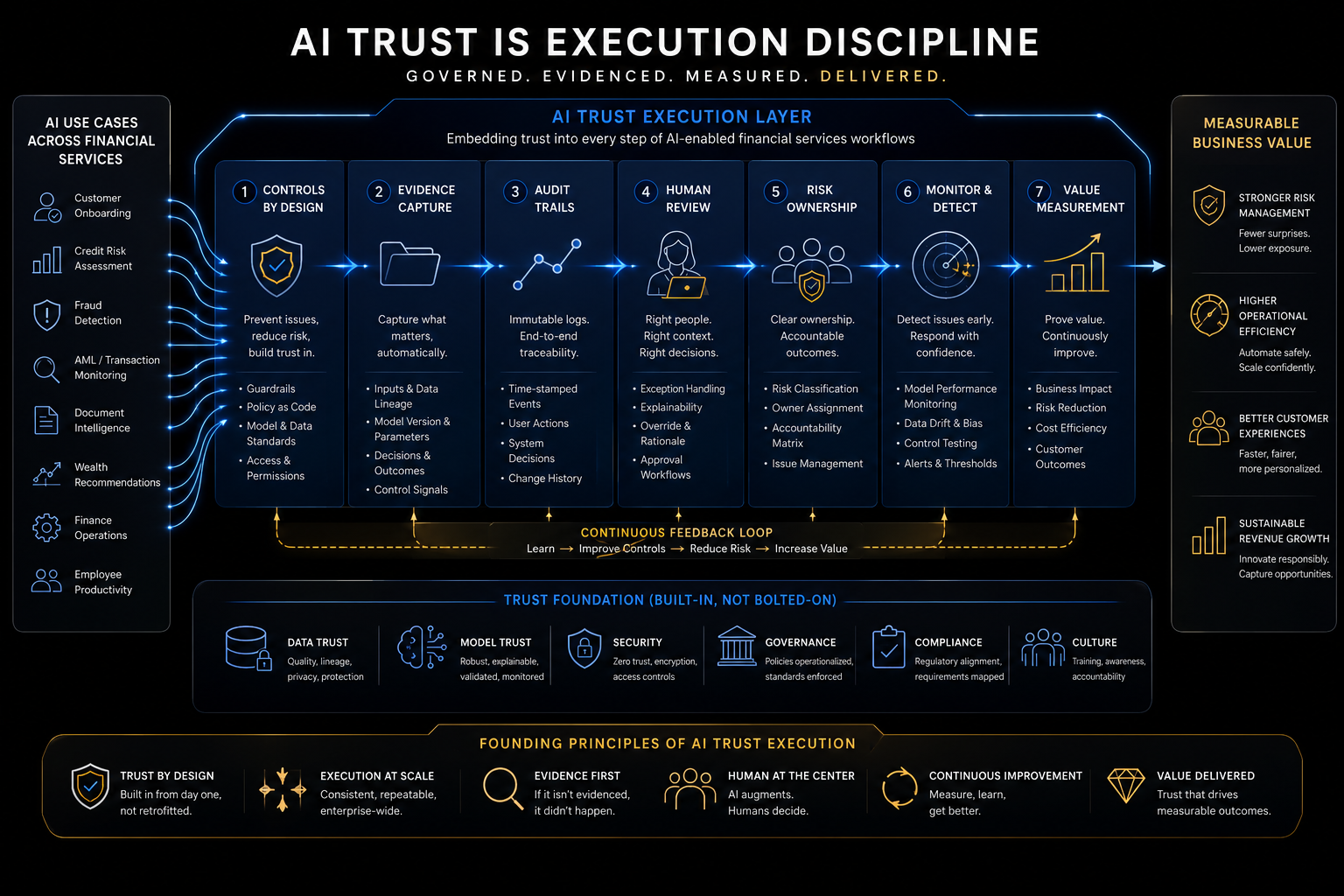
AI trust survives when the work is designed to be trustworthy.
AI trust has entered the executive vocabulary.
Good. It needed to.
Now comes the harder part: making the phrase mean something after the steering committee adjourns.
Plenty of organizations are treating AI trust like a governance theme, a policy workstream, or a committee topic. Document it. Review it. Brand it. Socialize it. Then place it lovingly into a repository where good intentions go to age quietly.
That will not carry the weight, especially in Financial Services.
AI is leaving the lab. It is moving out of isolated productivity use cases and into workflows that touch customers, employees, risk decisions, operations, fraud, service, compliance, engineering, and financial outcomes.
Agentic systems raise the stakes again. These systems can recommend actions, trigger workflows, call tools, move data, and interact with other systems. Every one of those capabilities expands the operational surface area of the enterprise.
A bad answer is embarrassing.
A bad autonomous action can become an incident before the meeting invite finishes loading.
McKinsey’s 2026 AI trust research makes this point directly. As AI systems become more autonomous, organizations have to manage the risk of systems taking unintended actions, misusing tools, or operating beyond appropriate guardrails, on top of the familiar risk of bad generated output. source
That is why AI trust has to move into the workflow.
The Short Version
If you only remember six things from this article, make them these:
- AI trust is an execution discipline.
- Governance that arrives after the workflow is designed is already late.
- Agentic AI raises the stakes because autonomous systems can act, and acting leaves consequences behind.
- Financial Services needs trust controls embedded in daily execution: ownership, permissions, evidence, audit trails, testing, monitoring, escalation, and human review.
- The right model is risk-tiered and AI-pragmatic: deterministic controls where rules are knowable, generative AI where synthesis helps, and agentic AI where autonomy is justified.
- The organizations that scale AI safely will be the ones that can prove what happened, why it happened, who approved it, what evidence supports it, and what value changed.
The AI Trust Problem Changed
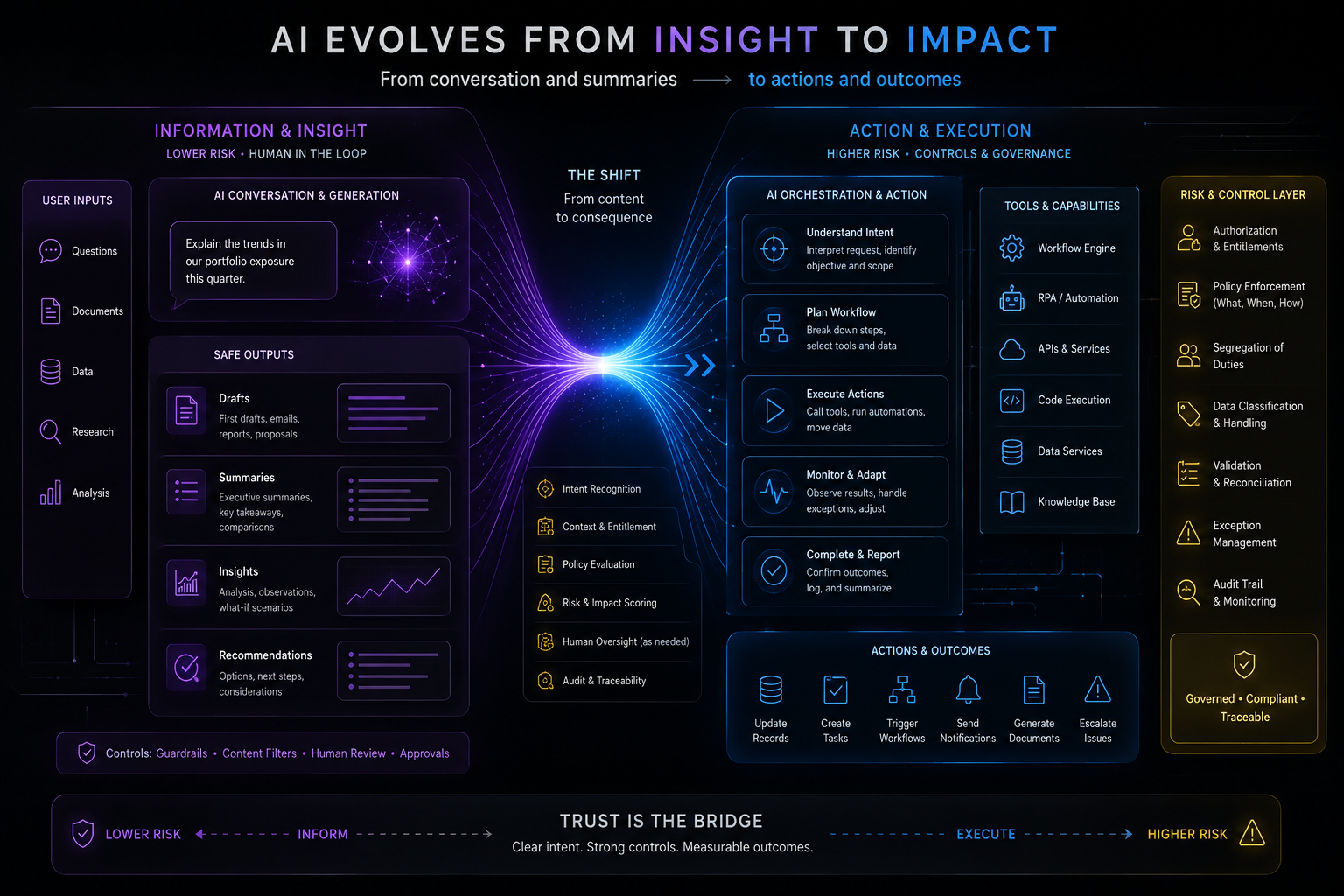
The trust problem changes when AI moves from generating answers to triggering actions.
The first wave of enterprise generative AI made leaders worry about hallucinations, accuracy, data leakage, intellectual property, and employee usage.
Those concerns are still real. Agentic AI piles a more operational category of risk on top of them.
Agency means the system can pursue a goal across steps. It can make a plan, call tools, interact with data, and coordinate actions. That can be useful. It can also create operational chaos with the confidence of a consultant who just discovered a new framework.
Deloitte’s 2026 State of AI in the Enterprise report expects agentic AI usage to rise sharply while oversight lags behind. Only about one in five companies reports a mature governance model for autonomous AI agents. source
That gap should make leaders sit up.
The enterprise is adding a new type of actor. One that may read data, write data, call systems, invoke workflows, draft decisions, prepare recommendations, and act under delegated authority.
That belongs in the operating model conversation.
Ask a few simple questions about any agent in production. What did it do? Why? Which source did it use? Which policy governed it? Who owns it? How do we stop it?
If the room goes quiet, the trust story has a hole in it big enough to drive a governance workshop through. What the organization actually has is AI optimism with a help desk.
Policy Is Necessary. Execution Makes It Real.
Most large organizations will produce the usual artifacts:
- AI principles
- responsible AI policies
- model risk standards
- acceptable use guidance
- risk classification templates
- governance committees
- architecture review boards
- training materials
- three-page frameworks with seven pillars, because apparently five pillars felt underdressed
Some of that is useful. Some of it is required.
Policy still needs machinery.
A policy sitting in a document library cannot stop a bad workflow.
A principle in a deck cannot preserve evidence.
A committee cannot generate an audit trail by sheer force of attendance.
A training module cannot prove which data an agent touched.
AI trust becomes real when governance changes how work moves.
Guidehouse’s 2026 guidance on operationalizing AI governance in Financial Services frames it in practical terms: governance has to live in daily operations through a risk-based operating model, defined roles, controls, testing, monitoring, and evidence-based decision-making. source
Governance earns its keep when teams can execute with confidence. Admiring the governance model from a safe distance doesn’t count.
Governance Has to Move Left and Stay There
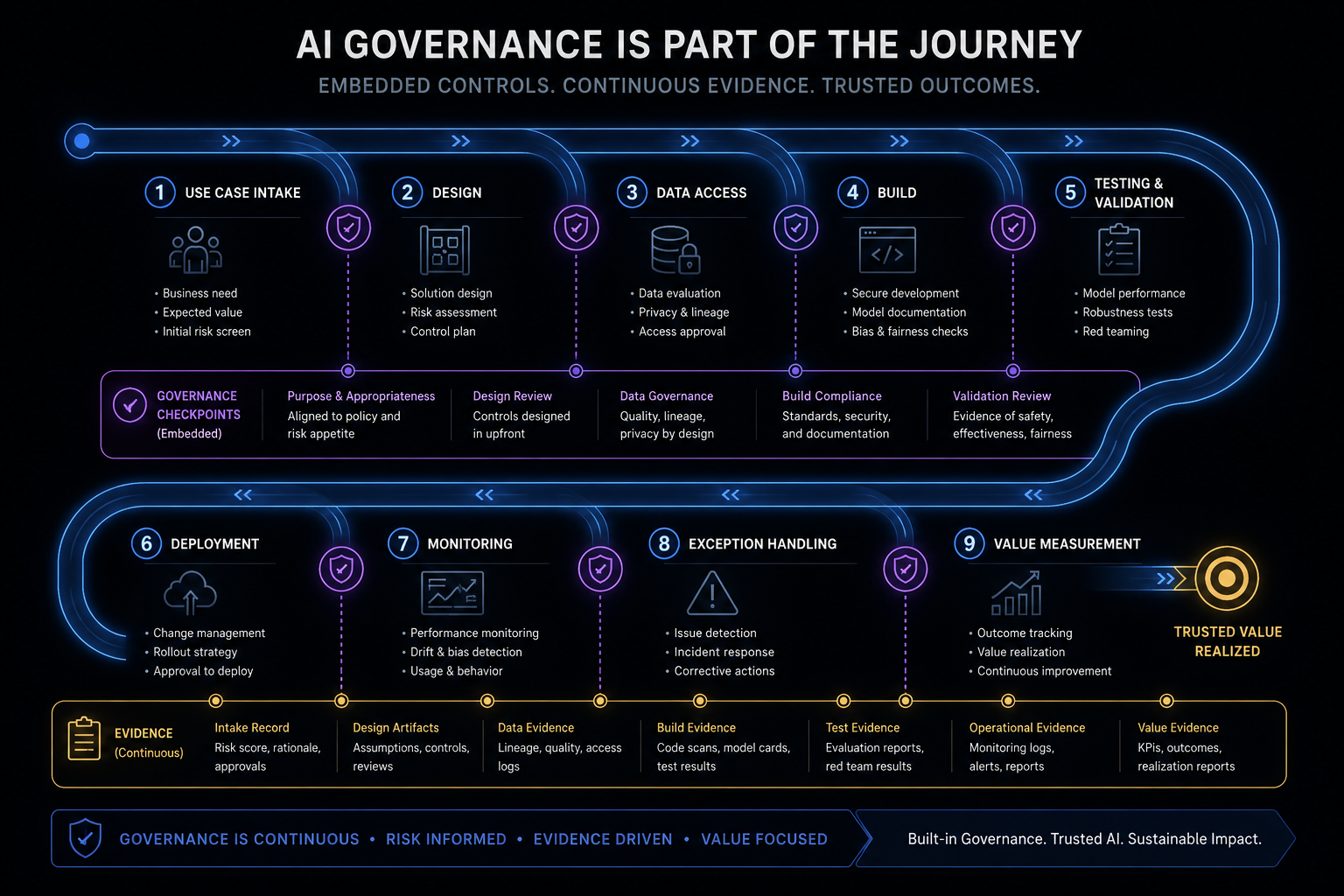
AI governance should not arrive at the end carrying a clipboard.
The failure mode is familiar.
A team identifies an AI use case. A pilot gets built. The demo looks promising. Someone says the words “scale this.” Then governance enters the room with several deeply inconvenient questions:
- What data was used?
- What decisions does the model influence?
- Who owns the risk?
- What controls apply?
- What is the human review pattern?
- What happens when the model is wrong?
- What evidence proves the use case is safe?
- What value will be measured?
- What is the rollback plan?
Those are the right questions, asked at the most expensive possible moment.
Late governance creates rework, delays, exception theater, and that glorious enterprise phrase nobody wants to hear:
We need to socialize this again.
Nobody wants to socialize it again. People want the system to catch the issue before the team falls in love with the pilot.
For AI trust to work, governance has to show up at intake, design, build, testing, deployment, monitoring, and value realization. A gate at the end catches too little, too late. The controls need to be part of the road.
Trust Has a Data Model
This is the part that sounds boring until the first incident.
AI trust needs structure. Vibes and good intentions make terrible substitutes.
For every meaningful AI use case, especially in Financial Services, the organization should be able to connect:
- business intent
- expected value
- use case owner
- risk tier
- impacted customer / colleague population
- data sources
- model or agent identity
- permissions and tool access
- human review pattern
- testing evidence
- control requirements
- monitoring signals
- exception path
- rollback path
- decision record
- value measurement
Call it the minimum viable memory of a governed AI system.
Microsoft’s Financial Services perspective on agentic AI in asset management describes trust as governed execution grounded in enterprise context, with outputs and actions aligned to approved controls, human oversight, reproducible governance, and fiduciary obligations. source
In regulated environments, trust depends on whether the enterprise can explain and reproduce the path from intent to action to evidence to outcome.
When the thread cannot be traced, the risk cannot be governed cleanly. When the risk cannot be governed cleanly, the trust story becomes a very expensive shrug.
Agentic AI Needs a Control Plane
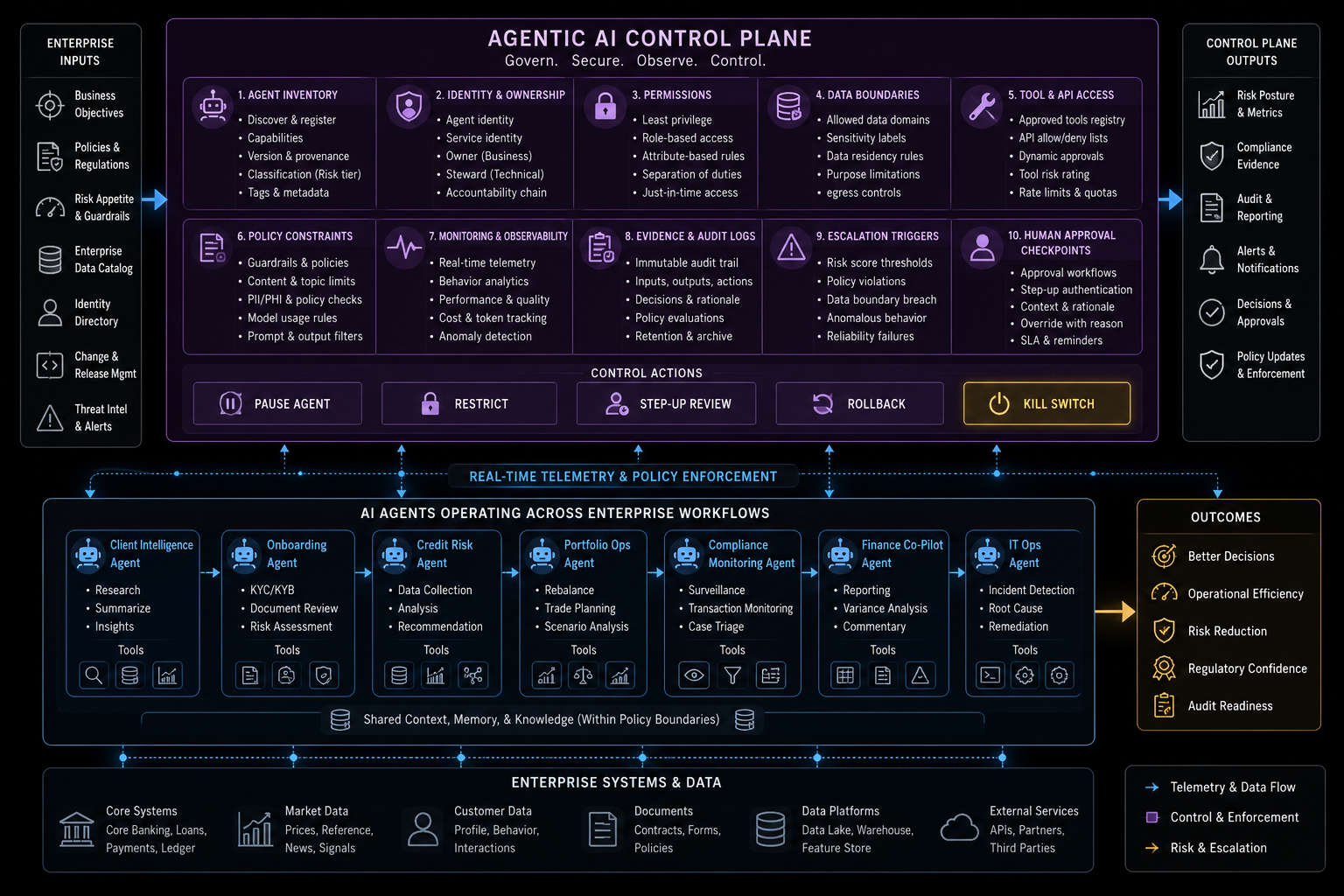
If an agent can act, the enterprise needs to know what the agent can touch, who owns it, what policy governs it, and how to stop it.
Traditional software executes defined workflows. An agentic system can interpret goals, choose steps, call tools, and adapt as the work changes.
That creates value. It also creates risk that traditional governance models were never designed to absorb politely.
MIT Technology Review Insights, in association with Deloitte and Microsoft, describes the need for an agent control plane: a centralized layer governing who can run which agents, with which permissions, under which policies, using which models and tools. Without one, the piece warns, organizations end up with unmanaged execution instead of scalable autonomy. source
Unmanaged execution. Sit with that phrase for a second, because plenty of organizations are building exactly that by accident.
An agent without identity is a ghost.
An agent without permissions discipline is a risk event warming up.
An agent without monitoring is a mystery machine.
An agent without a stop mechanism is a career-limiting surprise.
And an agent without a human owner is accountability laundering.
A serious control plane should handle:
- agent inventory
- business owner
- technical owner
- risk owner
- identity and authentication
- data access boundaries
- tool permissions
- allowed actions
- prohibited actions
- policy constraints
- monitoring and logs
- escalation triggers
- human approval checkpoints
- rollback / stop mechanism
- evidence retention
That discipline doesn’t slow innovation down. It’s what lets innovation survive production.
Financial Services Cannot Govern AI With Theater
Financial Services doesn’t get to treat AI governance as a branding exercise. The blast radius is too real.
AI-supported decisions and workflows can affect:
- customer treatment
- fraud exposure
- credit and risk decisions
- claims and servicing outcomes
- operational resilience
- financial crime controls
- cybersecurity posture
- regulatory reporting
- advisor productivity
- engineering and release quality
- vendor and third-party risk
The World Economic Forum and Accenture’s 2026 AI Playbook for Financial Services argues that successful AI adoption rests on strong foundations across platform architecture, skills, culture, governance, risk, compliance, security, model risk, human-AI partnership, leadership, sponsorship, and accountability. source
Read that list as the bill coming due.
A bank, insurer, payments company, wealth firm, or financial market infrastructure provider cannot seriously claim, “We trust the AI because the vendor demo went well.”
The vendor demo always goes well. That’s why it’s a vendor demo.
Trust needs evidence. Evidence needs architecture. Architecture needs ownership. Ownership needs governance embedded in the workflow.
Break that chain anywhere, and the enterprise is stacking ambition on top of hope and calling it transformation.
The AI-Pragmatic Governance Model
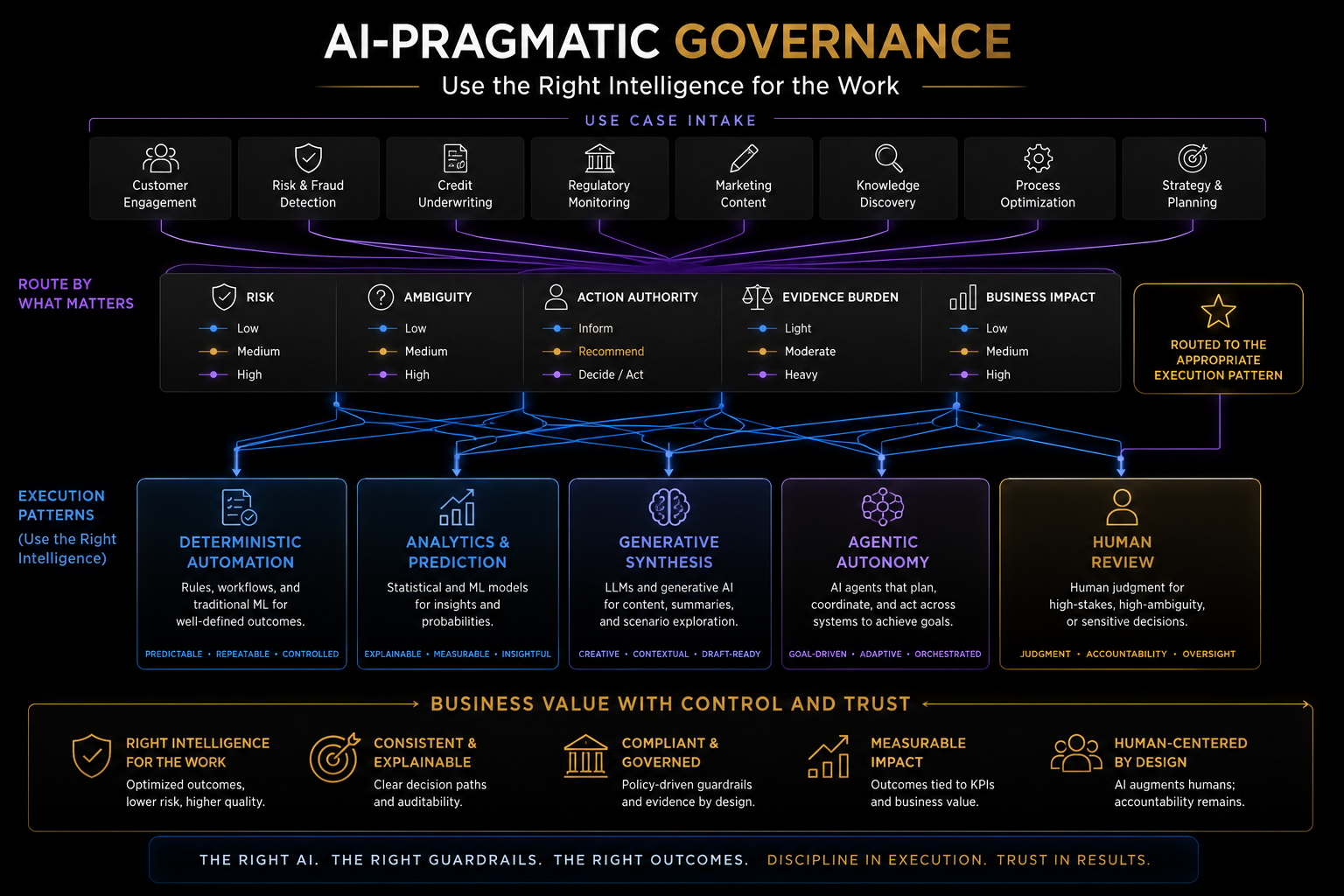
Use the right intelligence for the work. Governance should route AI use cases by risk, ambiguity, action authority, and evidence burden.
Nobody wants a paperwork bunker. Nobody should want a free-range agent petting zoo either.
What works is AI-pragmatic governance:
- start with the work, then pick the technology
- classify the risk
- define the decision being supported or the action being taken
- use deterministic automation where rules are knowable
- use analytics where patterns need measurement
- use generative AI where language and synthesis create value
- use agentic AI where ambiguity, planning, and adaptive reasoning justify the cost and risk
- keep humans accountable for judgment, governance, and risk acceptance
- measure value before celebrating adoption
This puts a premium on using AI for the right work, when it’s justified. The quarterly innovation showcase sometimes works hard to blur that line.
A low-risk internal summarization use case should not travel the same governance path as an agent that can trigger exception handling in a customer-impacting workflow.
A deterministic control that catches an overdue approval does not need a generative model.
A generative summary that drafts an executive brief does not need autonomous action authority.
An agent that can call tools, update records, or trigger workflows needs identity, permissions, monitoring, evidence, human review, and a stop mechanism.
The governance model should know the difference. If it doesn’t, the organization will smother low-risk value while under-governing high-risk autonomy.
Impressive, in the worst possible direction.
Where Leaders Get This Wrong
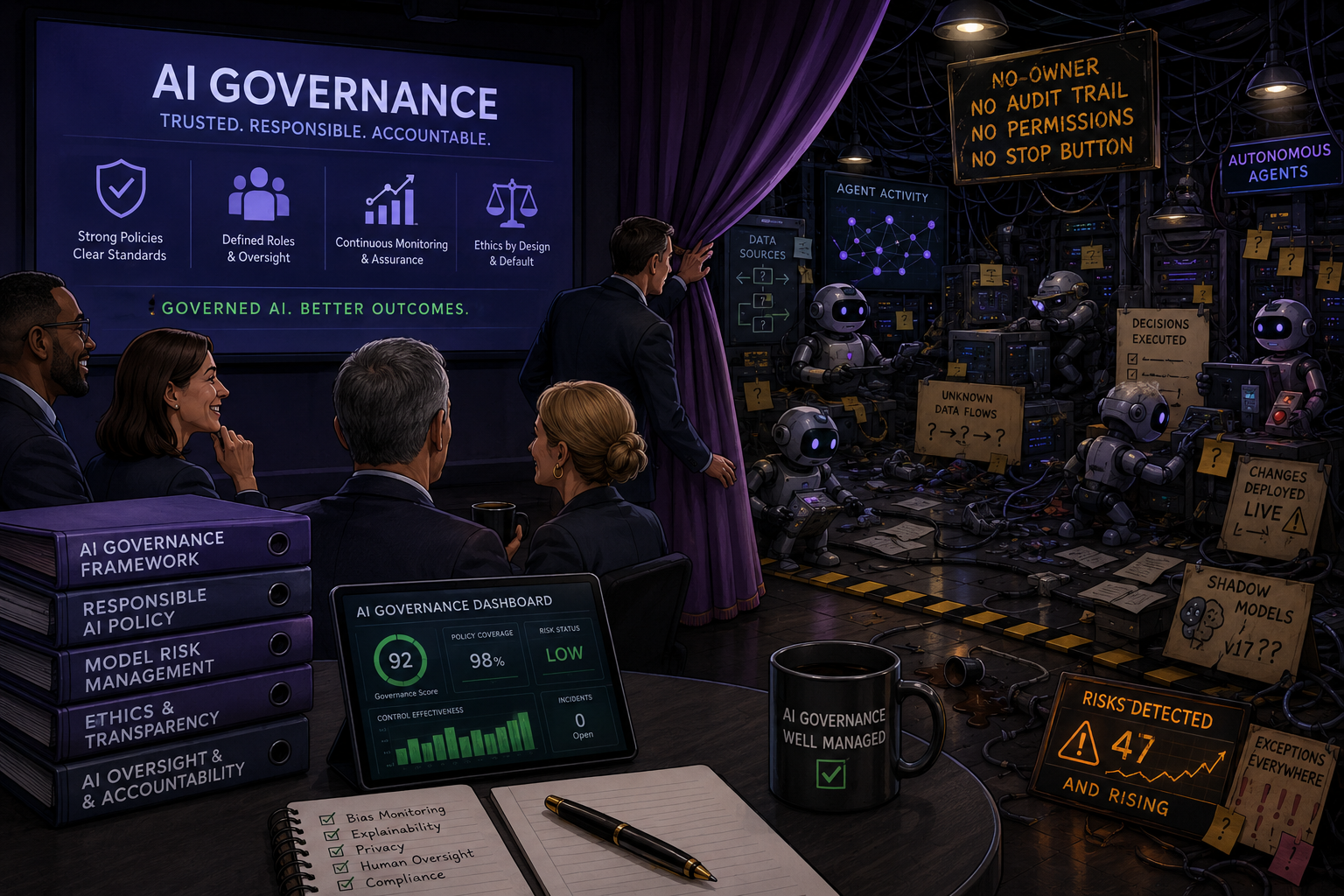
AI governance theater looks responsible right up until something happens without a clear owner, audit trail, or stop button.
The mistakes are rarely mysterious.
They treat governance as approval instead of design
Approval is a moment. Design is the system.
A governance model that only approves or rejects use cases is already watching from the cheap seats.
They confuse access with readiness
Giving employees or teams access to AI tools does not mean the organization is ready to scale AI safely.
Tool access is distribution. Readiness requires operating discipline.
They trust the use case and ignore the workflow
A use case can be valuable and still be unsafe if the workflow around it is weak.
Where does the data come from? Who reviews outputs? What does the AI change? What evidence is retained? What happens when the AI fails?
If those questions are unanswered, the use case is wearing a nice-looking suit and hoping nobody checks the seams.
They skip ownership
Every meaningful AI capability needs named ownership:
- business owner
- technology owner
- risk owner
- data owner
- human escalation owner
Shared responsibility is healthy. Shared ambiguity is how risk gets laundered.
They measure adoption instead of trustable value
Usage is not value.
Pilot volume is not value.
Prompt count is not value.
Trustable value means the organization can show what changed, why it changed, what risk was controlled, what outcome improved, and what evidence supports the claim.
Everything else is dashboard confetti.
What Good Looks Like
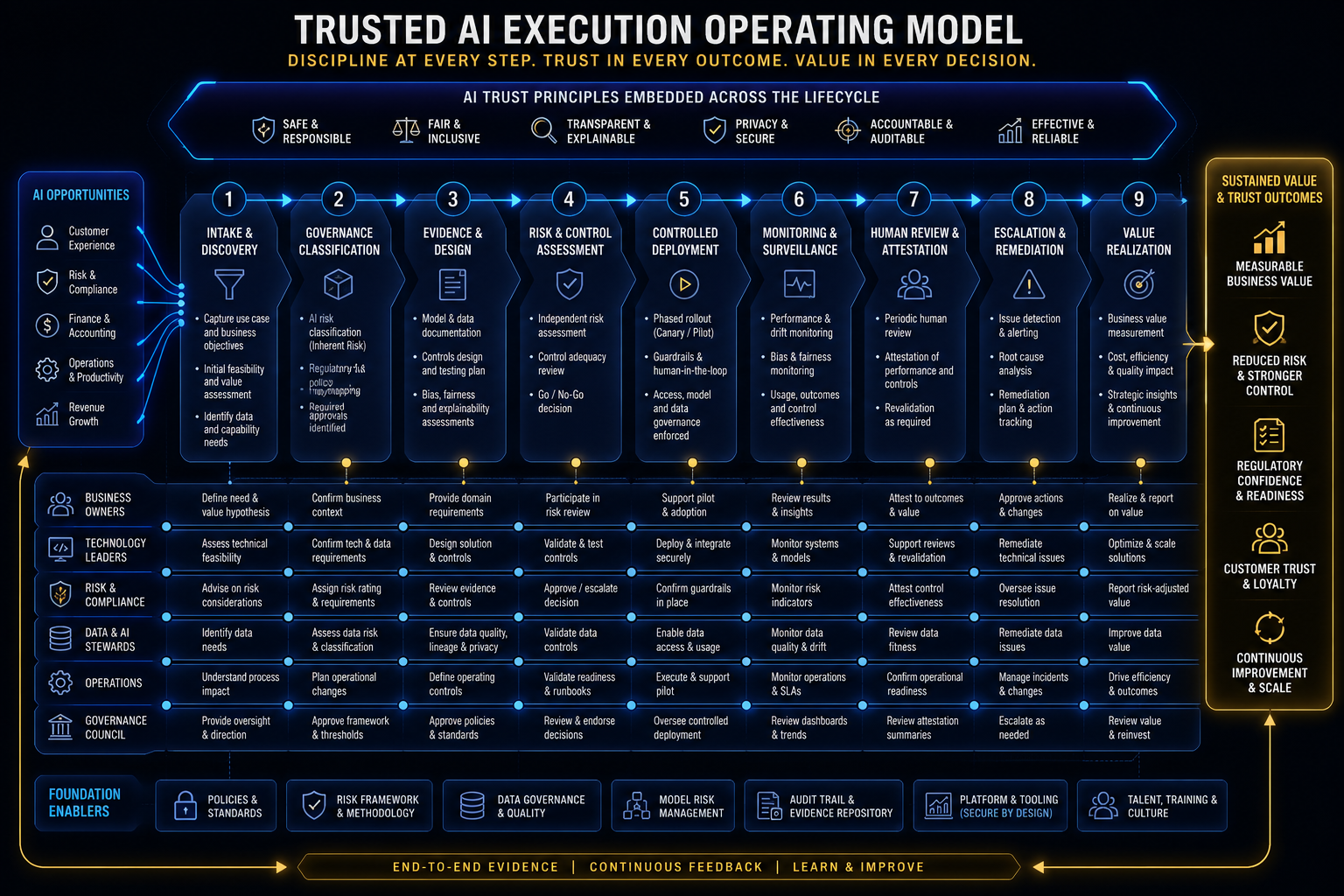
Trusted AI execution means the enterprise can move faster because the controls are already built into how the work moves.
A serious AI trust model feels different on the ground.
Teams don’t wait six weeks for a committee to discover basic risk questions.
Low-risk use cases move quickly. Higher-risk use cases get deeper control. Autonomous workflows get identity, permissions, monitoring, evidence, and human oversight.
Leaders get enough signal to know what’s happening before the incident report starts writing itself.
A good model should produce:
- clear use case ownership
- risk-tiered governance
- embedded evidence capture
- source and decision lineage
- tested control points
- human review where judgment matters
- agent identity and permission discipline
- monitoring and exception handling
- value measurement tied to business outcomes
- audit-ready visibility without forcing teams into manual evidence archaeology
The word “trust” should stop being decorative and start being observable.
If trust can’t be evidenced, monitored, tested, and improved, it’s a mood. Moods are terrible controls.
Where This Points Next
I drafted the first version of this article a while back. Since then, the rest of the picture has filled in, and almost every piece of it lands on the same conclusion: trust is something you build into the plumbing, then prove with evidence.
Here’s how the pieces connect.
Trust starts with intent. You can’t govern an AI-assisted change if nobody remembers why it exists. That’s the argument behind CLEAR, which captures intent at the front door and carries it through delivery. source
Trust needs a shared vocabulary. A risk mentioned in a Teams thread, a blocker buried in meeting notes, and a dependency nobody logged are all signals. If the enterprise can’t classify them consistently, it can’t trust what its own dashboards say. That’s the job of the Signal Taxonomy. source
Trust needs eyes on execution. RADAR watches for drift, repeated exceptions, and weak signals across the delivery system, so trust problems surface while there’s still time to do something about them. source
Trust needs a job description. Every agent should have a defined purpose, an accountable owner, scoped authority, approval gates, evidence requirements, and a retirement date. If nobody can explain the job, the agent isn’t ready for production. source
Trust needs a stop button somebody has actually pressed. When OpenAI shelved a model release for pushing past its own authorization, and NVIDIA launched a platform on the premise that agents can’t police themselves, the industry said out loud what regulated enterprises already suspected. Enforcement has to sit outside the agent. source
And trust needs a connected operating model. BRIDGE ties intent, signals, governance, evidence, readiness, and value together, so the questions in this article have somewhere to live besides a slide. source
Every significant technology change, AI or otherwise, should be able to answer the same list:
- What is the intent?
- What outcome is expected?
- What work is changing?
- What data is being used?
- What risk is introduced?
- What controls apply?
- What evidence is captured?
- What human judgment is required?
- What action authority exists?
- Who can stop it?
- What value was realized?
AI trust belongs in the workflow. Built into the way work moves, visible in the evidence, tested in the controls, and owned by real people.
That’s the operating discipline Financial Services needs now.
Final Thoughts
AI trust is created by behavior.
By controls, evidence, ownership, and traceability. By knowing what the system can do, what it actually did, who approved it, what data it touched, what policy governed it, which human reviewed it, and what value changed.
Bad answers from models are yesterday’s risk. The next wave comes from autonomous systems taking bad actions inside workflows the enterprise never governed well enough.
That’s a different game, and Financial Services leaders need to play it like one.
The organizations that win will make trusted execution normal. Boring, visible, evidenced, monitored, owned, and built into the work.
That may not sound glamorous.
Good. Glamour does not pass an audit.
Join the Conversation
Where does AI trust get hardest in your organization?
Use case intake? Data access? Model risk? Agent permissions? Human review? Audit trails? Value measurement?
Or the classic favorite: everyone agrees governance matters, right up until governance slows down the demo somebody already promised upstairs?
I’d love to hear the real-world version. Skip the responsible-AI poster. Tell me about the place where policy, delivery, risk, data, and business pressure collide.
That’s where the trust conversation actually gets useful.
About the Author
Joe Mack is a Technology Consulting Senior Principal specializing in technology leadership, enterprise SDLC transformation, release management, deployment governance, and delivery optimization for household name Financial Services companies. Joe is also a lifelong self-learner and builder of systems, and Free Tier Life is one of the ways he is trying to turn those experiences and instincts into something other people can actually use.
Bibliography
- McKinsey & Company. "State of AI Trust in 2026: Shifting to the Agentic Era." March 25, 2026.
- Deloitte. "The State of AI in the Enterprise: The Untapped Edge." 2026.
- Guidehouse. "AI Governance: Risk Management, Controls, and Testing." 2026.
- Microsoft Cloud Blog. "Trust as Infrastructure: How Agentic AI Is Rearchitecting Asset Management at Scale." June 16, 2026.
- MIT Technology Review Insights, in association with the Deloitte Microsoft Technology Practice. "Building Agent-First Governance and Security." April 21, 2026.
- World Economic Forum, in collaboration with Accenture. "The AI Playbook for Financial Services." June 2026.